

In the practice of immigration law, the world is often defined by the cold, binary reality of statutes and visa criteria. Yet, as the dust of April 2026 settles, the atmosphere within the Myanmar diaspora remains heavy with a familiar tension. The Burmese New Year, Thingyan, a festival whose name derives from the Sanskrit Samkranti, meaning “transition”, has now passed. It is a time intended to purify the spirit for the year ahead. This year, the very concept of transition was weaponised and the consequences of that weaponisation are still unfolding.
On 3 April, the military-led government had Senior General Min Aung Hlaing elected as President by a parliament of its own design. He was sworn in on 10 April. The water festival began three days later. The choreography is not accidental. To project an image of stability to the international community, the state has orchestrated “Grand Thingyan” celebrations and announced a Thingyan amnesty for some 4,500 prisoners, including the country’s last democratically elected President, U Win Myint. From a legal perspective, this is ritual without substance, a performative “wash” designed to entrench impunity and distract from the collapse of the rule of law.
To explain why this matters, a word about the cultural register being manipulated. Myanmar is a Theravada Buddhist society. Dhamma (in Pali; dharma in Sanskrit) is the central concept of that tradition. It is best understood not as “religion” in the Western sense but as the law of how things actually are, a moral and natural order to which both individuals and institutions are answerable. To act in accordance with the Dhamma is to act with truthfulness, restraint and accountability. To violate it is not merely to sin; it is to misalign oneself with reality. Vipassana, the type of meditation that I and many of Myanmar’s citizens practise, is one of the disciplines through which this tradition is internalised. Its name simply means insight, the slow, patient observation of things as they are, rather than as we wish them to be.
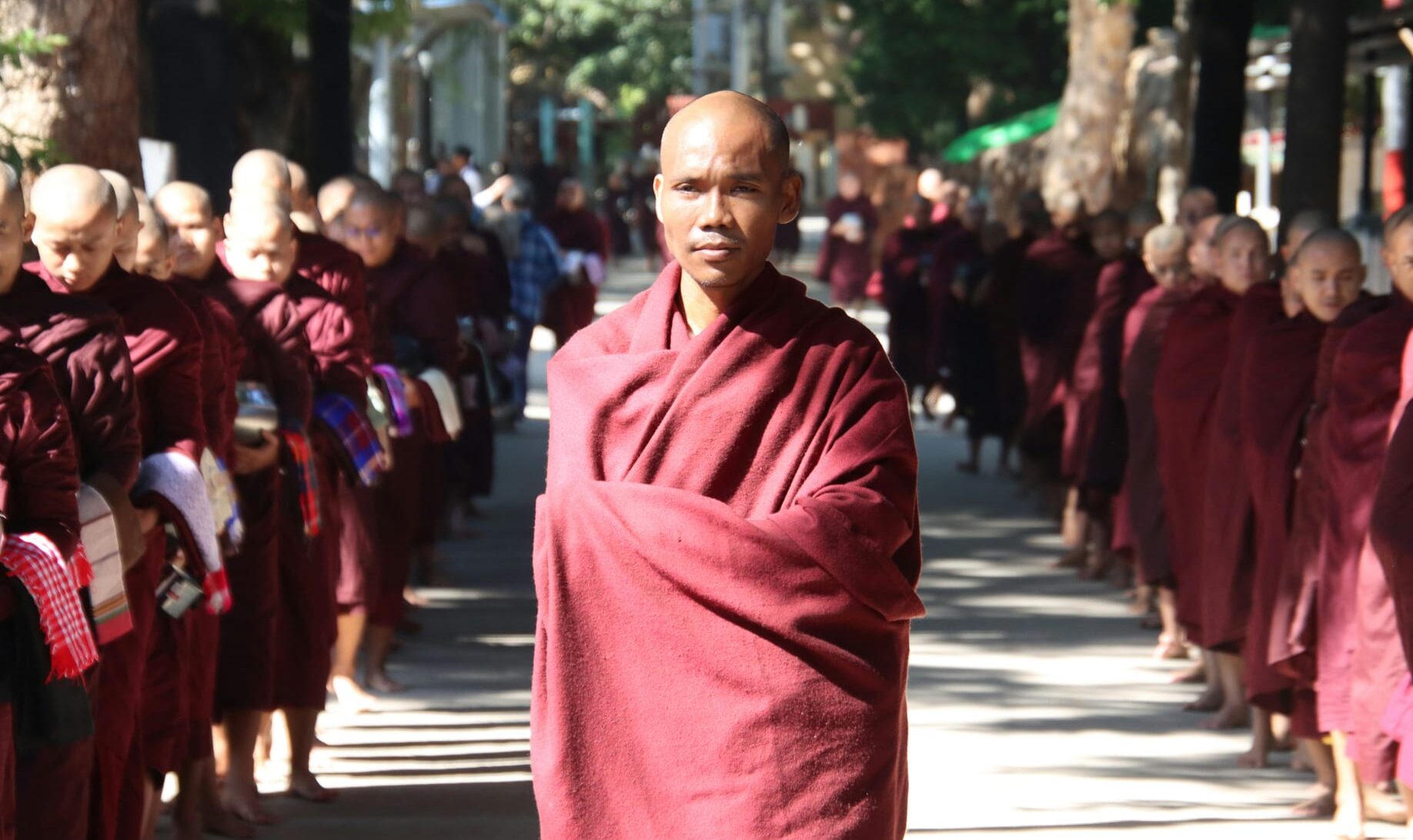
This is the cultural grammar in which Thingyan operates. Traditionally, the festival is gentle. Families pour scented water over Buddha images, wash the hair and feet of elders, offer alms to monks, observe the eight precepts of Buddhism, release caged fish and birds to grant them freedom, and sprinkle one another with water from silver bowls and bamboo cups as a sign of cleansing and goodwill. The point is purification, not power.
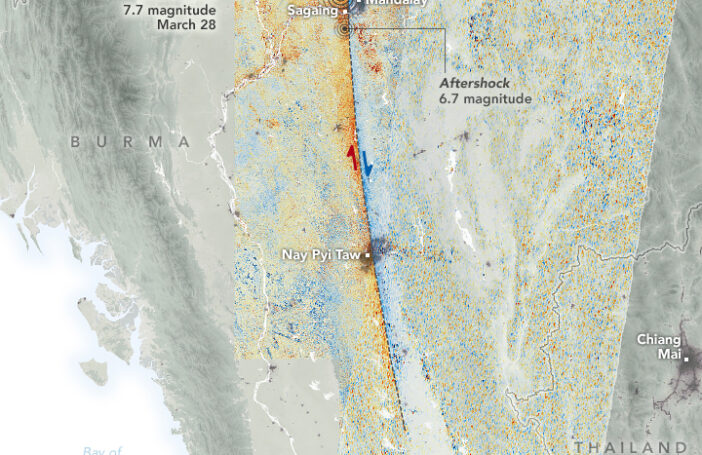
What the regime has built across the cities of Naypyidaw, Yangon and Mandalay this year is something different. State-sponsored Grand Thingyan pavilions feature fire-engine-grade hoses turned on dancing crowds, and televised loyalty pageants, a co-opted spectacle in which the soft civic ritual of cleansing is replaced by the hard pressure of state-directed celebration. Meanwhile, more than a year after the March 2025 Sagaing earthquake that killed thousands and left millions without shelter, survivors in conflict zones are still denied clean water and humanitarian aid because of military blockades. The contrast of hoses for the cameras and no taps for the displaced is the most honest summary of the regime’s priorities I can offer.
To understand why this distortion of Thingyan is more than aesthetic, one must look to the legacy of Sayagyi U Ba Khin. Long before his student S. N. Goenka brought Vipassana to a global audience, U Ba Khin served as the first Accountant General of independent Burma. For U Ba Khin, the “Vipassana way of thought” was not an escape from civic duty but the engine of it. He believed a state official could only serve the public if they first mastered their own mind, rooting out greed and self-deception through patient self-observation. He proved, by personal example, that integrity is the foundation of the state.
That legacy is being inverted today. As a lawyer working with those forced to flee, I see the human cost of this deception in case files: more than 3.7 million people now internally displaced across Myanmar; nearly 8,000 civilians killed since the 2021 coup, according to United Nations figures; over 22,000 political detainees still held, according to the Assistance Association for Political Prisoners. The Thingyan amnesty, when measured against those numbers, releases a handful of names while leaving the architecture of repression untouched. Independent monitors have found that fewer than 14% of post-coup amnesty releases have been political prisoners.
I do not fear the international community’s validation of the regime’s transition: no major Western government is doing that. The Gambia’s genocide case against Myanmar continues at the International Court of Justice. The International Criminal Court Prosecutor’s application for an arrest warrant against Min Aung Hlaing over the Rohingya deportations remains pending. The Independent Investigative Mechanism for Myanmar continues to gather and preserve evidence. The European Union, the United Kingdom, Canada, the United States, and Australia maintain targeted sanctions. ASEAN, under Malaysia’s 2026 chairmanship, has not recognised the election. The credentials of Ambassador Kyaw Moe Tun, appointed by the civilian-led government-in-exile known as the National Unity Government, are still recognised at the United Nations.
There is however a more specific and insidious risk. It is that the regime’s domestic theatre is engineered precisely to fracture that consensus at its weakest joints. China formally acknowledged the presidency within days. Russia and Belarus sent congratulations. Thailand’s Prime Minister became the first ASEAN head of government to write to Min Aung Hlaing. On 25 April, Chinese Foreign Minister Wang Yi travelled to the capital Naypyidaw in person to meet the new President. Each bilateral handshake is presented at home as evidence of “normalisation” and abroad as a reason to soften posture, ease sanctions, accept the military-led government’s nominee at the next UN credentials vote, fold Myanmar back into ASEAN.
This is why the integrity of process matters. The international legal mechanisms now in play, painstaking, slow, evidentiary, embody the same principle U Ba Khin embodied as Accountant General: that institutions are only as legitimate as the truthfulness of their procedures. A presidency produced by an election held in 42% of the country’s territory, with the Rohingya excluded entirely and most opposition parties banned, is not a transition. It is, in Vipassana terms, a clinging to illusion, the wish that a uniform changed for civilian dress alters the underlying conduct of power.
True renewal for Myanmar will not come from a ritual, an amnesty or a sworn oath. It will come from the patient, unglamorous machinery of accountability, the genocide case, the arrest warrant, the documentation mandate, the sanctions list, the universal-jurisdiction filing, the credentials vote, and from the safe, dignified return of those who have been forced into the void of displacement. The international community’s task in 2026 is not to invent that machinery; it is to refuse to let a water festival distract from it.
This is an expanded and edited version of an article first published by ABC Religion and Ethics on 9 April 2026.



Well articulated!
Thankyou for this clear-sighted summary of the situation.