


Jittu Estate is one of Suva’s oldest and largest informal settlements with population estimates ranging from 3,000 to 10,000. Despite congested living conditions and challenges around basic utilities, the settlement’s central location makes it an attractive destination for low-income households and recent migrants from all parts of Fiji to the nation’s capital. Over the years, the settlement has acquired a reputation for a range of social-order problems including disorderly conduct, family violence and petty crime, and as a haven for stolen goods, and more recently drug dealing and abuse. As a result, Jittu Estate was classified by police as a “Red Zone,” denoting a high-crime area. This reputation followed residents when they ventured outside the community, such that they were often the first to be blamed when something went missing.
Jittu’s social challenges and poor reputation feed into broad community anxieties around land security. Local leaders are aware that they are living on prime real estate in central Suva — land that investors would love to get their hands on. Rising crime in the community or attributed to community members heightens the risk of removal and the redevelopment of the settlement — an existential threat to all residents. As one told us: “If a single child does something, that will cause 10,000 to be evicted. That is a no-no for everybody. If somebody spoils the soup … everybody gets the consequences.”
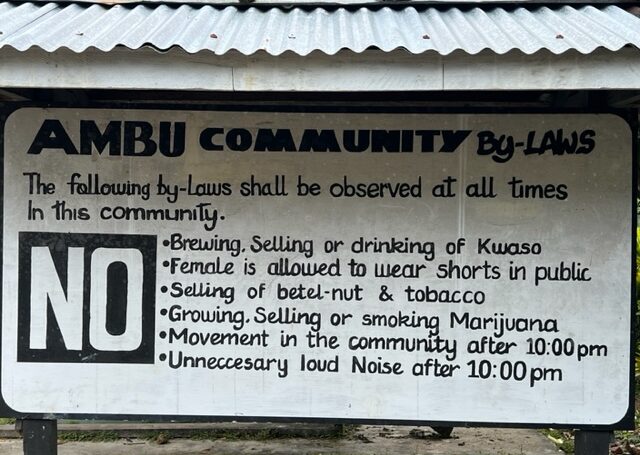
These concerns prompted a remarkable community response in early 2022. This involved communal efforts to reinvigorate the settlement’s informal governance system, including preparing detailed by-laws prescribing the dos and don’ts expected of all community residents. The process of making the by-laws entailed numerous local committees and their volunteer members undertaking extensive consultations over a three to four-month period. As well as a community-wide committee, each of the settlement’s nine zones have their own committee, while other committees represent specific groups such as women, youth and religious organisations, or focus on sectoral issues like health, education and sports.
Jittu Estate’s by-laws prohibit activities that undermine community safety and harmony, such as selling and consuming drugs and alcohol, disorderly and violent conduct or making excessive noise. They include rules to ensure children are at home by a specified time and others to enhance community cleanliness, hygiene and sanitation. Breaches of the by-laws were to attract an escalating series of warnings that could culminate in expulsion from the community. While the first warning was verbal, the second and third would be in writing, with the third being copied to the Ministry of Lands and the police to ensure compliance with relevant state laws and to assist enforcement where needed.
During the piloting of the by-laws, different government agencies and civil society organisations — such as the community officers from the Fiji Police, officials from the Ministry of Lands, Ministry of Social Welfare, Ministry of Health, Suva City Council and Save the Children — visited the settlement to undertake awareness-raising events. These well-attended meetings helped local residents understand the broader government system and connections that could benefit community safety and welfare, while educating officials about the views and priorities of community members. The introduction of the by-laws had an immediate impact. Residents reported a noticeable reduction in illegal and disorderly behaviour. Within a matter of weeks, Jittu Estate had been re-classified from a Red Zone to a Green Zone.
During our first visit in early 2023, residents expressed strong support for the by-laws and the work of the committees. This was despite the validity of the by-laws and the expulsion penalty remaining uncertain in the absence of endorsement from the Fiji National Police and Ministry of Lands. While submissions had been made to both bodies, community leaders were still awaiting their outcome. Despite this delay, local enthusiasm remained undiminished in light of the scheme’s positive impacts.
The inclusive and deliberative process of making the by-laws contributed to a stronger sense of community and common purpose, helping to transcend the ethnic, gender and generational and other divides found in this large multicultural community. Residents talked about increased community activities and competition developing between zones to outperform each other in sports activities and community clean-ups. Women visited families, sharing tea and cooking together, and donating household items to those with special needs.
Older i-Taukei residents drew attention to the similarities with traditional village governance. Each zone committee appointed a member to ensure compliance with the by-laws and this figure was compared to the village headman — the Turaga-ni-Koro — a respected voice of authority. The aspiration was to emulate aspects of the disciplinary structure and cultural authority of village life in the urban setting. This was seen as particularly important to address the settlement’s wayward youth, most of whom had little experience of living in a village.
The people we spoke with were proud of what they had achieved. Their experiences challenged prevailing framings of Jittu Estate and other urban settlements as places full of poor people unable to look after themselves or full of dangerous criminals. Shedding this disempowering stigma, residents were able to recognise individual and communal strengths and capabilities. Word about what was happening in Jittu soon spread to other settlements in the Suva-Nausori corridor and visitors came to learn.
We visited Jittu again in May 2025, meeting many of the same residents and officials. Much to our surprise, residents were still waiting on the endorsement of their by-laws almost two years later. Why was it taking so long? Explanations proffered included the change of national government, the unfortunate passing of a key official in one of the ministries, and the apparent loss of the original submission. While we were told the application of the by-laws had continued for some time, the absence of official endorsement had weakened the authority of local leaders. Growing pushback was explained in terms of them not being “proper laws”. Several residents voiced ominous warnings that the settlement was drifting back to being a Red Zone.
The risk of reversing all the progress made has been further accentuated by a major new crisis around drug use. The practice of “bluetoothing” — where blood from an intravenous drug user is withdrawn after a hit and shared with others — has taken rapid hold in Fiji and is now fuelling the second-fastest growing HIV epidemic in the Asia-Pacific region. As well as overwhelming the health system, it is contributing to rising crime, with young people turning to theft and robbery to finance their drug use. Local observers have linked this new scourge to a broader breakdown in family and community cohesion, most evident in urban settings. It would be tragic if the positive lessons from Jittu’s community order-making efforts were not learned. A small but significant step in this direction would be for the police and Ministry of Lands to finally get those by-laws endorsed!





Thanks for your comment and helpful suggestion Keith
Great example of a community led governance initiative. I suspect the answer to your primary question already lies in some of the responses you have already received, namely that the prerequisite legal framework, which would enable such bylaws as subsidiary regulation in the municipal context, is either absent or very outdated. The current institutional reluctance to endorse such a set of extra-legal rules may therefore be understandable, particularly where existing constitutional protections regarding arbitrary eviction would possibly conflict with any attempts at non-court ordered expulsion from a community. Would the institutional response to such a proposal not be similar in Australia? Why would you expect it to be different in Fiji? I suggest one way forward could be a focus on identifying the existing gaps in the relevant legal frameworks, which could enable the development and adoption of appropriate bylaws for different urban contexts.