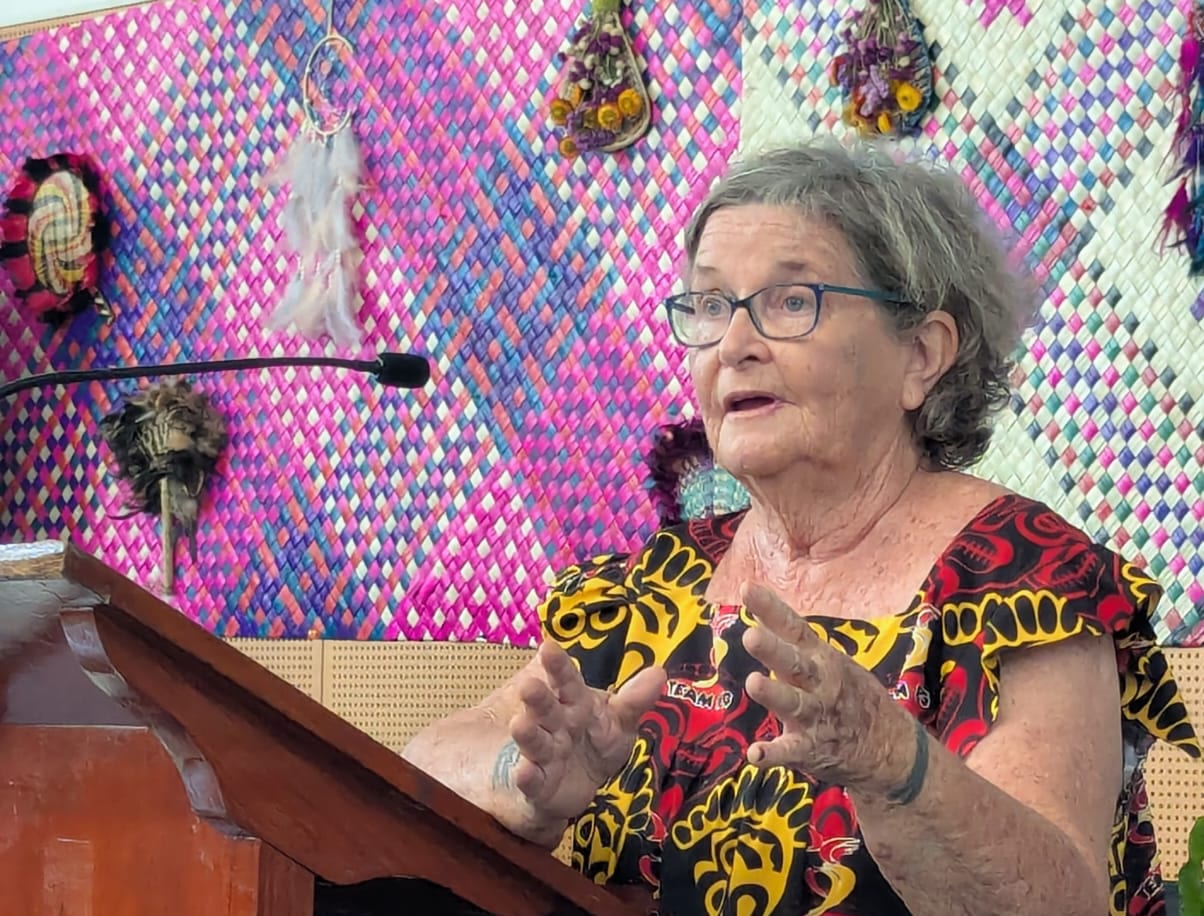
Papua New Guinea has elected only ten women to its Parliament since it became independent in 1975. Of those, only three have served more than one term. Dame Carol Kidu served three terms. Dame Josephine Abaijah, the first woman to be elected in 1972, served from 1972 to 1982 and from 1997 to 2002, and Dame Nahau Rooney served two terms from 1977 to 1987.
There are currently three women in the PNG parliament. The Hon. Rufina Peter was elected in the 2022 elections for the Central Provincial seat as a member for the People’s National Congress Party. The declaration of her election was followed by the declaration in favour of the Hon. Kessy Sawang for Rai Coast Open for the People First Party. Both Peter and Sawang were in second place on first preference votes but rose to claim their seats after distribution of preferences. They were joined in a 2023 by-election by the Hon. Francesca Rianna Semoso as the member for North Bougainville Open Electorate representing the Pangu Party.
Three is the equal-largest number of women ever elected to the now 118-member parliament (there will be an increase of six seats to 124 in the 2027 elections). The 2012–2017 parliament had three women members but they all lost their seats in 2017. Incumbency has long been a challenge in PNG for both men and women, although the 2022 election saw a much lower turnover rate of 38%. If the current women members of parliament retain their seats in the 2027 general election, this will be a historic event for PNG.
The pathway to parliament for each of these women shares some common features. All three had a tertiary-level education. All three had careers in the public sector.
Each of these women has a track record of political campaigning. Both Peter and Sawang contested the 2017 general elections, and each came in a credible third in their electorates. Semoso has previously served two terms in the Bougainville provincial government.
Historic though their success may be, three women represent just 2.5% of the parliament. They face obstacles in their electorates and in the parliament, simply because they are women. Explaining her advocacy in her campaign, Peter said:
I had to challenge them about the perceptions of women, especially women in leadership. I would just use the analogy of a woman in a home, and what she does when she wakes up, how many jobs she gets done before she sleeps … And then I say, ‘pick a woman who is qualified to run for this office, and don’t you think she is going to do the same in this house, this parliament house?’ Of course she is.
Each of these women is courageous in her championship of the interests of women. Semoso has long been affiliated with the Bougainville Women’s Federation and is an “ardent advocate” for women in political leadership. Peter and Sawang highlighted women’s issues in their campaigns and wear the burden of representing women with grace. As Sawang said: “I represent my people, the Rai Coast people, but … there’s already Papua New Guineans saying we represent the voices and aspirations of Papua New Guinean [women]. I’m happy with that, I’m okay with that”.
Dame Carol Kidu, who mentored Peter and Sawang in their successful campaigns, noted that the parliament itself would present obstacles: “the atmosphere in parliament is not gender friendly”. Two of the three women, Sawang and Semoso, sit on the government benches. They have immediately assumed leadership positions.
Sawang was appointed Vice Minister for International Trade and Investment before being appointed Minister for Labour and Employment in July 2023. Semoso, having previously chaired the Bougainville Parliament, was appointed Assistant Speaker of the House. In a historic moment, she became the first woman to chair the parliament on 13 March 2025. On this occasion, both Sawang and Peter gave speeches. Sawang outlined her legislative reform initiatives in the employment portfolio that would benefit women, including equal pay legislation, addressing the transition from informal to formal employment and ensuring equal rights in employment.
Peter addressed a broad range of issues, including gender-based violence; the impact of social media and illicit drugs on violent behaviour; the empowerment of women, particularly through sections 101 and 102 of the Constitution, which allow additional women to be appointed to parliament; corruption and electoral fairness, devolution and the application of traditional law at the local level. The confidence with which these women are asserting their agendas in a house in which they are such a small minority demonstrates leadership.
In the lead up to the 2027 election, there is little doubt their re-election will be challenged. In PNG, voters tend to judge their representatives on service delivery. Each of these women appears to be highly visible and active in their electorates, but gaps in service delivery are ubiquitous in PNG and barriers challenging to overcome. As each of these women has brought a style of leadership that rests explicitly on the fact that they are women, the 2027 election will also be a test of whether PNG is ready to begin a more robust embrace of women’s empowerment.