


Papua New Guinea’s many parties in parliament make for fragmented politics. In previous posts, one of us (Laveil) used the effective number of parties (ENP) index to measure fragmentation at elections and in the previous parliament. In this post, we extend the analysis to the current parliament.
Although most candidates stand as independents, most winners come from parties. Since 1977, an average of 81% of winners in each election belonged to parties, reflecting the tendency of parties to endorse the candidates they judge most likely to win. PNG’s parliament had 109 seats between 1975 and 2011, 111 seats between 2012 and 2021, and 118 seats since 2022.
A simple count of parties in parliament overstates fragmentation, because many parties hold only one or two seats. The ENP index corrects for this by weighting parties by their size. It is calculated as one divided by the sum of the squared seat shares of each party. A parliament with two equal parties has an ENP of 2; a parliament with one large party holding 80% of seats and four small parties holding 5% each has an ENP of about 1.6, because the small parties add little to the effective total. The higher the ENP, the more fragmented the parliament. The index can also be calculated from vote share (electoral ENP) instead of seats (parliamentary ENP). We use the parliamentary ENP throughout this post.
The chart below (Figure 1) shows three measures for each election: the total number of parties, an ENP that excludes independents and an ENP that treats each independent as a one-member party. The ENP excluding independents is consistently the lowest of the three. In the 1990s the ENP including independents rose above the total number of parties, because so many independents were elected.
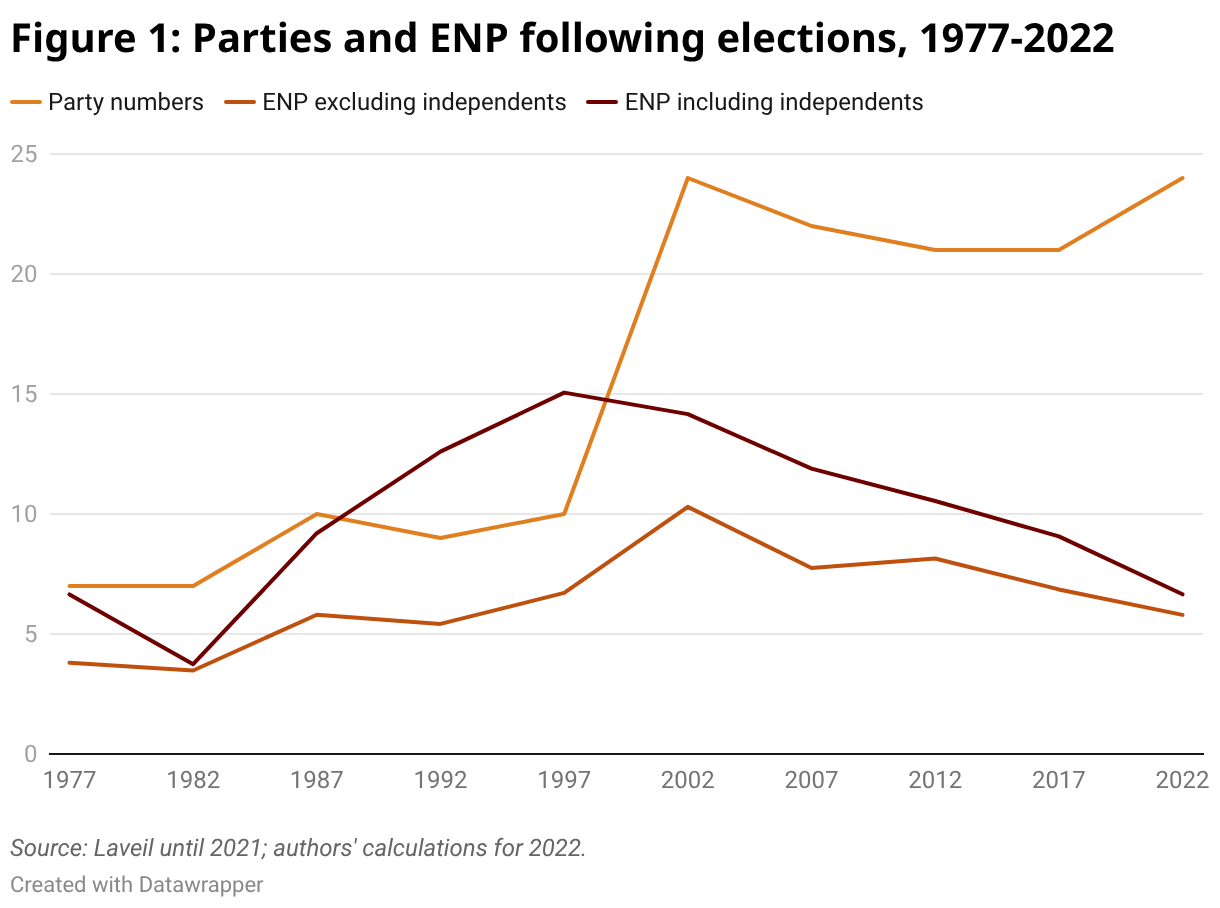
The ENP including independents has fallen since 2002 for two reasons: fewer independents have won seats (down from 38 in 1997 to 10 in 2022), and the ENP excluding independents has also fallen.
The total number of parties has likewise trended down since 2002, though it levelled off in 2017 and rose again in 2022. Since 2012 the number of parties has risen while the ENP excluding independents has fallen: more parties have entered parliament, but most MPs sit with a handful of larger parties.
PNG’s parliament is highly fragmented by international standards. Its ENP including independents of 6.7 in 2022 ranked 10th of 139 countries with elected parliaments. In the region, PNG is less fragmented than Vanuatu (9.1) but more fragmented than Solomon Islands (6.2), New Zealand (3.8), Fiji (2.6), Australia (2.4) and Samoa (2.3). (See online table and download data from the 139 countries.)
Fragmentation in PNG does not stay fixed between elections, because MPs frequently switch parties (Figure 2). In the 2017-2022 parliament, 75 MPs switched parties at least once, and 28 switched more than once. In the current parliament, 48 MPs have switched at least once, and eight more than once.
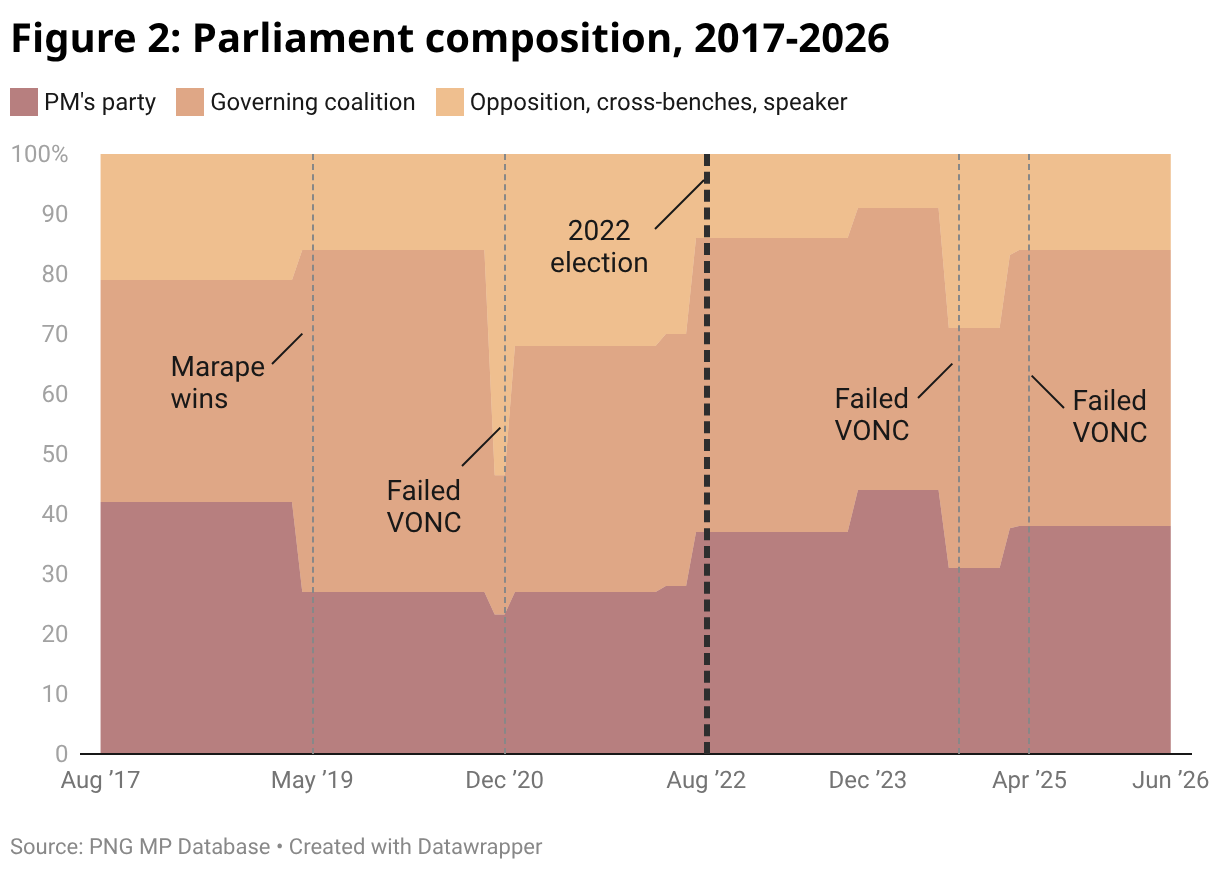
Because party sizes shift during a parliament, so does the ENP of parliament and of government. Switches cluster around votes of no confidence (VONCs). Between 2017 and 2024, MPs could not move a VONC in a “grace period”: the 18 months after an election. The 12 months before an election is known as the dissolution window when a successful VONC would trigger an early election. MPs have never mounted a VONC in this period likely because they fear the high turnover rates of elections or would like to gather as many resources as they can before elections. In 2025, another 18-month grace period was added, triggered by any unsuccessful VONC. The chart below (Figure 3) tracks the ENP including independents since 2017.
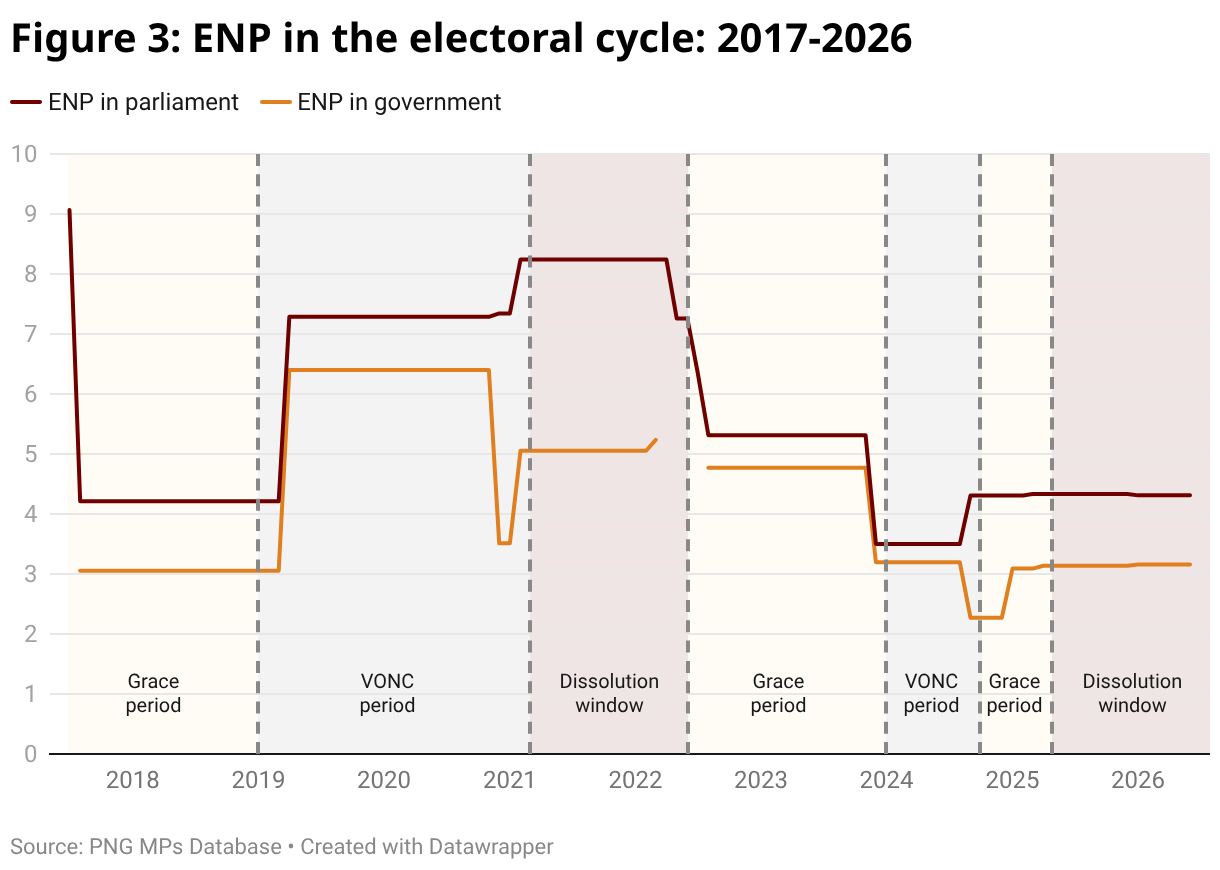
Five points stand out. First, fragmentation falls sharply once a government is formed after an election, as independents and small parties join larger ones. Second, the ENP of parliament is higher than that of government, because only some parties join the governing coalition. Third, the ENP of parliament and of government move together, except in December 2020 and September 2024. Fourth, in the two failed VONCs before 2025, parliament became more fragmented while the governing coalition became less so because several MPs and parties left government for the opposition to unseat the prime minister. During the April 2025 VONC, however, both ENPs were stable. Fifth, the current (11th) parliament is less fragmented than the 10th, with an average ENP of 4.5 now against 6.5 then.
The ENP has been stable since 2025, almost certainly because of the new failed-VONC grace period. Fewer MPs have switched parties in the current parliament, because the shorter window for changing government offers fewer rewards for doing so. Instead, MPs have tended to remain with their large coalition parties, which hold ministries and a greater influence over finances. Some MPs in government have declined to join the prime minister’s party to preserve their bargaining power.
The Finschhafen MP Rainbo Paita, who challenged for prime minister in the failed 2024 VONC, is an example. Paita was originally a member of the PM’s party, PANGU. After the VONC he chose not to rejoin PANGU on returning to government, keeping his new party (Our Party) separate. With 15 MPs behind him, he secured three ministries. This tactic, used by Paita and other coalition parties, has kept fragmentation from falling further.
Political fragmentation in PNG has fallen since 2002 because most MPs are now elected from a smaller number of large parties. Within each parliament, fragmentation falls further as independents and small parties join large ones in search of resources and influence. Since 2017, fragmentation has risen around VONCs but stabilised after the 2025 failed VONC grace period reduced the incentives for MPs to switch parties.


Thanks all. It will be interesting to see if this trend continues. Conventionally, few strong parties often develop around policy areas. What makes the low fragmentation (few big/strong parties) in PNG interesting is that it’s happening without clear ideological differences between parties, or sometimes parties with no policies at all. The traditional “charisma” argument has it’s limitations: Gary Juffa, for instance, one of the most charismatic leaders of this decade has not had more than one MP elected under his party in successive elections. Post-elections, his party numbers didn’t grow beyond himself. This is the same with Bryan Kramer. We will wait to see how Allan Bird fares in 2027 with a new party.
One way to think about this phenomenon is that the State has increasingly become the major source of resource allocation to MPs. This takes the form of constituency development funds (DSIP/PSIP), the executive determining where donor funding goes, and ministerial allocation, among other things. Whilst the last point has always been there, the former two have become more important in recent decades.
So as a MP, the question you ask is: how do I maximise my chances of accessing state resources? Do I remain independent, or as part of a small party? Or do I join one of the bigger parties and let the party negotiate, or negotiate as a member of a big party?
The best option is of course the one: you improve your access to state resources, which is allegedly controlled by the prime minister. Big parties matter to the prime minister because he’s always under threat of a vote of no confidence. So joining one of the big parties makes you “visible” to the prime minister, and improves your access to state controlled resources.
To remain a one man party, you need to be a Gary Juffa or Bryan Kramer. To remain independent, you have to be an Allan Bird. So charisma is still relevant because charismatic leaders can be visible without a big party. But charisma can no longer command a following, or maintain followers.
The allocation of donor projects is an interesting thing to watch. The need for roads and bridges is common across PNG. But where exactly does the government direct donor assistance for bridges and roads? Does it go to opposition MPs or government MPs’ electorates? Does it go to single party MP’s electorate or electorates of one of the bigger parties?
Totally agree, Maho, if you can confirm the data, that would be very interesting. In my presentation and the blog Terence help to do up for ENP, I was tempted to put forward the impact of electoral change ( LPV) on party visibility togther with ENP as accessing and getting the appropriate data and calculating it is a bit difficult for me. My take is given 2027 election I hope you and Michael and Terence can confirm. I held the belief that incentives in the LPV together with Section 63 of OLLIPAC is having an impact on Party visibility. I really hope you continue this.
Great Presentation!
Just one thought here.
The measuring model (ENP) of political fragmentation maybe limited in capturing key elements of PNG politics -election ENP and parliamentary seats ENP to project a weighting on fragmentation. Political fragmentation in PNG is dynamic over the last 15 years, never was it consistent or stable in party alignment by MPs after election. It may be different in comparison to other country’s ENP.
It would be good to identify factors influencing the PNG political fragmentation. One view is that it is not driven by national development policy platforms, rather by individualism, for wealth and enterprise, through ethnic induced and regionalism practice.
If ENP model can be flexible to accommodate or generate informative analysis on factors influencing fragmentation would be ideal.
Thanks Domyal for your comment. Firstly, the ENP was calculated with the data that is available, election results which are thankfully available. Parliamentary MP party affiliation since 2017 is taken from the PNG MP Database. Second, you’re right in that party loyalties do not stem from policy or ideology but rather from the charisma, resources, and popularity of party leaders. This makes PNG’s party system weak and is an inherent feature of clientelist democracies, see here. It is difficult to measure the popularity of party leaders but we can infer this afterwards when MPs switch.
Gentlemen, thanks for the write-up. It’s informative. I just want to share another perspective on winning parties. One or two parties that have changed leadership, especially Political wing, have seen increased winning numbers. A good example, Peoples First Party, stagnant for quite a while under late Governor for Morobe Luther Wenge, when the leadership changed to Richard Maru won couple of seats. PANGU’s resurrection came during the time of late Sam Basil. He maintained momentum for giving life to a party, did the same for ULP until his untimely passing. Not the same for PDM Paias Wingi held onto the leadership and once a powerful party now became nonexistent. PNG Party once had huge following under Sir Mek. Today it’s still struggling to go past 2 MPs. THE Party once powerhouse now probably has no political wing after Kandep MP defected to PANGU. When Parties changes leadership it produces different results. Just a suggestion, you could look at an article that assess the changes in leadership and its impact on winning candidates.
Thanks Ezra for your comment. You’re correct in saying that the fortunes and decline of many (if not all) of PNG’s successful parties have been dependent on big men, something studied at length by many political scientists in PNG. Paita is the most recent example. While the ways that parties are sustained has not changed, we demonstrate here that overtime, these “strong” parties have become fewer in number, attracted more MPs and smaller parties, and recent amendments to laws governing government change has led to their consolidation within parliament.
Thank you Michael and Maho, for generating the data and discussion in relation to ENP, the data now confirm indeed fragmentation has fallen. I have discuss here as well the casuality of ENP to Section 63 of OLLIPAC [invitation to Form the Government] after 2002 but have not have data to support this claim. This is intersting development as I think the debate in Party politics party system is gradually shifting from frangmentation to party Visibility.
Thanks Russel for your comment. Your blog (and UPNG presentation) was interesting. PNG’s election outcomes had become increasingly fragmented leading into and including 2002, and I agree that this was likely a reason for inviting the largest party to form government – it’s also why post-elections, the ruling party grows even larger as independents and small parties join it. Michael has written at length on this. I also think the fall in ENP since 2002 is an LPV effect reflecting the strategic voting on the part of voters. It is likely, generally, that while 1st preference votes reflect voters’ “true” preference, 2nd and 3rd preferences are likely used to “hedge their bets” by voting for the candidate who is most likely to win. Competitive candidates are more often than not, members of large, strong parties. And as you know, most elections go into consecutive rounds, which favour the chances of these candidates, including an increase in incumbent success after leading on first preferences – this rose from 35% in 2007 to 63% in 2022. If this is true, I can certainly argue that it is, then the strategic voting brought about by the LPV system has made electoral and parliamentary politics less fragmented, something that Terence Wood, Michael and I missed in our discussion paper that reviewed the LPV system.