When Cameron Hill posted a link to this year’s Australian aid attitudes blog on LinkedIn, a commenter suggested the data showed that support for aid was rising over time. As I read that I thought to myself, “you’re seeing things”. Needless to say, I was wrong. They weren’t seeing things. I was missing them.
Bar charts are clunky beasts, so I’ve plotted scatterplots with trend lines on the charts below.
The first chart shows the percentage of respondents who think Australia gives too little aid. The data isn’t limited to our polls but comes from all the surveys I could get my hands on. (I had to exclude Lowy Institute polls, as they don’t appear to report on don’t knows, which means that they cannot be used for comparisons over time.) There’s some movement around the line of best fit, but the overall trend is clearly upwards. More and more Australians think their country does not give enough aid.
Figure 1: Percentage of Australians who think that their government gives too little aid

Source: Author’s calculations using various Australian public opinion surveys.
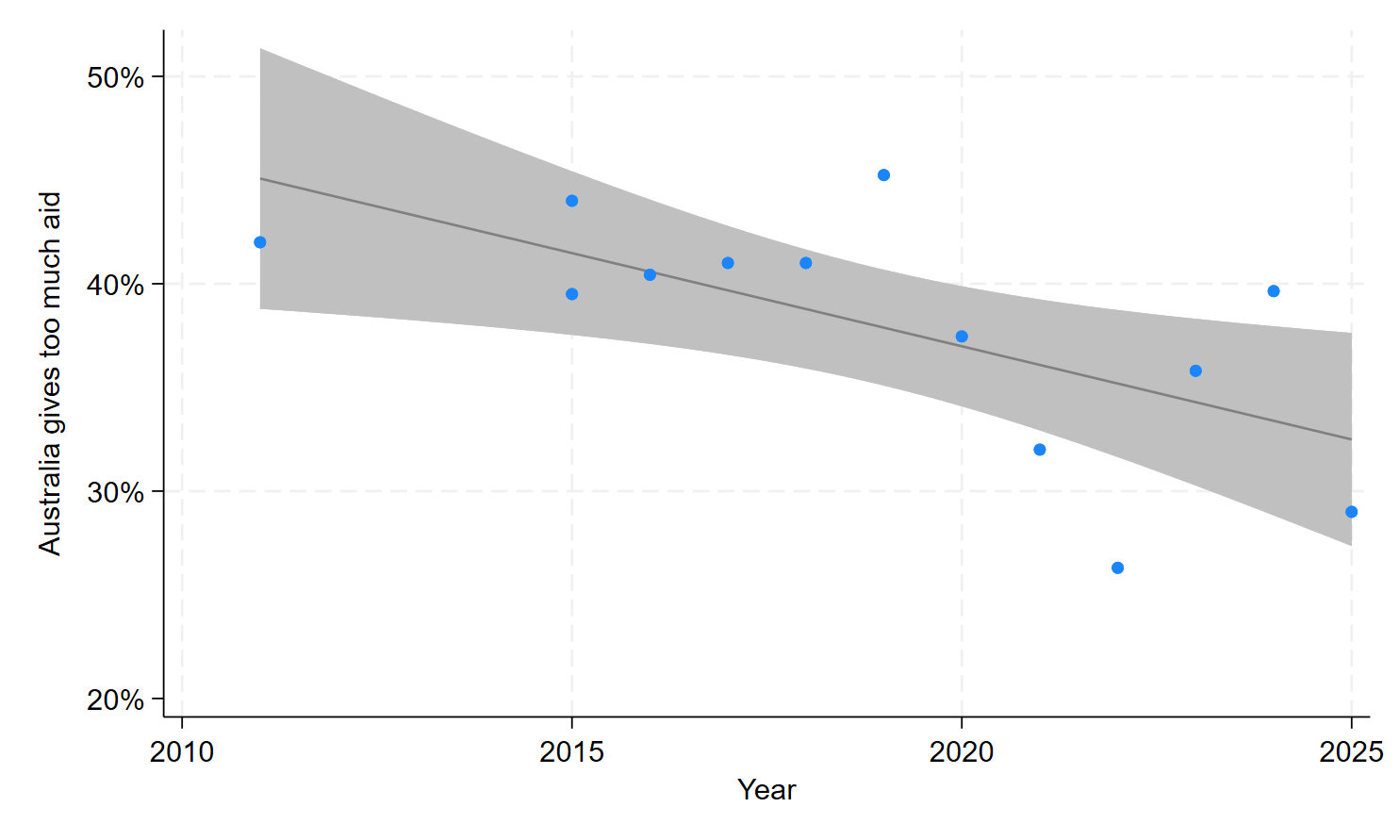
And, as Figure 2 shows, the share of Australians who think their government gives too much aid is also falling.
Figure 2: Percentage of Australians who think that their government gives too much aid
Source: Author’s calculations using various Australian public opinion surveys.
Both relationships are statistically significant (p<0.05). There is, in other words, some noise, but the signal is clear: Australians are becoming more favourably disposed to aid.
On average, the share of Australians who think their country gives too little aid has been rising by a bit over half a percentage point per year, while the share who thinks that Australia gives too much aid has been falling by nearly a percentage point per year. That doesn’t count as a transformation, but the change is starting to add up. Based on the average trend the share of respondents who thinks Australia gives too much aid is more than 12 percentage points lower than it was in 2011.
What is causing decreasing hostility to aid? As Cameron and I mentioned in the blog post on our 2025 survey, changes from year to year almost certainly reflect individual events, such as the COVID-19 pandemic or inflation. However, idiosyncratic changes of this sort are unlikely to be behind the trend.
One possible explanation for broader changes over time is simply that Australia is wealthier now than it was in 2011. Perhaps people feel more affluent and so are more supportive of sharing the wealth around. Yet Australia is also wealthier now than it was in 2005, and old AusAID survey data show that Australians were even more supportive of aid back then.
Another potential explanation is China. Perhaps people’s preoccupation with the rising super-power is causing them to become more sympathetic to aid and, in particular, aid given to advance Australia’s geostrategic interests. This is possible, but I doubt it explains all the change. In 2025, we also asked Australians what they thought the primary purpose of their aid should be and the majority said helping people in developing countries as opposed to advancing Australia’s interests. Even among Coalition voters a plurality stated they thought aid should be focused on helping the poor.
A very different reason for changing attitudes is campaigning — since the early 2010s several organisations including the Campaign for Australian Aid and Micah Australia have advocated for more aid. It’s possible this is having an effect.
There has also been a decline in high-profile opposition to aid. Once upon a time, Australian aid had some very vocal critics. They are much less prominent now. This might be causing active antipathy to aid to wane.
Interestingly, the overall change is visible both amongst Labor and Green supporters, and amongst Coalition supporters, albeit in different ways.
To look into this, I used Development Policy Centre surveys. I used our surveys because they contained data on political party support, which people were also asked about (other surveys haven’t always broken results down politically). Using our data, I ran regressions in which the unit of analysis was individuals’ responses, not aggregates. First, I focused on Coalition supporters, and then Labor and Green supporters (to whom I refer as “the left” for convenience’s sake). The results of my analysis are shown in Figures 3 and 4.
(In case you’re wondering. I used annual aggregates in the first two charts above because results were similar for both aggregate and individual level data, and the aggregate data were easier to put on a scatterplot. When running regressions on data from individual respondents I clustered standard errors by year.)
Figure 3 shows the percentage of survey respondents who think Australia gives too little aid. The red line represents people on the left. The blue line represents Coalition supporters. The red line slopes upwards meaning that — if anything — people on the left have become more likely to think Australia gives too little aid. However, the trend is not at all close to being statistically significant — any apparent change on the left may just be a product of chance alone, not shifting attitudes. Among Coalition supporters, however, there is a clear upwards trend (p<0.05). It’s still the case that fewer Coalition supporters think Australia gives too little aid compared to people on the left, but the attitudes of Coalition supporters are clearly changing.
Figure 3: Percentage of Australians who think that their government gives too little aid, Labor/Greens vs Coalition
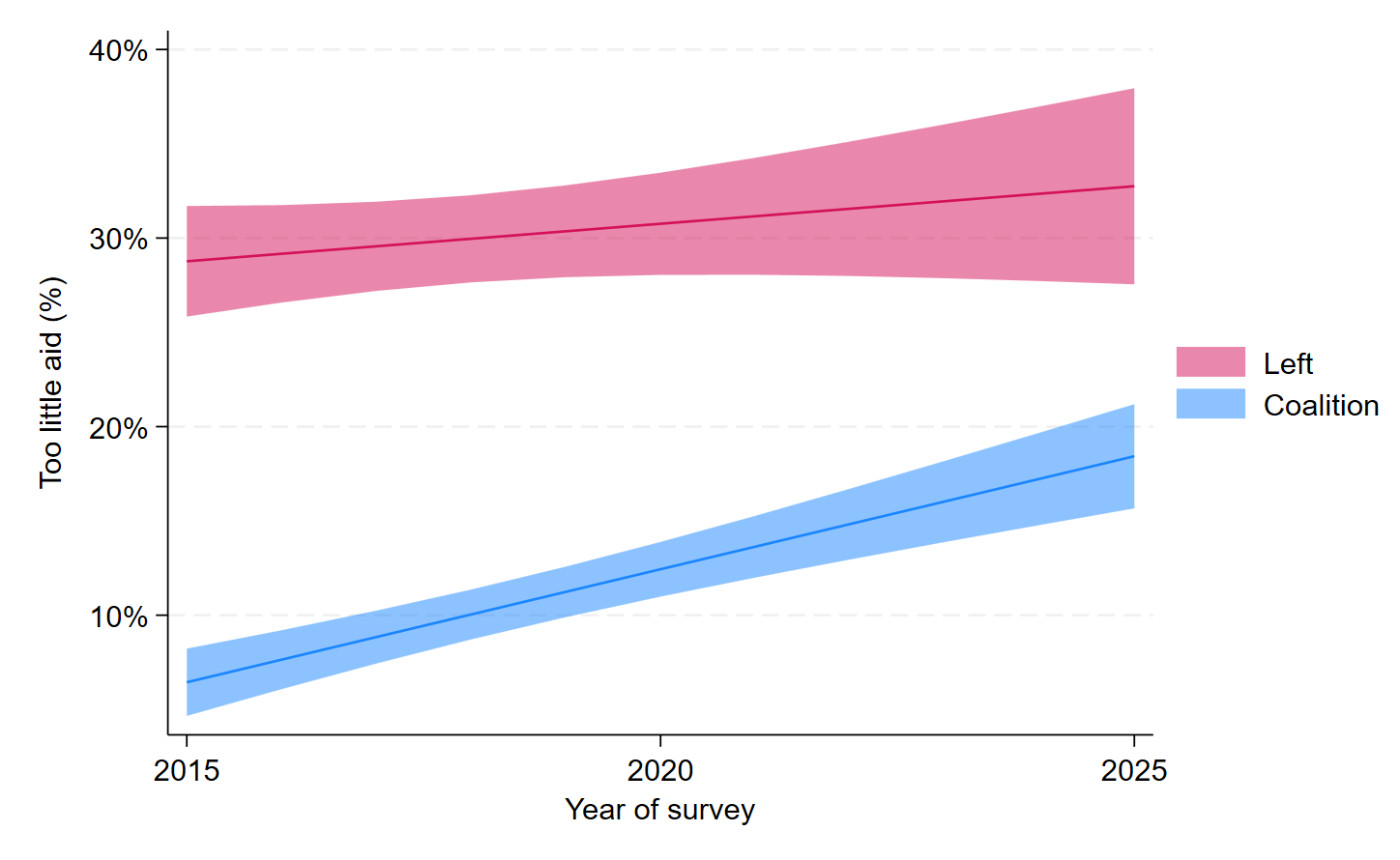
Source: Author’s calculations using various Australian public opinion surveys. Respondents who supported other political parties or answered “don’t know” to party questions have been excluded from analysis.
Figure 4 shows the percentage of survey respondents from the two sides of the political spectrum who think Australia gives too much aid. Once again both lines suggest people are becoming more supportive of aid. However, the trend is most clear on the left this time. There appears to be a trend amongst Coalition supporters too, but it’s not quite statistically significant.
Figure 4: Percentage of Australians who think that their government gives too much aid, Labor/Greens vs Coalition
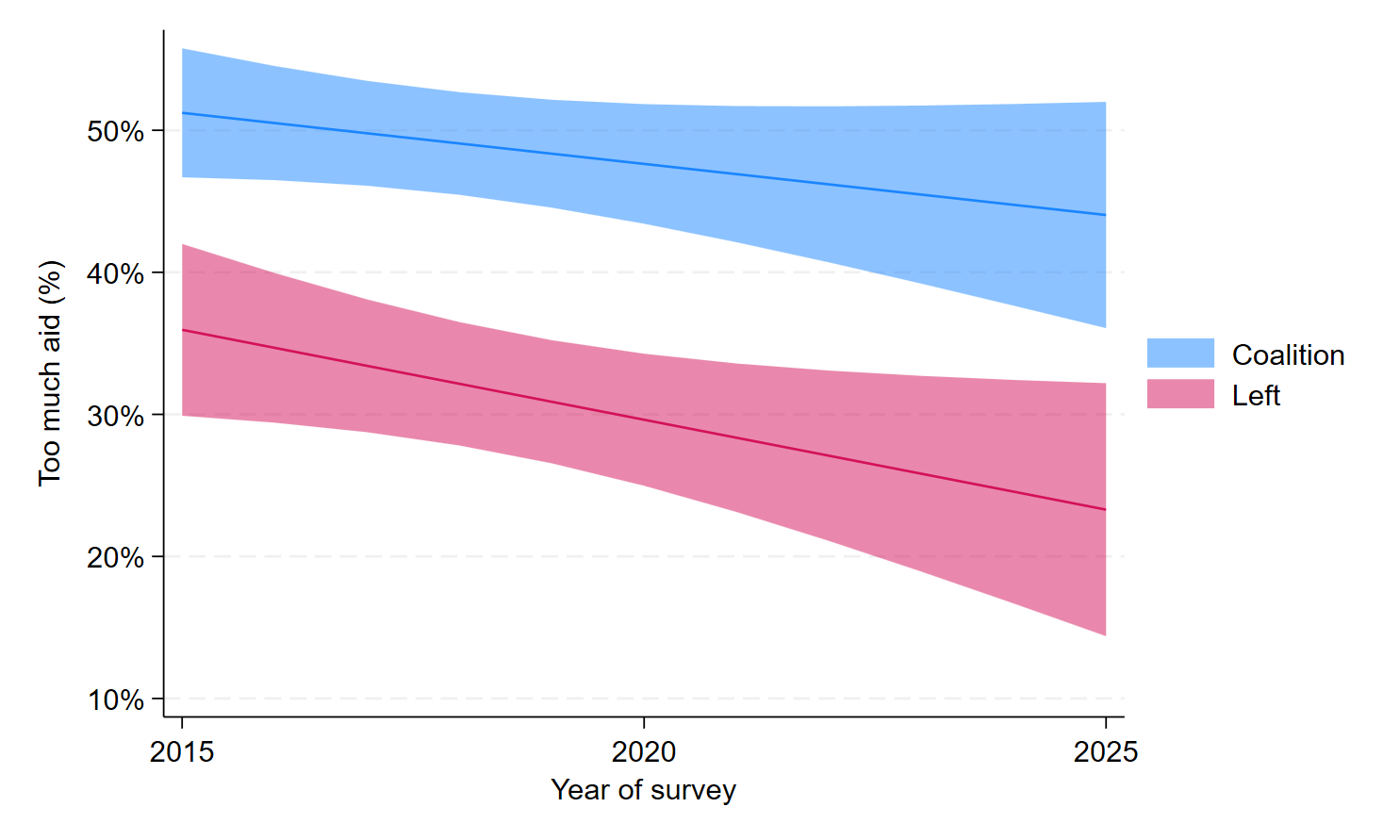
Source: Author’s calculations using various Australian public opinion surveys. Respondents who supported other political parties or answered “don’t know” to party questions have been excluded from analysis.
These are not the changes I was expecting to see. I had thought that overall changes would have stemmed primarily from shifting attitudes on the left. I’d always assumed that Coalition supporters were, on average, irretrievably opposed to aid. Once again, I was wrong: on both the left and right views have changed. On both the left and right people are now more supportive of aid than they once were.
It’s not a trend that’s guaranteed to continue into the future. And it hasn’t been a transformation, but the change is encouraging if you think that Australia ought to give more aid.