


The January by-election for the provincial seat in the New Ireland province of Papua New Guinea marks a moment of transition from the death of Sir Julius Chan in 2025, one of the country’s most significant post-independence political figures.
At one level, it would appear to offer continuity. The provincial seat has been secured by Byron Chan, the son of Julius. But what emerged from the campaign were two phenomena that mark an important departure from the New Ireland way of doing politics.
The first of these was the remarkably successful outcome for the independent candidate Kepas Wali, who recorded the second-highest vote.
The second is the protracted political and legal battle over whether the winner of a provincial seat in a by-election also assumes the position of governor. At the heart of this conflict lies a complex web of customary power, constitutional interpretation and political ambition.
Byron Chan’s campaign resonated strongly with the issues Sir Julius championed, such as autonomy, education and material well-being for the province. He carried the authority of chiefly status from his mother’s clan and benefitted from an alliance with Ian Ling-Stuckey, member for Kavieng District, and the Pangu Pati, who refrained from standing a candidate and endorsed Chan’s campaign. The campaign was orderly, despite frustrations about the accuracy of the electoral roll, and the counting proceeded smoothly.
For decades, the political style of New Ireland could be described as stable and is often locally referred to as the “New Ireland Way”. It has been characterised by relatively orderly elections and the managed transition of political authority between the People’s Progress Party (PPP), founded by Julius Chan, and the National Alliance Party, founded in 1995 and associated with the Prime Ministership of Sir Michael Somare.
Ling-Stuckey was from the National Alliance Party (NAP) until he joined the ruling Pangu Pati on being appointed as Treasurer in 2019. In New Ireland, the PPP and the NAP were tied to a small political elite. Ling-Stuckey’s father was a close friend of Julius Chan’s; Byron Chan won the Namatanai seat, once held by his father, only to be defeated by Julius Chan’s nephew, Walter Schnaubelt for the National Alliance Party.
Several features underpin this political order. New Ireland is governed by a hybrid of traditional norms and an imposed Westminster system. This arrangement reflects a broader pattern in Melanesian governance where authority is stabilised through the interaction of formal state institutions and customary leadership structures. Traditional cultural norms remain strong, albeit challenged by the more powerful region-wide reach of the parliamentary system.
The matrilineal system of land ownership and succession exerts a powerful influence in mediating disputes and endorsing political and cultural leaders (maimai or chiefs). This hybrid system has functioned smoothly in part because parliamentary leadership has been tightly controlled and aligned with chiefly status, and partly because the traditional norm of ruru (respect) has been transplanted into the parliamentary process.
On the one hand, this hybridity has been reinforced with the election of Byron Chan and the PPP. But it has also been profoundly disrupted.
After the distribution of preferences, the first three candidates were Byron Chan (PPP), Kepas Wali (Independent) and Joshua Takin Soi (NAP). Kepas Wali has a distinguished career, coming from an engineering background. Wali was unable to break into the Ling-Stuckey stronghold in Kavieng District but polled strongly in a number of Namatanai areas. His campaign focused on his being mangi ples (from the village), a strong rebuke to the elite party politics of New Ireland. His polling places him in a strong position for the 2027 general election.
More significantly, the aftermath of the election has seen an escalation of institutional and possibly constitutional conflict. Walter Schnaubelt is the member for Namatanai, and, by virtue of his being a maternal nephew of Sir Julius Chan, the inheritor of chiefdom of Sir Julius’s clan. In 2025, the Provincial Assembly appointed him as Governor to fill the vacancy left by Sir Julius’s passing. Schnaubelt has challenged both the calling of a by-election and, upon the outcome of the election, has sought to sever the tie between the provincial member and the position of governor which has operated by virtue of the Organic Law on Provincial Governments and Local-level Governments, which provides that the elected provincial member is the governor (S17.2), but also provides for the filling of a vacant position of governor (S21).
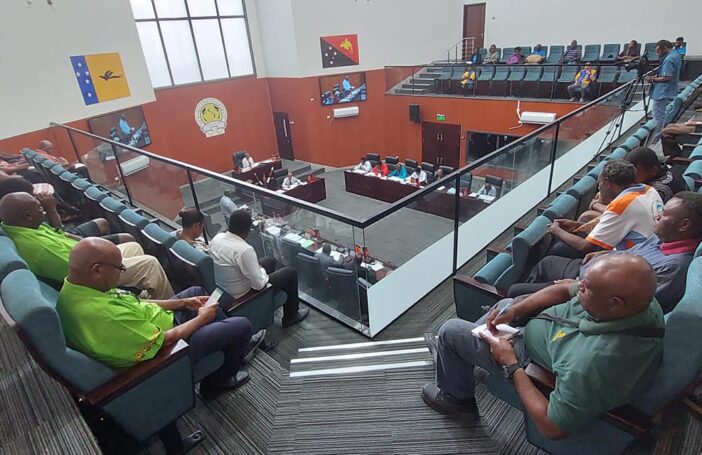
Following a tense stand-off outside the Provincial Assembly building on 25 February in which calm was urged upon a large PPP assembly by traditional elders, Chan was sworn in by a meeting of the Provincial Assembly. With Schnaubelt still defiant, the matter is now before the National Court. Chan filed an application on 23 February seeking relief to occupy the position of governor.
On the same day, the Provincial Executive, still chaired by Schnaubelt, filed an application with the Supreme Court, seeking a constitutional interpretation. On 9 March, the National Court handed down interim orders granting Chan the power to be Governor and restraining Schnaubelt (Decision, OS no 49 of 2026, Integrated Electronic Case Management System).
The substantive matters remain to be dealt with and the reference to the Supreme Court has yet to be determined. Schnaubelt has re-opened the legal challenge with an urgent application to the Supreme Court which commenced on March 23. A similar reference to the Supreme Court has been made by the Morobe Provincial Assembly, who face a by-election in similar circumstances.
These developments mark a notable departure from the expectations of orderly succession that have often been associated with New Ireland politics. Rather than a clean transition within a stable elite framework, the election has produced a period of uncertainty in which authority is contested across both customary and parliamentary arenas.
The strong campaign from Wali as an independent may be seen as a protest vote against a party system that has delivered stable leadership aligned with traditional values, but has delivered government services in a partisan manner. The crisis over the position of governor demonstrates the potential for conflict when claims for power under the chiefly system by Schnaubelt meet the opposition of a popular vote in the election of Byron Chan.
The authors wish to acknowledge the kind permission of NBC New Ireland for use of the banner image.



it will be interesting to continue to track these developments