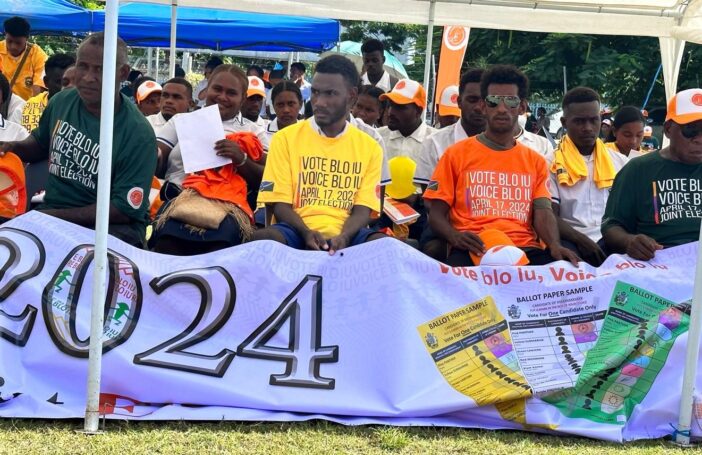
Papua New Guinea, despite its high levels of perceived corruption, has held national elections regularly since independence in 1975 without interruption or deferral. However, in recent years there has been an observed worsening of elections, with voters and candidates affected. The link between corruption and the weakening of democracies has been studied globally and is evident in PNG.
There is cause for concern as Transparency International’s most recent Corruption Perception Index (CPI) score for PNG shows a precipitous decline. This drop in perceived governance quality is happening at a time when the PNG Electoral Commission (PNGEC) is seeking to reassert its constitutional mandate, in the face of recent legal and logistical challenges.
PNG’s 2025 CPI score of 26/100 was announced by the PNG chapter of Transparency International (TIPNG) on 5 February 2026 in Port Moresby. The CPI is a composite index, that is, an index of other indices, drawing from a minimum of three independent sources over a two-year period measuring perceived levels of public sector corruption in a country.
The higher the CPI score out of 100 the less corrupt a country is perceived to be. Conversely, the lower the score, the higher the perception of corruption. PNG’s score of 26/100 in the 2025 CPI shows a five-point drop from the last assessment — with PNG attaining its lowest score in a decade.
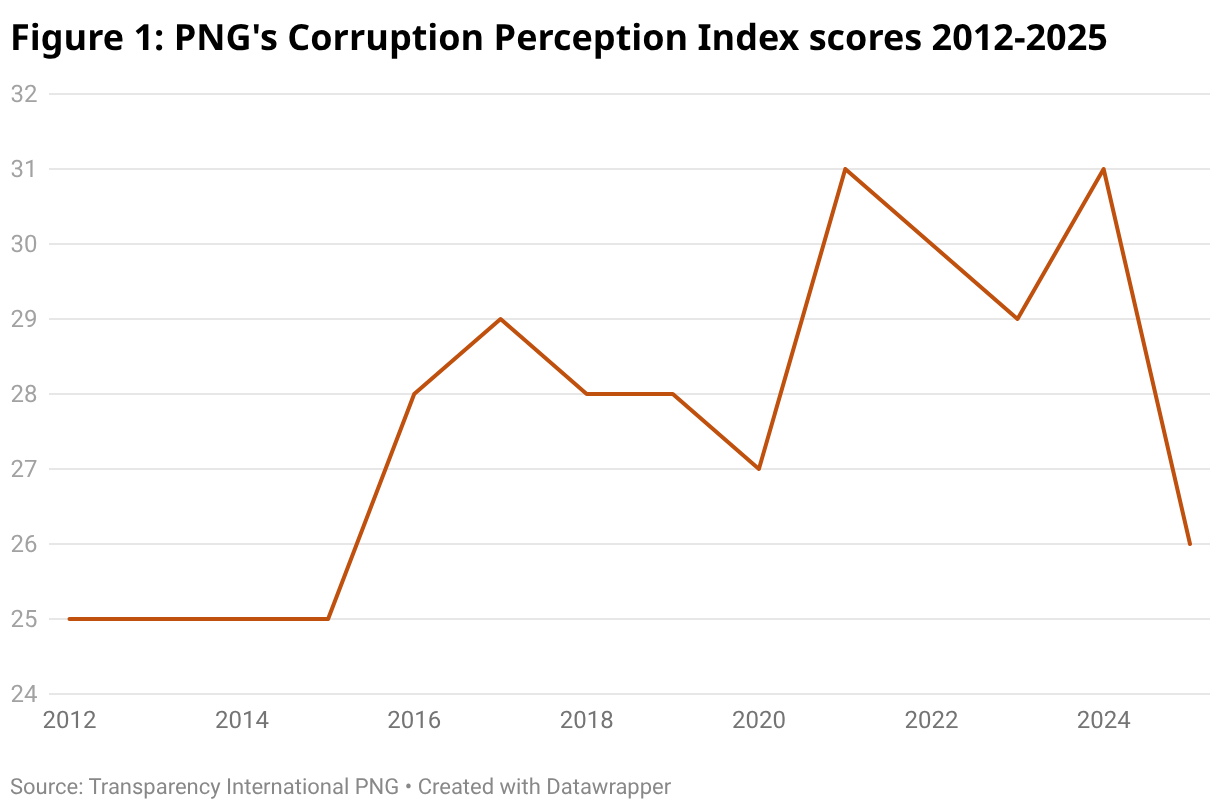
While the CPI has been criticised both by governments and scholars for its perceived limitations, it has nevertheless remained a widely used indicator of governance quality in part due to its longevity. Indeed, PNG’s Medium Term Development Plan IV (2023-2027) specifically includes reforms that aim to “improve … the corruption index”. With this in mind, when announcing PNG’s 2025 CPI score, TIPNG focused on the historic dataset of CPI scores to identify trends influencing the country’s overall governance.
From the analysis of PNG’s CPI data since 2012, a recurring pattern is evident when considering the relative year-on-year changes in the score. There is a cycle of stagnation followed by improvements in the score, followed by a decline. This recurring cycle becomes more visible when charted against the five-year elections cycle in PNG.
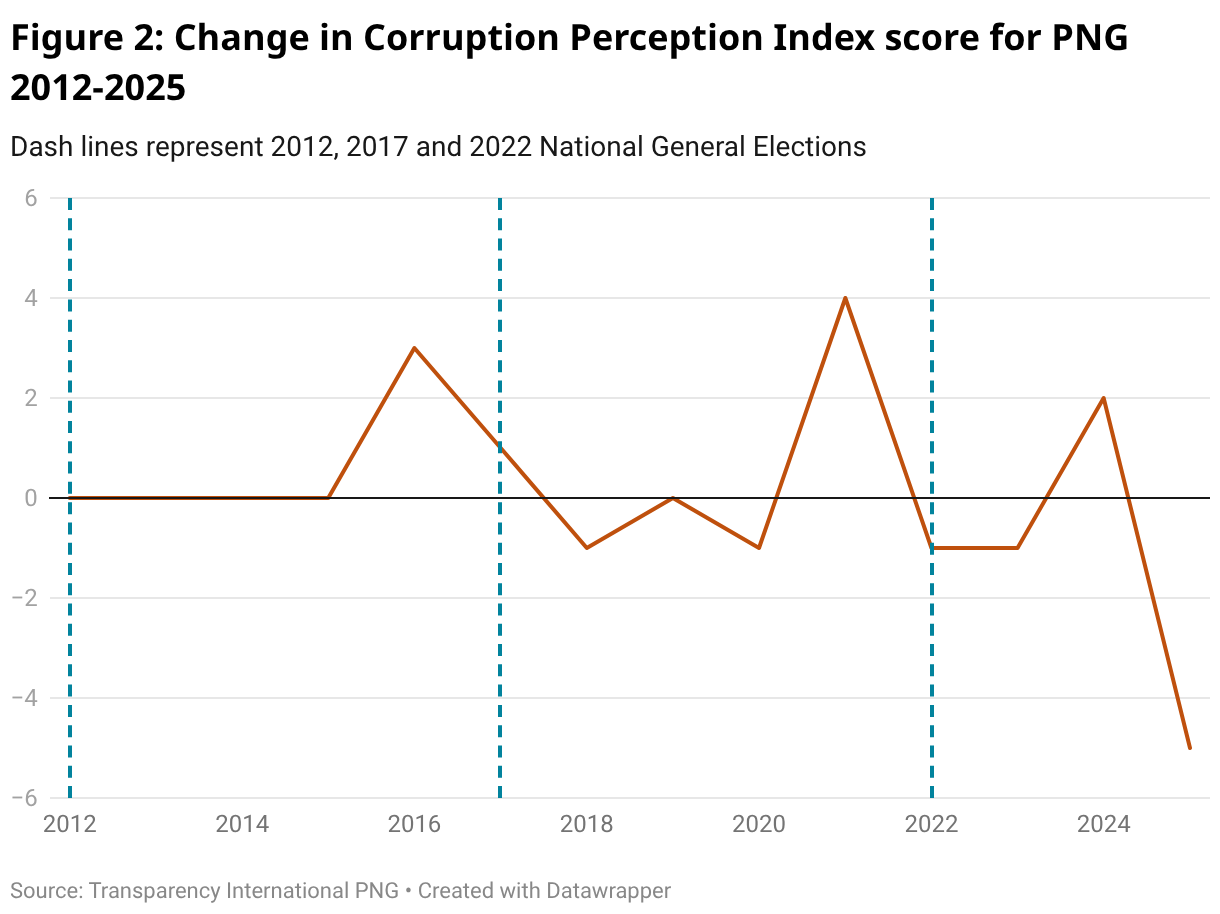
The periods of stagnation align with the years following the formation of a parliament after an election. Then there are improvements in CPI scores at the end of a term of parliament, followed by stark declines in election years. This trend has held for the last three electoral cycles in PNG. This makes the five-point drop in PNG’s 2025 CPI score even more alarming as it is ahead of schedule — the next election is scheduled for mid-2027. Assuming the pattern observed by TIPNG holds and intensifies, it is highly likely that the political climate will only worsen perceived corruption in the lead-up to the election unless strategic action is taken now.
In a statement on the 2025 CPI score, TIPNG called for a twofold approach to protect the integrity of the 2027 elections. First, supporting integrity institutions and processes, most notably fully funding the PNGEC so as to enable the commission to “independently fulfil its mandate”. This call for funding unsurprisingly has been echoed by PNGEC Acting Commissioner Margaret Vagi in a recent appearance before the Special Parliamentary Committee on the 2022 general election. The Committee was also mentioned by TIPNG as a body that needed to be supported, alongside the Inter-Departmental Elections Committee and law enforcement agencies such as the police and the PNG Independent Commission Against Corruption.
The second strategic action recommended by TIPNG is to shield against foreseeable risks to the delivery of the 2027 election in PNG. Identified risks include rushed reforms before the election, leadership vacuum without a permanent electoral commissioner, politicisation of the PNGEC and the delaying of constitutionally required processes such as the roll update. The risks were identified based on previous independent observation reports by TIPNG, the Australian National University and diplomatic missions in connection with prior elections in PNG.
Since TIPNG’s release and analysis of the CPI score, political developments in PNG have validated the concerns. In a recent by-election in the Western Highlands electorate of Dei Open, a decision by Vagi to reject ballot boxes due to allegations of tampering was challenged by her own returning officer who was subsequently suspended by the PNGEC. Similarly, the result of the New Ireland Provincial by-election at the time of writing is being disputed by the acting governor, despite a clear directive from Vagi.
The writing is on the wall for PNG: if addressing corruption is a priority then steps must be taken in 2026 to secure elections integrity in 2027. The ability for eligible citizens to hire and fire elected representatives via the ballot box is the final guarantee of accountability afforded to Papua New Guineans. TIPNG and the PNG Electoral Commission are showing the way to safeguard that privilege of free, fair and safe elections in 2027. This is a call that should not be ignored.