

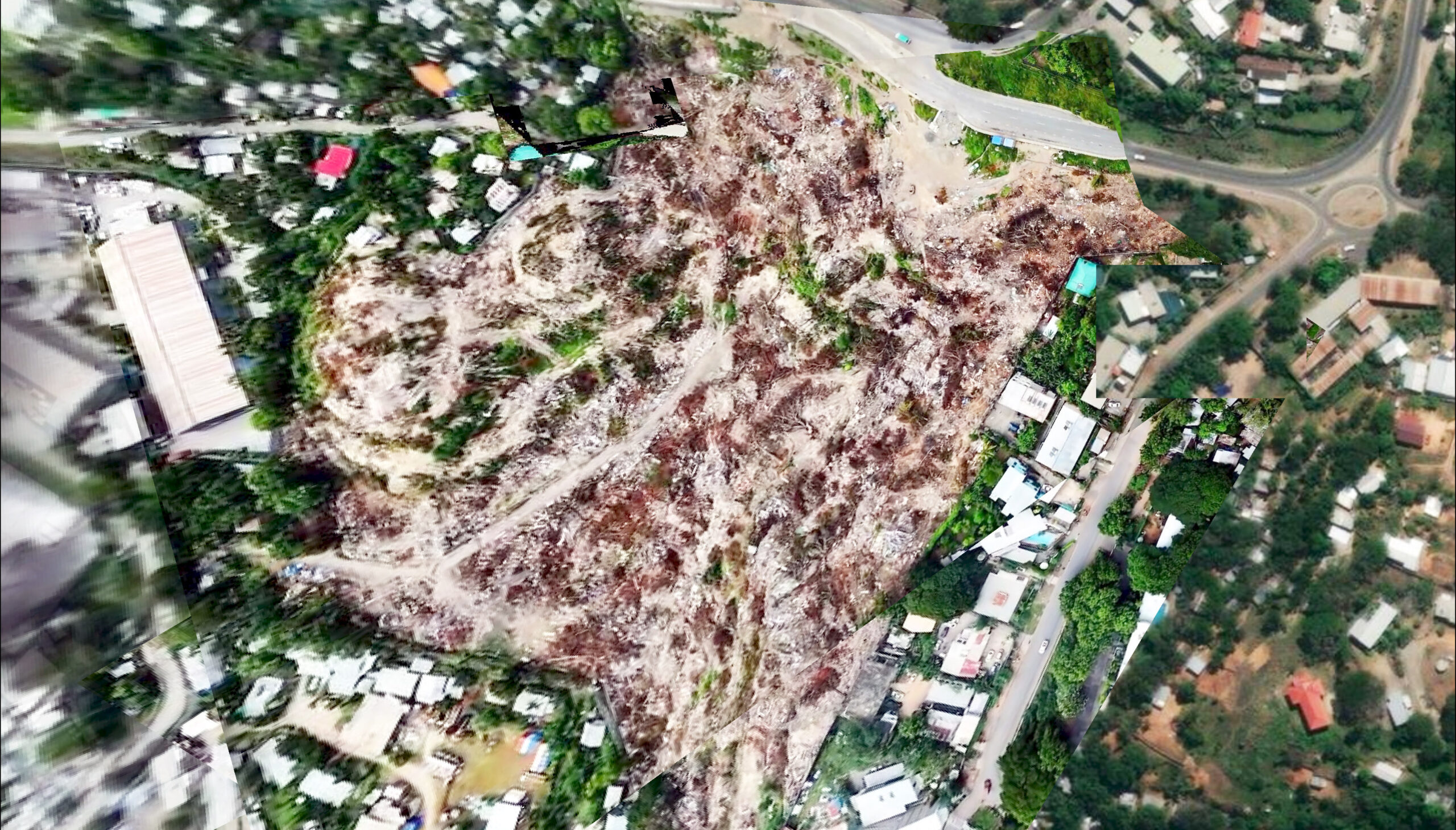
The dust may now have settled at Two-Mile Hill, but twelve hundred former residents of Port Moresby’s Rabiagini settlement remain homeless. They are the unfortunate victims of the latest of Papua New Guinea’s state-sponsored eviction campaigns. Forced to move into other crowded settlements scheduled for future demolition, they embody Port Moresby’s interlocking crises of housing insecurity, escalating violence and failing urban policy.
Urban squatter settlements are growing rapidly in the cities of Australia’s Melanesian neighbours. Across Noumea, Suva, Port Vila and Honiara, each is a testament to the region’s accelerating rural-urban migration. The issue is most pronounced in PNG’s capital Port Moresby — where over 50% of the city’s population now reside informally and illegally in sprawling squatter settlements. These agglomerations emerged in response to ongoing housing shortages and reconnect people who felt separated from friends and family when they reside in culturally unfamiliar Western-style suburbs. Communities recreated village structures on unoccupied stretches of state-owned land, wiring up their own (usually illicit) power connections and tapping into the city’s water. They were first called “self-help” settlements: as settlers had no choice but to help themselves establish basic services.
Now, settlements are a defining feature of Port Moresby. They are equally the primary target of National Capital District (NCD) Governor Powes Parkop’s urban policy. Political elites, the Royal PNG Constabulary and many others have long blamed settlements for Port Moresby’s manifold urban problems — from the deteriorating city water supply to carjacking. Traditional media and increasingly pervasive social media amplify this narrative. Settlements are often stereotyped as hotbeds of criminality and settlers, by association, as hordes of unwelcome criminals.
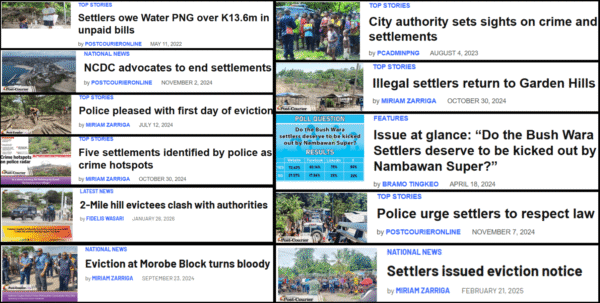
Anti-settler rhetoric in newspaper headlines from the PNG Post-Courier, PNG’s leading daily newspaper (Curated by author).
This rhetoric exacerbates existing settler marginalisation. While trustworthy quantitative data is scarce in PNG, qualitative markers strongly suggest Port Moresby residents face record unemployment. When a supermarket opened recently at 8-Mile, a large settlement in the city’s north, and advertised entry-level positions, owners were met by a queue of 3,000 hopefuls — many waiting more than 12 hours in the sun and without food, for the possibility of an interview.
Without income, settlers cannot secure loans necessary to access formal housing. They remain trapped in the settlements under the ever-present threat of violent eviction. Despite this insecurity, many settlements have grown into communities of thousands. My previous research combining satellite imagery analysis with ground-level interviews suggests 8-Mile, a settlement covering 250 hectares, houses around 25,000 people, many of whom have lived there for decades. Their houses are far from shanties, built not just to last but for children to inherit.
However, children growing up in a settlement cannot legally inherit this land. Instead, they will inherit housing insecurity. The informal (and often traditional) network of leases governing settlement housing are not accepted by PNG’s legal system. Despite official acknowledgement that customary land leasing is widely understood and accepted, the NCD recognises only those physically possessing land titles, which grow increasingly valuable. Land titles in a fast-growing city are sensible capital investments for corporations — particularly so when security is provided by the state. This dynamic has generated, and continues to generate, sporadic violent confrontations between settlers and officials executing evictions.
Typically, settlers receive 30 days’ notice before police, private security and bulldozers arrive to burn and level the settlements. This may be ordered pre-emptively by the NCD or at the behest of a land-title holder. This is what occurred in January and February 2026 at Two-Mile Hill (Rabiagini) and likely caused the contemporaneous attacks on police. Geospatial analysis of open-source aerial imagery and drone footage shows at least 150 dwellings over 8.8 hectares were destroyed in the Two-Mile Hill settlement. Those wishing to stay but having lost their homes have no recourse but to rebuild their lives in other settlements. Otherwise, they must uproot to villages far from the capital where government services may be limited or non-existent and opportunities for paid employment scarce.
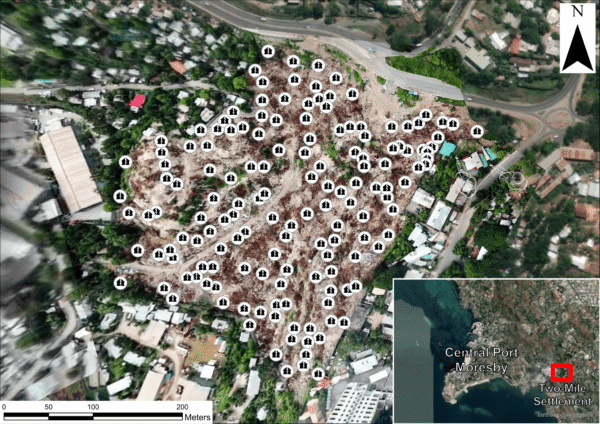
Drone footage imagery georeferenced and overlaid onto a satellite map, highlighting demolished dwellings (Bradley Dare using imagery by Ovia Oa).
Few choose to leave. Data from a recent study of 8-Mile demonstrated that mass evictions around a settlement increase housing density within its boundaries. Settlers do not move out of Port Moresby when evicted. They move further in.
As more settlements are slated for future demolition, the number of people displaced by evictions is likely to increase, causing the issue not only to persist, but worsen. Continuing to violently evict settled internal migrants without planning for their future residential or economic integration furthers the marginalisation of an already-marginalised group, inviting instability and further violence into PNG’s capital.
To avoid this future, NCD urban planners — and urban planners watching from across Melanesia — must engage with their settlers before eviction. Rural-urban migration cannot easily be halted nor reversed, and therefore a dialogue must be opened that acknowledges settler rights to secure housing and employment opportunities, whether in formal or informal economies (such as gardening). Steps have already been taken in this direction, such as Governor Parkop’s calls for settlement upgrades, but these statements mean little while settlements such as Two-Mile Hill continue to face demolition without sufficient planning for the future welfare or security of their displaced residents.




Some of these evictions happen because there is a land grabbing syndicate that operates in Papua New Guinea, which is consist of Politicians, Lands Dept Officers, Foreigners, Corporate Businesses, Private Businesses and Fraudsters all collude to deprive the poor citizens of Papua New Guinea. I’m commenting because I have first hand knowledge of the situation because I was evicted twice due, only thing we need is legal aid, since some of us have our facts to defend in court.
Great piece Bradley. Well done. Always good to see analysis coming out of PNG that is backed up by credible evidence.
Thanks Bradley – your work has been really insightful. The question you pose is one of ‘equity in planning’ – it is a perennial challenge across all planning systems around the world. I’ve spent a few years travelling to observe how cities treat those living outside the formal housing system whether illegally or otherwise. I am never as surprised by the treatment from the government as I am by the formal residents of the cities in the way they talk about those who they see as ‘a problem that needs to be solved’. It is shameful but reflects the politics of the willing. If there was willingness in society, the politics would priorities equitable development.
As a planner and a Papua New Guinean who worked between several planning systems, I can say that there is only so much that planners can do to ensure equity in planning. Legislation and governance limit our authority and arena for responsibility. The ‘urban policy’ you refer too lies in our physical planning act from 1990 but the act is not the framework for how development occurs in this country, it only outlines the process to get to an approval. A planning framework would setup a system to ensure an outcome. But all this comes down to the politics of the willing, and judging by the rhetoric spewed by the ‘urban elite’ in PNG, it will take a while to understand how to solve the ‘problem’.
I know you explained to me in a previous email exchange the limits of your project being a desktop analysis, but this is a great start to what is needed. If you were a bit more curious, I would implore you to ask the itching question – why can’t planners plan equitable cities in Melanesia?
It is similar to the most of the South Asian urban realities. In one perspective communities squatting in government lands have not one but dual benefits which are earnings from unknown sources and not liable to take responsibility of any ownership disputes because again the problem boomerang towards to government failure. Faced the same issue in one of the development initiative I actively participated. Political voting bases and influence have great deal to play in resolving these issues.
Sporadic urban settlements are nothing but showing incapable governance. The government is forced to bear the cost in two ways. First, to evacuate “illegal” settlers to pave the way for a “development” project costing the government coffers. Second, the government has to bear a massive cost to relocate settlers if the land is taken for a development project funded internationally. The eviction has to be aligned with the resettlement guidelines, paying for illegal settlers. I worked on a internationally funded project in Lae when the port project (funded by a BIG Bank) had to evacuate thousands of families squatted on government land. This could have been avoided if that state land was well-protected. The government machinery failed to do so and now pays back the people from its own resources. Unlike other countries in the middle east and Central Asia, PNG’s rural land is productive and rich in natural resources. Yet, we see an exodus of rural people migrating into cities. Surely, it is a problem of governance and unless this core issue is addressed, the exodus of rural masses into urban areas will remain unabated.