

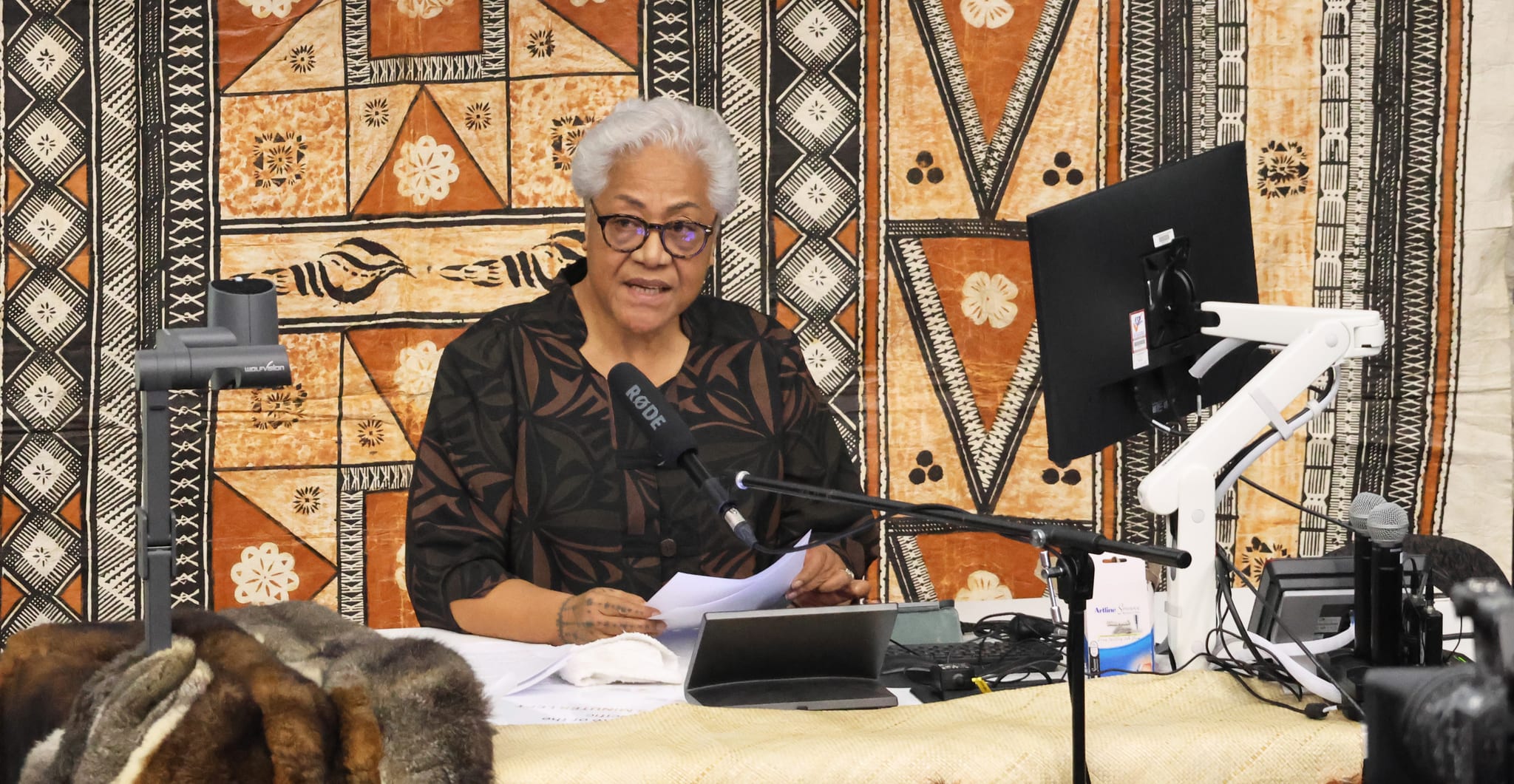
This is an edited version of the opening address of the 2026 State of the Pacific conference hosted by the Department of Pacific Affairs (DPA) at The Australian National University from 14-16 April 2026.
It is an honour to reflect with you at the State of the Pacific 2026 conference on the theme Weaving Pacific Research Relationships. I centre my reflections on people, belonging and Pacific futures.
I want to begin not with theory or policy language, but with lived experience. When I first became Prime Minister, I was asked a question many leaders are asked: What is your vision? My answer was deliberately simple: “I want a Samoa where people want to stay — and where they have a stake.”
That statement was not a rejection of mobility. Movement and free mobility have always been part of Pacific life. Our ancestors were navigators, settlers, adapters and innovators, crossing vast oceans in search of sustenance, safety and opportunity long before modern borders or migration policies. Before I entered politics, I was myself a product of this movement — a young Samoan who moved to Aotearoa New Zealand for education. Like many Pacific families, mine believed mobility was necessary to widen opportunity, never to abandon home but to strengthen it.
What I meant, then and now, is that staying should remain a viable, dignified and meaningful choice. The true measure of nationhood is not whether people can leave, but whether they can imagine a future at home without feeling left behind.
In the early years of independence, there was clarity of purpose. Our foremothers, forefathers and elders took responsibility for shaping their destiny, asserting sovereignty not only as a legal status but as a moral commitment to our people. Institutions were built to reflect culture, spirituality and collective responsibility — what we understand as faasinomaga, belonging.
But the context in which our nations operate has changed profoundly. Globalisation has compressed distance and time, geopolitics has intensified competition for influence, and digital connectivity has reshaped aspiration. Trust is increasingly fragile, and public expectations are higher while tolerance for long-term planning is lower.
Viability is too often discussed as a technical issue, measured in economic indicators and fiscal ratios. But viability is personal. It is shaped inside families and households, not in ministries. When people leave, it is not for lack of attachment. More often, it is because in order to build their homes, provide for their families and protect their heartlands, they must migrate to search for paid work in the cities, or overseas in the agriculture fields of Australia and New Zealand.
People move because they are rational and relational, pursuing dignity, security and opportunity. Migration is not a failure of nationhood; it is a signal, revealing where systems are unequal and where structural gaps remain — and compelling us to ask whether our development models have inadvertently hollowed out the very communities that sustain us.
The challenge is not to reverse history or romanticise the past. It is to rethink development itself. How do we build economies that generate meaningful livelihoods locally? How do we strengthen rural and outer-island communities so staying is a choice rather than a compromise? How do we adapt institutions so they serve people, rather than requiring people to continually adapt to systems that no longer fit their realities?
Nation-building is ongoing — a negotiation between growth and belonging, mobility and rootedness, global opportunity and local responsibility.
From this worldview emerged the Blue Pacific narrative, which re-centres the Pacific as a region defined by shared stewardship of one of the world’s largest ocean spaces. As Pacific scholar and ANU alumnus Epeli Hau’ofa reminded us, our ocean connects us rather than divides us.
But I also want to be honest: Pacific states are small. Our populations, economies and institutions are limited, carrying immense responsibility with constrained capacity. Smallness is not our weakness; denying it is. Designing for smallness enables smarter governance and stronger regional cooperation.
Geopolitical competition narrows policy space. Climate change challenges the physical foundations of sovereignty — security, livelihoods, wellbeing and identity. Economic systems continue to prioritise extraction, scale and mobility, while undervaluing care, community and stewardship. The response cannot be isolation. It must be agency exercised collectively and intelligently — through regional solidarity, strategic partnerships and values-based engagement.
In this complex landscape, universities occupy a pivotal position, shaping ideas, leadership and policy imagination, and determining whose knowledge is valued.
First, research must align more closely with Pacific priorities. Research agendas should be co-designed with Pacific communities, institutions and scholars, grounded in ethical partnership rather than extraction. Second, curriculum matters deeply. Education systems must prepare students for global engagement while grounding them in Pacific histories, languages, values and Indigenous knowledge systems. Third, institutional partnerships must be re-imagined — long-term, reciprocal and capacity-building, with joint degrees, co-supervised research and sustained investment in Pacific academic leadership mattering far more than short-term projects.
Decolonisation is not a historical exercise; it is a living process that requires shifting power in knowledge production. Indigenous epistemologies must be recognised as theory and method, not as cultural supplements. Pacific peoples must define research priorities, control narratives and benefit directly from academic work.
The future of the Pacific will not be secured by borders, balance sheets or policy frameworks alone, but by whether our people can imagine a meaningful life at home, connected to place, culture and community. Mobility will continue, as it always has in our oceanic history, but staying must remain a dignified and viable choice, not a sacrifice. Our task — as leaders, scholars or institutions — is to ensure our knowledge, partnerships and policies serve Pacific agency on Pacific terms, so that our people move through the world with confidence, always knowing they belong and always having a reason to return.
One of my favourite Samoan proverbs — which has guided my leadership in the village, in government and in international settings — is O le mativa fa’afesaga’i. It reminds us that in times of challenge, hardship or adversity, we do not turn our backs on one another; we face each other, fully present. When I say that I want a Samoa where people want to stay — and where they have a stake — I mean a Samoa where people feel there is something precious worth holding on to: their land, their language, their culture, their families and their future. A stake is more than economics; it is belonging — the quiet but powerful commitment to protect what we love and to stand for one another, because our future is not built by those who turn away, but by those who face each other and stay.
Read the full version of this speech in this ANU Department of Pacific Affairs Discussion Paper.




Thank you Fiame and Devpolicy blog for this beautiful piece about Pacific belonging, highlighting connection to country that indigenous people feel, and the need for development to occur in people’s homes in the Pacific.
I am a descendant of colonial people with only one generation in the country I consider home, so my connection cannot be as strong as those of indigenous peoples who live where hundreds or thousands of generations of ancestors lived. I feel uncomfortable that Pacific people must travel to someone else’s country to build their country’s economy. I think of the PALM scheme which appears successful economically but betrays people’s connections to their land and sea. This highlights, as this blog does, the need to build a truly local economy rather than depending on work in and for another nation.