Australian aid
At its triennial national conference, the Australian Labor Party adopted its latest policy platform which says that the party will “increas[e] aid every year that we are in office” and “work on sustainable pathways towards allocating 1% of the federal budget for overseas development assistance expenditure … “. While aid will increase in nominal terms, Australia’s aid spending will decline both in real terms and as a share of the federal budget over the forward estimates. It is projected to fall from its historic low of 0.17% in 2026-27 to 0.14% of Gross National Income (GNI) over the next decade. Notwithstanding global aid cuts, Labor’s previous commitment to reaching spending worth 0.5% of GNI has been delegated to “the international community”. The platform is not binding on Labor governments.
As part of the new Vuvale Union treaty, Australia has pledged over $1 billion over ten years in “new investment” to Fiji comprising $660 million in grants and $350 million in loans for various security, economic and people-to-people initiatives. Prime Minister Anthony Albanese has said that this package “isn’t additional” to measures in the May budget, meaning that funding for the aid-related components will come from other parts of the development assistance program where not already allocated to Fiji.
Albanese has said that any additional funding associated with the recently signed Nakamal Agreement with Vanuatu will be included in the mid-year budget update. An earlier version of the agreement, from which Vanuatu subsequently withdrew, was linked to $500 million in Australian security, development and climate funding over a decade. It is not clear how much of this spending would have been genuinely additional. The parliament’s treaties committee has opened an inquiry into the agreement.
Australia has committed $25 million in funding for UN and World Bank-led multi-donor efforts to support recovery and improved public financial management in the Occupied Palestinian Territories. The US-led Board of Peace’s plans for Gaza continue to falter with reports that its ambitious reconstruction program has now been scaled back to a small pilot scheme which is yet to commence.
The government has pledged $2 million for humanitarian recovery efforts following the twin earthquakes in Venezuela in June. The number of confirmed deaths from the disaster has now reached over 5,000, with as many as 50,000 still missing. The UN has said that there remains a US$567 million funding gap for its current humanitarian appeal.
The government has “agreed in principle” to a parliamentary inquiry’s recommendation that it legislate a humanitarian exemption to the Autonomous Sanctions Act 2011. DFAT says that the government is still considering the issues raised by the sector in response to a 2023 options paper.
The OECD Development Assistance Committee’s latest update on tied aid (for 2024) reports that while Australia has a very high level of de jure (measured by formal rules) untying, its de facto (measured by procurement awards for untied aid) level of tying is also among the organisation’s highest.
Figure 1: Geographical origin of suppliers for untied ODA contracts, 2024
Value of contracts (USD million, current prices), Individual and aggregate contracts
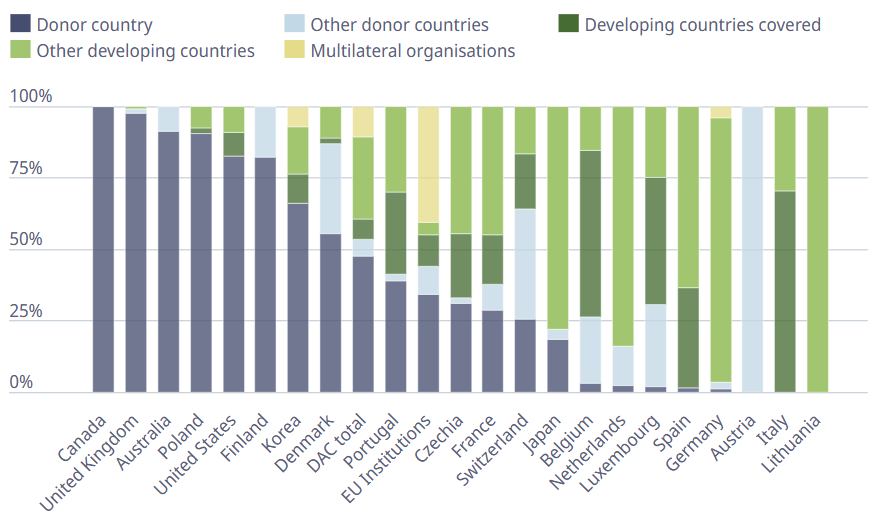
Source: OECD DAC, Untied aid in Development Co-operation, website, n.d. For the purposes of reporting, foreign owned companies registered in Australia count as donor country suppliers.
Regional and global aid
Solomon Islands’ Foreign Minister Rick Houenipwela visited China, with Beijing pledging a further US$10 million for rural development programs and US$1 million in disaster relief assistance, as well as visa exempt travel to Hong Kong. Prime Minister Matthew Wale visited the US, with Washington pledging to restart the Peace Corps program in the Solomon Islands, provide more help to address unexploded ordnance from World War Two and advance engagement through the Millennium Challenge Corporation. Both Houenipwela and Wale then visited Japan where they signed a new development policy loan agreement.
The International Monetary Fund (IMF) has confirmed that its multi-year economic reform support program in PNG will conclude at the end of the year and that the organisation will shift to regular consultations and technical assistance. Australia’s $3.1 billion in budget support lending for PNG since 2020 has been linked to the IMF program’s policy reforms.
Sri Lanka, the Philippines, Vietnam and Federated States of Micronesia have had their income classifications upgraded by the World Bank, with all four countries moving from “lower middle income” to “upper middle income” status. The income classifications are based on estimates of GNI per capita and are used to inform which countries can access concessional loans and development assistance.
More than 500 Rohingya asylum seekers are missing and presumed dead after two boats disappeared off the coast of Myanmar. This brings the number of Rohingya reported lost at sea so far this year to 800, close to the 2025 record of almost 900. The US and other Western donors have cut humanitarian assistance to both Myanmar and Bangladesh, which hosts over one million Rohingya refugees, in recent years.
The Ebola outbreak in the Democratic Republic of Congo and Uganda is spreading at a rate that is outpacing previous outbreaks of the disease and is now the third largest on record in terms of the number of infections. There have been almost 3,200 confirmed cases and over 1,400 confirmed deaths to date.
As part of its stated policy of “leveraging assistance as a tool of statecraft”, the Trump administration has laid out US$11 billion in additional cuts to mandated bilateral, multilateral and food relief programs and sought an increase in foreign assistance funds able to be used at the discretion of the president in its FY2027 budget request to Congress. The budget is unlikely to be agreed in full by Congress before the mid-term elections in November.
While it is yet to be confirmed by the State Department, a senior US Republican Senator has said that the Trump administration will transfer US$600 million in funding to Gavi, the Vaccine Alliance, which was appropriated by Congress earlier this year but blocked by health secretary Robert Kennedy Jr.
Under pressure from the Trump administration, the World Bank has not renewed its 45% climate finance target. The Bank, which channels around a fifth of the world’s climate finance, says it will retain its broader climate action plan and will shift from input-based spending targets toward a focus on outcomes.
Against the backdrop of the publication of further detail on the UK’s far-reaching aid cuts, Kirsty McNeill has been appointed by Prime Minister Andy Burnham as Britain’s new development minister. McNeill has previously served as head of advocacy at Save the Children UK. Unlike her predecessor, McNeill has not been appointed as a member of the cabinet.
Books, reports, articles, podcasts
The Lowy Institute’s latest Pacific Aid Map confirms that in 2024 Australia was not only the region’s biggest aid provider in the region, but also its biggest source of debt finance (Figure 2).
Figure 2: Sources of debt financing in the Pacific, 2008-2024
Disbursed loans, constant 2024 US$
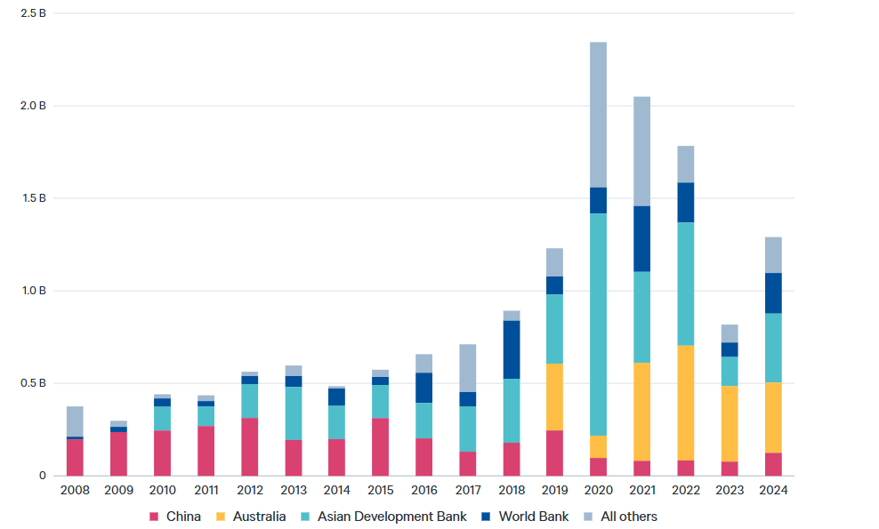
Source: Lowy Institute, 2026 Pacific Aid Map in five charts, website.
In a new working paper, researchers from ODI Global make the development and financial case for an exemption to current ODA graduation rules for Small Island Developing States.
Maria Repnikova from Georgia State University examines China’s soft power in Africa in a new book that challenges popular claims about China replacing the West in the Global South and examines “the inconsistencies and limitations of Chinese influence”.
Writing for InDevelopment, Oliver Kim revisits the flawed legacy of Robert McNamara, “the living embodiment of mid-century American technocracy”.