

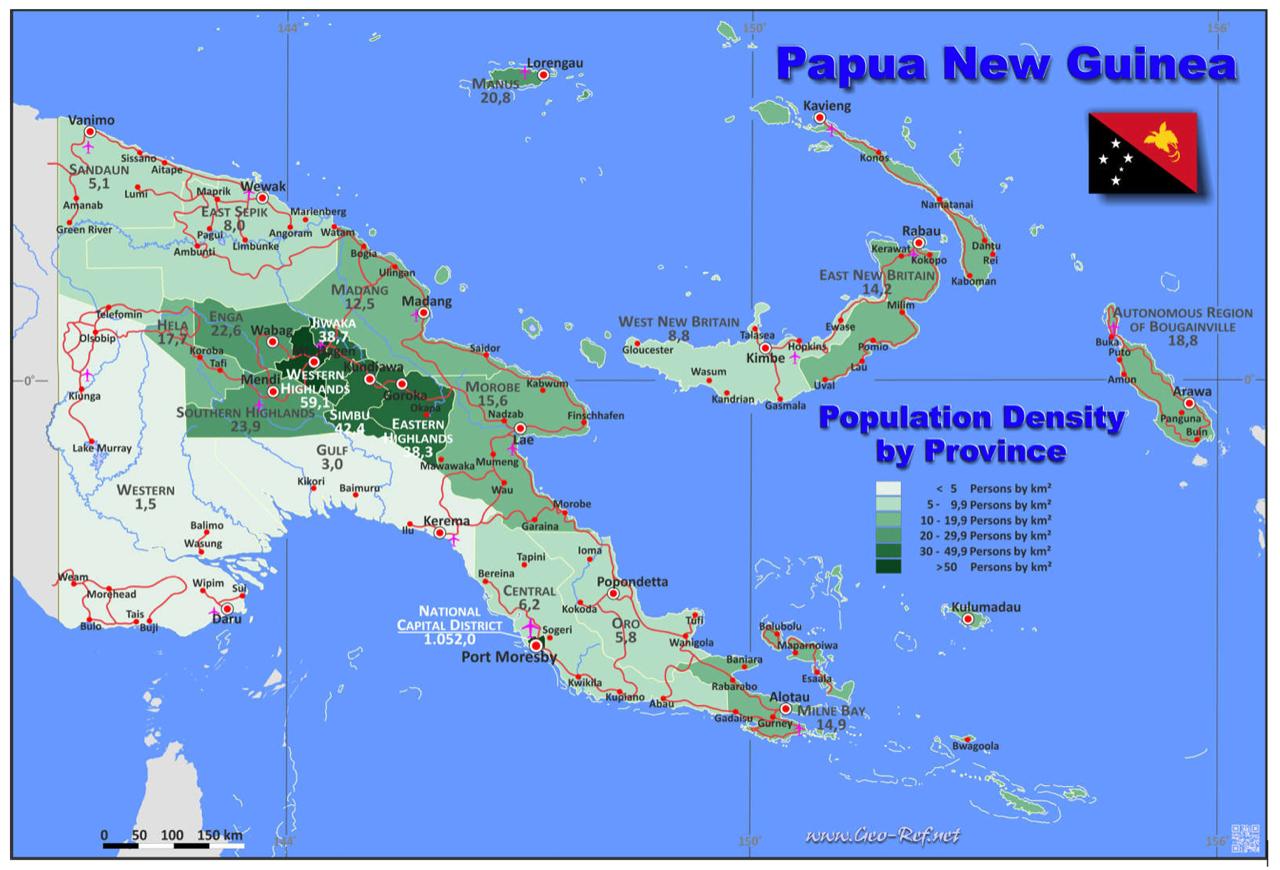
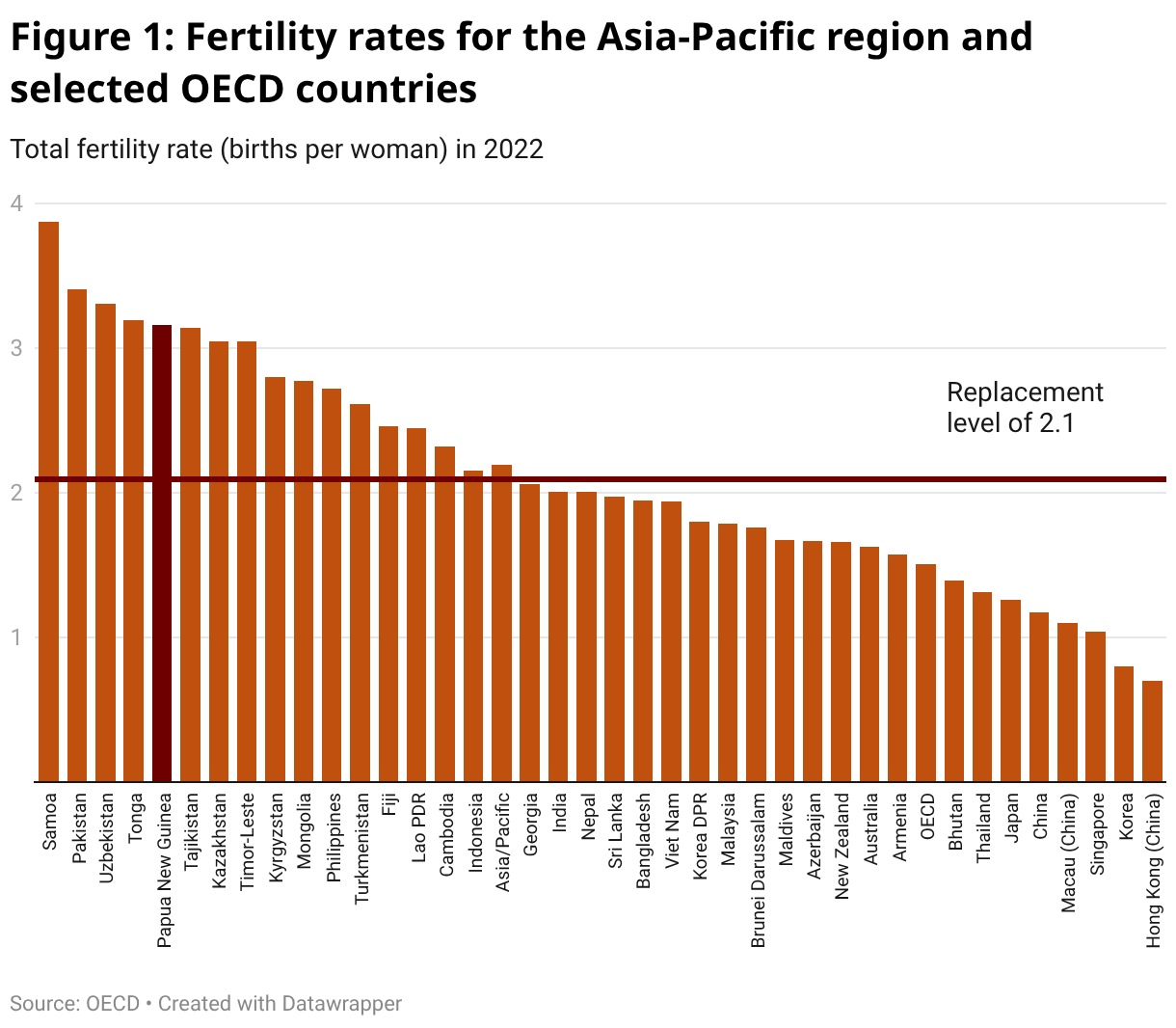
Papua New Guinea has one of the highest fertility rates in the Asia-Pacific region (Figure 1), and the highest of any Pacific Island country in its most recent Demographic and Health Survey (DHS), conducted in 2016-18. Every year, the country adds about 230,000 people to its population, the net result of births minus deaths. The population has now exceeded 10 million. But schools, hospitals, policing and the formal labour market have expanded far more slowly. The results are visible in crowded classrooms, stretched health facilities, law and order problems and a growing number of young people competing for too few formal jobs.
Population pressure, however, is only part of the case. The more immediate issue is that many women are having more children than they say they want. PNG’s total fertility rate declined from 4.4 births per woman in 2006 to 4.2 in 2016-18, while wanted fertility is about three children.
A family planning policy should begin with this gap between what women say they want and what happens. Its purpose should be to support free and informed decisions, not to impose a preferred family size. I set out this argument in my recent report for the PNG Reset@50 project, “Big Bet 3: Enable universal access to voluntary family planning services”.
The report argued that family planning in PNG has a conversion problem: knowledge is widespread, but use is not. In the 2016-18 DHS, 88% of currently married women and 92% of currently married men knew at least one contraceptive method. On average, both women and men knew about six methods. Yet only 37% of currently married women were using any contraceptive method, and only 31% were using a modern method.
Around one quarter of currently married women had an unmet need for family planning, and only 59% of total demand was satisfied. The gap was much wider among sexually active unmarried women, whose unmet need was estimated at about 65%. Meanwhile, 24% of births still occurred within two years of a previous birth, and teenage childbearing changed little over two decades, remaining at about 12% to 14%. These figures describe demand that the current system does not reliably serve.
Access to services is also unequal. Contraceptive use among married women was 50% in urban areas and 35% in rural areas. Women in the highest wealth quintile were about twice as likely to use contraception as women in the lowest quintile, 46% compared with 23%. The Highlands is the lowest-performing region, despite improvement over time.
Services also depend heavily on the public health system. About 89% of modern contraceptive users obtained their method from a public-sector source in 2016-18. If government facilities lack supplies, trained staff, privacy or reliable outreach, access fails right across the country.
The quality of services matters as much as their availability. The DHS shows that only 37% of women using contraception said they had been told about possible side effects, what to do if side effects occurred, and alternative methods. Among women not using contraception, 85% had not discussed family planning with a field worker or anyone at a health facility. Women need someone they can trust with confidential information.
Closing the gap would also bring economic benefits. The report’s scenario starts from an annual birth cohort of 230,000. That figure is PNG’s net annual population increase, births minus deaths, so treating it as a count of births obviously understates the true number: United Nations estimates put annual births at about 255,000, and the crude birth rate recorded in the DHS implies a figure closer to 290,000 at a population of 10 million. The scenario is therefore a very conservative one.
Of those births, the DHS indicates that at least 28% are unplanned, counting both births unwanted at the time and births wanted later. That definition is narrower than the one in related work putting the unplanned share at about one in three. On the report’s assumptions, a gradual reduction in the unplanned share to 10% would avert about 41,400 unintended births in a single year’s cohort. Using the report’s own estimate of K127,000 in household and public costs from birth to adulthood (see page 17), that amounts to about K5.26 billion in avoided future costs for that group of children. Recalculated on the United Nations birth estimate of 255,000, the same reduction would avert about 45,900 births and about K5.83 billion in costs. The per-child cost figure is an assumption made for the scenario rather than a published statistic, and the result is sensitive to it. This is a modelling scenario, not an immediate cash saving and not a valuation of a child. It shows the long-run resources that families and public systems must provide when intentions and outcomes diverge.
The policy environment is favourable. PNG has endorsed family planning through its population and sexual and reproductive health policies. But those policies have not been rolled out effectively. The third National Population Policy 2015-24 has expired. The focus should now be on developing a fourth National Population Policy and establishing a National Voluntary Family Planning Program as a funded delivery reform.
In sum, women and couples know about contraception but often cannot obtain a method they trust when they need it. Actual fertility remains higher than preferred fertility. Big Bet Three can close that gap through a funded national program that guarantees voluntary, free and informed access. That would improve maternal and child health, strengthen household investment in children and ease future pressure on public services.
Read the author’s full report and other ANU-UPNG contributions on the RESET@50 website.

T/his is a great piece to read.
There are few points that, I consider worth discussing. The first is family planning data/evidence verses policy development and execution. The way PNG public policy is design, resourced and implemented, one can confidently conclude that a PNG family planning policy will not achieve any constructive outcome – many reasons, low literacy is one obvious reason, for example.
The next reason why any opportunity for family planning will not work well in PNG is the large rural population based than urban nuclear family style. In your data analysis, you mentioned areas like percentage of married women -88% and married men 92% with knowledge of a birth control method. While the rate of women and men using a birth control method was 37% and 31% respectively. Then you have data on the use of birth control method -rural 35% and urban 50% women and the availability of accessible services in the two places is unequal. With what you mentioned and other compounding reasons between rural and urban setting, the level of accessibility by beneficiaries and the level of availability by the providers is seriously unequal, therefore the issue remains.
The PNG government system and the NGOs and development partners approach of one size fits all policy and program development and implementation will not make a huge impact. Example, married couples having more children has a different reason than young sexually active adolescences having unplanned pregnancies or rural family planning is different to urban family planning. However, the partners taking the same approach thinking it will work for everyone, or circumstance is an unrealistic dream. Definitely successful development policies and strategies in other places did not work that way.
In order to see tangible impact in family planning and greater improvement in the demographic data of a family, society and a nation is not to focus on family planning but address the factors that contribute to low birth control, unplanned pregnancy, early marriage, low literacy level, greater income opportunity, further education opportunity, the list goes on.
In PNG, we have family planning policies, government allocated resources, donors and NGOs running errands to support the agendas, yet you have the data and evidence that speaks otherwise. Family planning in PNG is a (resources) conversion problem, or one size fits all approach problem.
Dear Domyal,
Thank you for reading the blog and raising these points. Your observations are consistent with the full report, although the blog could only summarise its recommendations. Heres my five response.
First, about the policy implementation and literacy, I agree that policy commitments alone cannot deliver results. Pages (pp.) 10–11 of the report discuss earlier implementation failures.” And page (p.) 19 proposes an operational reform with clear responsibilities, protected financing, trained providers and reliable supplies. The literacy concern is captured in p.15 which identifies weak counselling, while p.20 recommends provider certification covering informed choice, confidentiality and follow-up.
Second, about the rural disadvantage and the gap between knowledge and use, the report explicitly recognises these inequalities. P. 13 records contraceptive use of 50% in urban areas and 35% in rural areas. pp 20–22 propose transport funding, mobile clinics, district outreach and stronger supply arrangements. One small clarification is that 37% and 31% both refer to married women using any contraceptive method and a modern method, respectively. They are not separate female and male use rates. Knowing that a method exists also does not establish informed understanding or access. As such, the report examines unmet need and reproductive preferences alongside awareness.
Third, about the one-size-fits-all delivery, the report total agrees. p. 24 states that “In PNG, unmet needs and modern contraception vary across wealth groups, regions and socio-economic demographic characteristics, meaning that a uniform delivery model will fail.” It then concludes that “The program should therefore be national in commitment, provincial in design and district-based in implementation.” Recommendation 10 on p. 27 specifies different approaches for low-access provinces, growing urban settlements and remote communities. Similarly, p.23 address adolescents’ privacy, stigma and confidentiality concerns. In short, different circumstances require different services. Its captured in the report.
Fourth, about the broader social and economic conditions, I agree that education, literacy, income opportunities and early marriage deserve attention. p. 23 recognise these connections. Recommendation 8 on p. 27 proposes population and family life education through collaboration with the Department of Education. However, this chapter does not provide a comprehensive literacy, employment or early-marriage prevention strategy. Those wider reforms should accompany improvements in voluntary reproductive health services.
Fifth and finally, about the existing resources, NGOs and whether the problem is conversion or uniform delivery, these problems are closely connected. Poorly adapted services can prevent funding and knowledge from becoming effective access. pp 24–27 specify delivery responsibilities, predictable financing, partner agreements and public reporting on stock-outs, outreach, counselling quality and regional equity. These arrangements must be judged by results.
The focus of PNG should be to having healthy children and not just on having less children. I dislike the narrative that PNG women should have less children just for the sake of meeting modern norms because PNG will go down the road of the Western nations which are now an aging society. Europe cannot function without its migrants. This did not work for them .Once the fertility rate drops below the replacement level of 2.1, it will be dangerous because there is no modern OECD nation today with a low birthrate that has been able to recover; except to bring in migrants to prop up their countries. For example, Europe as we know it may not exist in 50 years time because it is an aging continent. Look at modern Italy, failing because they do not have babies. Look at Japan.They need migration to prop up their economies. And with the influx of African and Asian migrants (who have higher fertility), this will change Europe.
Hi Japheth, thanks for your comments. I can’t find time to respond in details like I did for Domyal. Download the report in the link below and more information about your concerns are in the report. Thankyou again for your comments.
https://static1.squarespace.com/static/69818a68ee1c43266e17f151/t/6aa8927678399d296260511f/1789432438462/7.+Annex+G+-+Family+Planning%2C+Power%2C+Internet.pdf