Australian aid
As part of a strengthened Vuvale Partnership Australia will allocate, from within the existing aid budget, another $40 million over four years in bilateral aid to Fiji. As at the March federal budget, Australia’s total aid to Fiji in 2025-26 was estimated at $123 million.
The Trump administration has refunded $1.5 million to DFAT as a result of its termination of a co-funded urban water and sanitation program in Indonesia. Details of another co-funded program potentially affected by the US aid cuts have been redacted in Freedom of Information disclosure documents.
The Australian government has joined over two dozen other countries to denounce Israel’s new aid distribution system in Gaza, condemning “the drip feeding of aid and the inhumane killing of civilians, including children, seeking to meet their most basic needs of water and food”. Subsequently, Prime Minister Anthony Albanese has said that Israel has breached international law: “quite clearly it is a breach of international law to stop food being delivered, which was a decision that Israel made in March … ”. Despite multiple and credible reports of mass malnutrition, as well as scores of starvation deaths, Israel has refuted “false claims of deliberate starvation” but has paused some military operations and permitted air drops to allow for “minimal humanitarian supplies” to enter Gaza.
Australia has joined 20 other donors in endorsing the UN’s “humanitarian reset”, which offers specific reforms and, in exchange, encourages donors to “prioritise flexible, multi-year donor funding to enable a needs-based response that reflect people’s priorities” and “channel substantially more funding through the full range of humanitarian pooled funds … ”.
Australia’s new international development minister, Dr Anne Aly, attended the UN’s Fourth International Conference on Financing for Development in Spain. Minister Aly called for “multidimensional vulnerability” indicators to guide the allocation of global development and climate finance and for the reform of “outdated systems, like ODA eligibility, that disadvantage Small Island Developing States”. Despite the minister declaring that the conference was a time “not just to reflect — but to act”, Australia is not listed among the “lead implementing countries/entities” for any of the more than 130 individual initiatives contained in the summit’s “platform for action”.
Australia ranks 25th out of 40 official development finance providers in the Center for Global Development’s latest Development Finance Performance assessment. Australia performs well on the share of aid allocated to fragile countries, aid transparency, untied procurement and country ownership. It performs poorly on aid generosity, share of multilateral funding and poverty focus.
The Lowy Institute’s latest Southeast Asia Aid Map finds that development finance directed to this region increased slightly year-on-year in 2023, but was still below its pre-COVID levels. Australia provided 3% of the region’s development finance in 2023. The largest shares were provided by the World Bank (21%), the Asian Development Bank (20%), China (17%) and Japan (14%). The authors predict that as a result of ongoing aid cuts by Western donors finance directed to the region could fall by about US$2 billion by 2026. The Lowy data shows that China’s development spending in Southeast Asia, while rising by 12% year-on-year, fell by $US4.4 billion (almost 50%) between 2015 and 2023.
DFAT has published a new data dashboard on its commercial aid suppliers, showing these suppliers’ aggregate staffing profiles, sub-contracts and funding flows in 2023-24. DFAT has also published new guidance on disability inclusion and enhancing First Nations’ perspectives in development programming.
Regional/global aid
A unanimous ruling from the International Court of Justice (ICJ) has found that high carbon emitting states have “additional obligations” to combat the “urgent and existential threat to human life and natural ecosystems” posed by climate change. The non-binding advisory opinion allows for the possibility that states disproportionately affected by climate change could seek reparations from countries that have contributed the most to global greenhouse gas emissions. Vanuatu’s climate change minister Ralph Regenvanu has stated that his government will take the ICJ ruling to the UN General Assembly to “pursue a resolution that will support implementation of this decision”.
The stand-off between New Zealand and Cook Islands over the latter’s relationship with China continues, with Cook Islands’ Prime Minister Mark Brown saying that the country needs funding for its NZ$650 million infrastructure plan and “if we can’t get help from New Zealand, we will go somewhere else”.
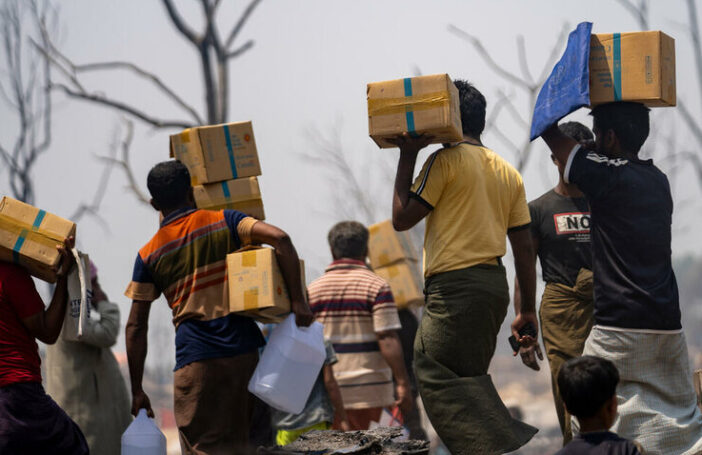
Addressing the General Assembly, former Australian foreign minister and UN special envoy for Myanmar, Julie Bishop, has said that the UN’s 2025 Myanmar humanitarian plan is less than 8% funded and that just 22% of funding committed in the wake of the March earthquake has been received. The UN’s 2025 Rohingya humanitarian plan, focused on Bangladesh, is only 20% funded.
Ahead of an expected formal replenishment event at the November G20 summit in South Africa, several non-G20 countries (Spain, Luxembourg and Norway) and philanthropies have announced pledges to the eighth funding round for the Global Fund to Fight AIDS, TB and Malaria. The Global Fund is seeking US$18 billion for this replenishment round. The size of any future contribution from the US, traditionally the Fund’s largest donor, remains uncertain given the administration’s ongoing aid cuts and continued speculation over whether it will boycott this year’s G20 summit. The World Health Organization predicts that, globally, health aid could fall by as much as 40% in 2025 compared to 2023.
The US Congress has passed a budget bill which terminates almost US$8 billion in previously legislated foreign aid funding. Around US$400 million in proposed cuts to international HIV/AIDS programs were rejected, although much of the funding for non-government partners that help deliver these programs has been terminated. US officials have reportedly drafted plans to transition these programs away from HIV/AIDS prevention and treatment in low-income countries in favour of a focus “on the detection of outbreaks that could threaten the US and the creation of new markets for American drugs and technologies.”
USAID was formally shuttered on 30 June with its remaining administrative and program functions merged into what will be a dramatically downsized State Department.
The head of Russia’s international assistance agency, Rossotrudnichestvo, has said he wants the agency to fill the gaps created by the dismantling of USAID, saying, “This is not charity – this is beneficial for the country.” Currently, the agency manages a US$77 million annual budget. It is seeking to increase this to US$1.5 billion, the equivalent of Finland’s aid spending in 2024. Reportedly, 75% of the agency’s expenditure is on administrative costs and its programs are focused on advancing Russia’s influence in its “near abroad”.
In the face of ongoing and dramatic reductions in aid budgets by many of its members, the OECD’s Development Assistance Committee (DAC) has announced: “a review the implications of the changing landscape of development finance, … including for the role of Official Development Assistance (ODA) and of the DAC itself.” There is no known timeline for the review.
Books, reports, articles, podcasts etc.
A new study published in The Lancet article forecasts that cuts to US global health assistance could result in more than 14 million avoidable deaths, including 4.5 million deaths in children under five, by 2030.
This American Life explores the consequences of the chaotic demolition of USAID and most of its programs, speaking to beneficiaries, partners and experts. John Norris, who has written a history of the agency, tells the podcast that “there’s a consistent theme to the places where [US]AID had its biggest failures, and it’s in those places where it was used as a blunt instrument of US foreign and security policy”.
The proceedings from the 2025 Annual (World) Bank Conference on Development Economics, “Development in the Age of Populism”, held in Washington DC from 22 to 25 July can be viewed online. Among others, they include panels on the future of multilateralism, AI, geopolitics, migration, and climate change and development.