I come from Manus, Papua New Guinea’s smallest province, consisting of a large main island and a group of smaller islands in the country’s north. Home to just under 70,000 people in 2024, Manus is smaller than 78 districts and several Local Level Governments (LLGs) in other parts of PNG.
Manus is most famous for hosting one of Australia’s Regional Processing Centres (RPC) that ran from 2012 to 2017. The RPC operated as part of Australia’s offshore processing policy aimed at managing asylum-seeker arrivals by boat. The RPC housed 600 male refugees and asylum seekers at the time it closed. Over time, the RPC became mired in reports of mistreatment of refugees and several deaths. The RPC was ultimately found to be illegal for depriving the personal liberties of refugees and was ordered by PNG’s Supreme Court to close in October 2017.
Despite its notoriety, the RPC had a profoundly positive impact on the Manus economy, for a time. Compared to PNG’s other provinces, Manus is even more highly import dependent — relying on goods shipped in from other provinces — exhibiting many of the characteristics of small island economies in the Pacific. Local production mainly comprises subsistence agriculture and fishing. The province also has small commercial industries in logging, fisheries and tourism. These industries provide some jobs; however, much of Manus’s formal employment is provided by government and concentrated in teaching and health work. Many Manus residents also depend on remittances from relatives working throughout Papua New Guinea and further afield, and development is largely driven by public expenditure from the provincial and district government.
During the years when the RPC operated on Manus, the total cost of regional processing in PNG was A$2.96 billion (K6.7 billion). A report prepared by Adam Smith International in 2014, analysing the impact on the Manus economy of the early years of the RPC, found that the Australian investments contributed amounts to provincial income totalling K25 million (A$11.6 million) in 2013 and K48 million (A$26.4 million) in 2014. The RPC provided 780 jobs linked to its operations (750 were filled by locals), and 323 temporary jobs in the construction of RPC infrastructure (240 were filled by locals). For the residents of Manus, the RPC represented an increase in formal employment of 70%.
Local businesses also reported experiencing a surge in sales of between 60% and 200%. Both the number of fuel suppliers and car hire companies quintupled, and the two hotels in Manus reported a sharp increase in occupation rates and restaurant and bar sales. This reflected the increase in commercial ship arrivals from 30 in 2012 to 86 in 2014, and the increase in commercial flights from four to ten per week. In addition, an Australian aid project on Manus titled “Building resilience of communities in Manus” in 2015 had a total expenditure of US$375,686 (K1.04 million).
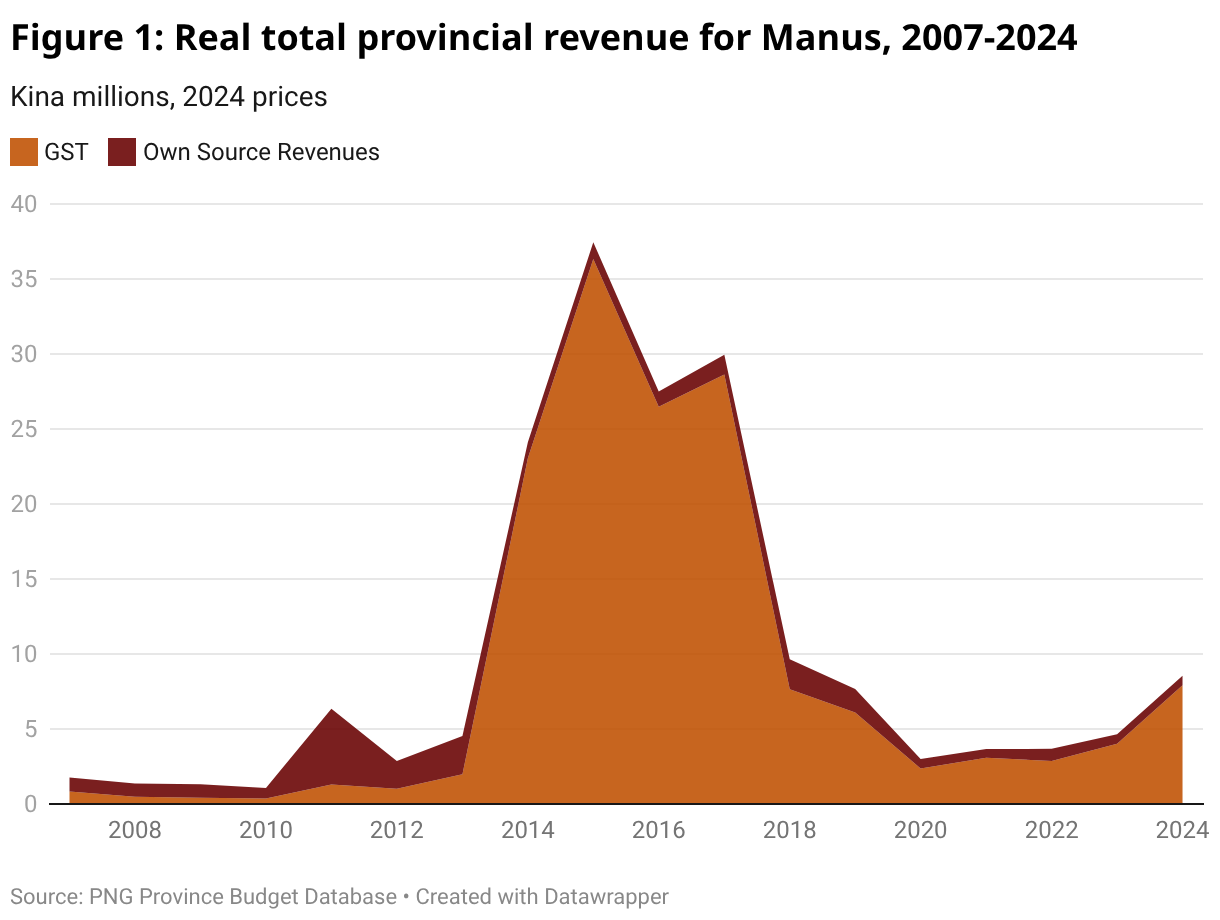
Nowhere is the massive and temporary impact of the RPC more clearly seen than in Manus’s provincial revenue. The Manus government draws revenue from two sources: goods and services tax (GST collected by the national government, of which Manus receives 60%) and “own source revenues” which the province itself collects, comprising various fees and charges such as liquor licenses, motor vehicle registration fees and others. Of the two, GST reflects the RPC impact best given it is a broad-based tax and a good proxy for economic activity. As the chart below shows, the RPC impact began in earnest in 2014. Real (adjusted for inflation) GST tax collections peaked in 2015 at 17.4 times higher than the pre-RPC level and remained high before plummeting in 2018.
The closure of the RPC saw the end of the economic boom in Manus. While it is unclear how the Manus administration utilised the revenue boost it received, it is unlikely this windfall was saved or invested. The unsustainability of the RPC boom was also more pronounced because of Manus’s high rate of import dependency. More than 90% of the goods and services that local Manus businesses provided were shipped in from elsewhere, meaning only a small share of the income boost went to local procurement which would have otherwise resulted in higher local production.
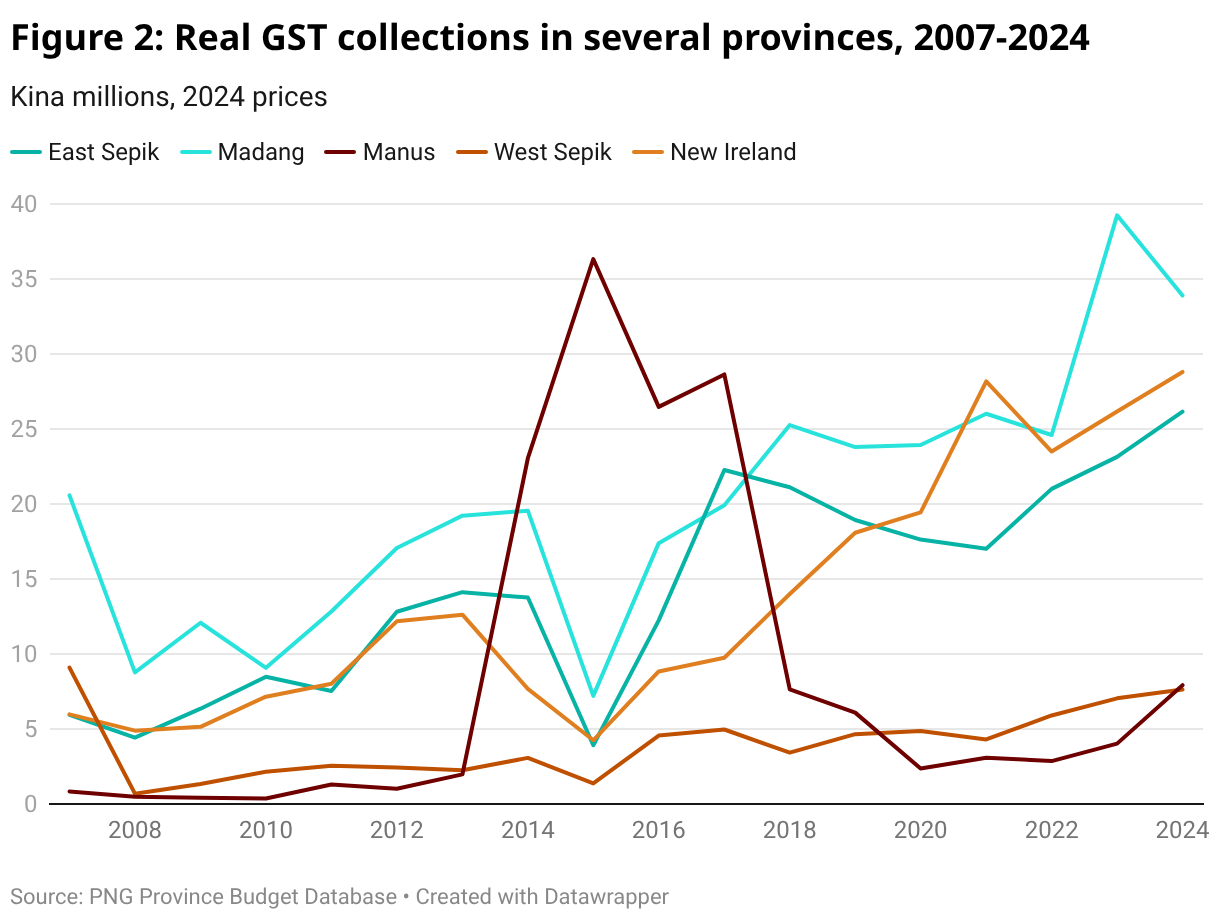
The RPC also enabled Manus to escape the drought and global commodity price slump of 2015. These events caused real non-resource gross domestic product to contract by 5.1% and GST collections to fall in many provinces. All the provinces that share a sea border with Manus experienced a dip in GST in 2015. During the period in which the RPC operated, Manus’s GST collections exceeded those of its larger neighbours, and only in 2023 was Madang able to surpass Manus’ peak in 2015. Following the RPC, the Manus economy went bust until 2024, when total revenue finally recovered to exceed pre-RPC levels. Manus’s revenue has now caught up to West Sepik, a province which is more than five times larger. The 2024 increase likely reflects recent high commodity prices and investment by Australia and the US to upgrade the Lombrum naval base.
In conclusion, the Manus RPC experience shows clearly how unsustainable the economic impact of large, temporary investments can be for small, sub-national areas. As other provinces prepare to receive large levels of foreign investment, it is important these provinces secure spillovers that last beyond the life of the venture.