

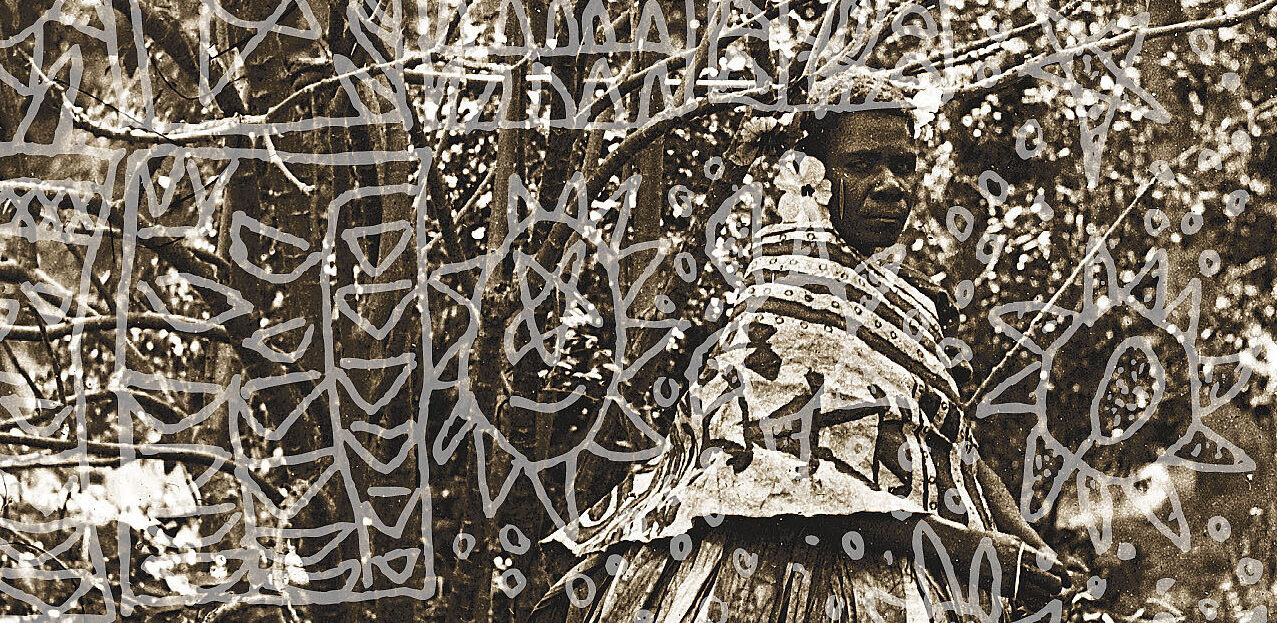
Last month I had the privilege of connecting with my Erromangan ancestral heritage, stored in a museum warehouse in Sydney. There, carefully preserved in stacks in the climate-controlled facility, lay countless items of nemah itse (traditional decorated barkcloth) and tunmit (traditional decorated outer grass-skirt), once proudly worn and produced by our women. Our teven’s (ancestors’) clothing is a reminder that for centuries we had a vibrant material culture where women were celebrated for their skills and knowledge, and held significant roles in society as ovahimnalam (women leaders).
But almost 200 years ago, women were required to discard traditional clothing in favour of attire accepted by European missionaries and colonialists. The same missionaries and colonialists imposed a nineteenth-century preference for engagement with masculinised social structures, effectively marginalising women’s traditional social status.
How did this historical transition damage women’s roles more broadly in Melanesian society? 45 years into independence, are our government, church and community systems perpetuating a neo-colonial, patriarchal attitude, rather than reconnecting with a more holistic tradition of Melanesian values?
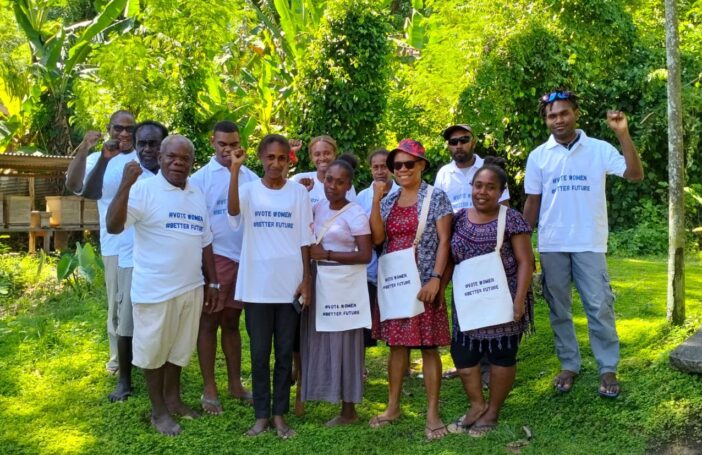
A key measure of the modern ni-Vanuatu woman’s progress is participation in political life. Vanuatu has had only seven female MPs in 45 years. Nevertheless, this is a reasonable achievement for a society that still has to do a lot of un-learning and re-learn that women have always held important social and political roles in our traditional culture. For example, the late Hilda Lini Motarilavoa was one of the first female MPs in 1987, and also a female chief in her place in Raga, northern Pentecost.
Dedicated reforms to embed temporary special measures in Vanuatu’s municipal elections since 2013 have positively transformed gendered leadership at the local government level. Many in Vanuatu hope for a first female prime minister or president one day, and this incremental progress suggests the goal is still in sight — but only if we can get past unhelpful masculinising political structures and public attitudes that consign women to so-called “traditional gender roles” rather than allowing them their place at the helm of this country.
The lack of women in Vanuatu’s political life reflects a more disturbing side of modern society. In 1995, gender advocate Merilyn Tahigogona wrote:
Violence
You omitted my nomination
You jealoused off my election
You prevented my vote
You drive my decision making
You damage my participation
The prevalence of violence indicates that ours is a society that does not respect women, constraining our advancement and leadership. Two out of three women and girls over the age of 15 in Vanuatu have experienced violence at least once in their lives from someone close to them.
While important headway has been made on gender-based violence in the past 45 years — including through implementation of the Family Protection Act and the delivery of critical services by the Vanuatu Women’s Centre in many communities around the country — there is still much work to do. Mass campaigns to break the inter-generational cycle of violence are needed. These must draw deeply from our rich cultural values where care and respect for women and children are embedded in our traditional philosophies and social codes, yet only selectively practiced.
In 2024, the Vanuatu Cultural Centre’s Filwoka network focused on the topic of traditional leadership, drawing in community researchers from across the country. The story that emerged was very different from the popular narrative about male-dominated leadership practices and women’s subservient roles. As several Filwokas said, “Kastom does not happen without women.”
Each of Vanuatu’s 100+ languages holds a rich vocabulary reflecting cultural values and gendered leadership roles, such as the ovahimnalam of Erromango, notari of Maewo or mwei/ motari / sal of Pentecost. Similarly, extensive vocabularies to describe recognisable transgressions against women and children exist in our vernaculars, with community-based punishments calibrated accordingly. On Erromango selwogi nomplat (‘to pass the grass-skirt’) is a serious transgression against women, punishable by banishment, flogging or death to the perpetrator. The traditional tabus placed on harming women and children constitute important social codes that reflect a deep traditional respect and care — but our alarming rates of violence suggest we have almost lost these values.
Such public narratives — about traditional women leaders, strict tabus and robust traditional justice and care for vulnerable populations — are more important now than ever before. Female leadership, justice for gender-based violence and the cultural values of respect, care and honour are not foreign concepts: they are embedded in our Melanesian cultures.
The promise of renewed recognition for women in leadership spaces has recently been asserted by Prime Minister Jotham Napat in his advocacy for an inclusive national nakamal (traditional meeting house). “Nakamal has a place for everyone”, he said publicly, expressing a rare non-masculinised version of our kastom and culture. Vanuatu must continue to build on this.
We have come along way as women in Vanuatu, despite having had our nemah itse and tunmit taken away, and our voices silenced and marginalised through the missionising, colonising and masculinising processes that have extended over almost 200 years. But there is still some way to go.
At 45, it is time for Vanuatu society to reclaim the rightful place of women. A place where the legacies of masculinised societies are reconciled with a returned recognition of women’s valued leadership roles. A place where kastom is not an excuse to perpetuate male domination or injustice, but is rather a reason for nurturing the values of respect, care and honouring our women. And for this to manifest in less gender violence and more spaces where ni-Vanuatu women lead.
I am hopeful.



A powerful and well written article Anna!
Thanks Anna, great to hear from your perspective how colonial structures disempowered women.
Here’s hoping Anna! Stellar thoughts and words as ever Hapi Independens dei to all
An incredible piece with hope and great trajectory Anna!
We’re hopeful too Anna. Great article!
A powerful reflection and uplifting note of optimism on Vanuatu’s 45th birthday.
What a wonderful article Anna!