Gender inequality has long been a major social concern in the Pacific, with persistent disparities in employment, political representation and leadership. Australia, by contrast, ranks among the world’s most gender-equal societies. This contrast raises an important question: do these disparities diminish or do they continue when Pacific people migrate to Australia?
As part of our Understanding Pacific Communities in Australia series, this first article explores population composition and educational attainment among Pacific migrants living in Australia. A second article will examine gender differences in labour market outcomes.
According to the 2021 Australian Census, the Pacific population in Australia has a roughly even balance of men and women, with a gender ratio similar to that of Australian-born residents and of other migrants from both Western and non-Western countries (see Figure 1).
However, the gender balance varies significantly by country. For example, there are more than twice as many male migrants as there are female migrants from Vanuatu. Migrants from Solomon Islands and Tonga also include more men than women. In contrast, there are far fewer male migrants from Papua New Guinea and Kiribati than female migrants.
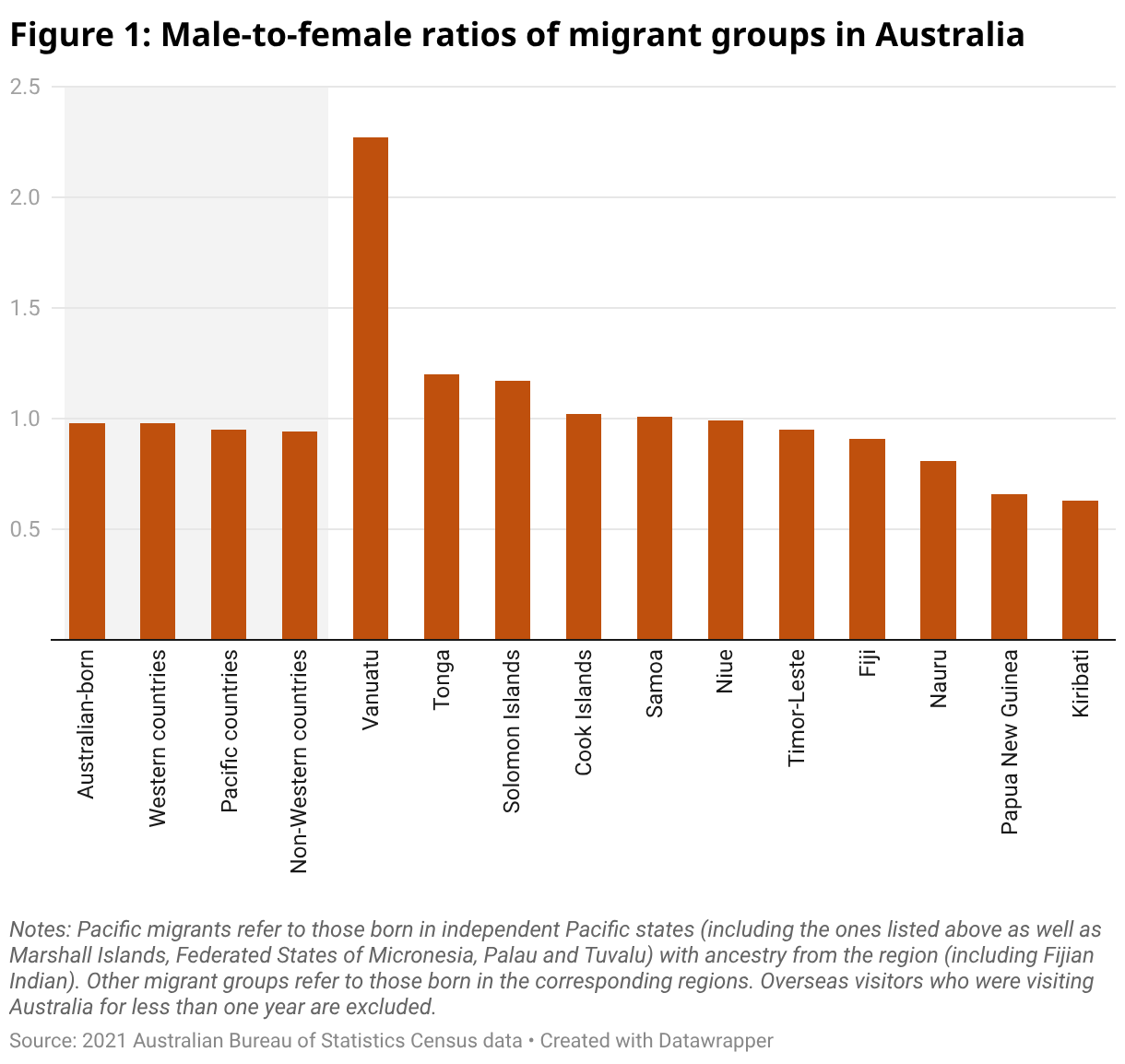
Pacific migrants are those born in independent Pacific states (including the ones listed above as well as Palau) with ancestry from the region (including Fijian Indian). Other migrant groups are those born in the corresponding regions. Overseas visitors who were visiting Australia for less than one year are excluded. See this article for more details on the definitions of each migrant group, and population sizes by country of origin.
The differences largely reflect the influence of migration pathways. The Pacific Australia Labour Mobility (PALM) scheme, an important migration route for Pacific people, has contributed to shaping gendered migration patterns – though it is not easy to quantify this contribution on the basis of available data. In countries such as Vanuatu, participation in overseas seasonal work is dominated by men, contributing to the much larger number of Ni-Vanuatu males living in Australia. Although temporary visitors staying for less than one year should be excluded from the Census counts, many workers who originally came for seasonal jobs were stranded in Australia during the COVID-19 pandemic and were therefore captured in the data. The gendered migration trends are also reflected in employment outcomes. As noted in an earlier article, 58% of employed Ni-Vanuatu in Australia work as farm, forestry and garden workers, followed by 17% as factory process workers, both of which are traditionally male-dominated occupations.
Similar patterns are seen among migrants from Solomon Islands and Tonga, where 23% and 12% of the populations work in farm, forestry and gardening jobs. By contrast, Papua New Guineans and I-Kiribati in Australia are more likely to work as carers and aides (13% and 19% respectively). This could be a result of more diversified migration pathways or greater participation in care and service sector roles under the PALM scheme, as such roles tend to be dominated by women.
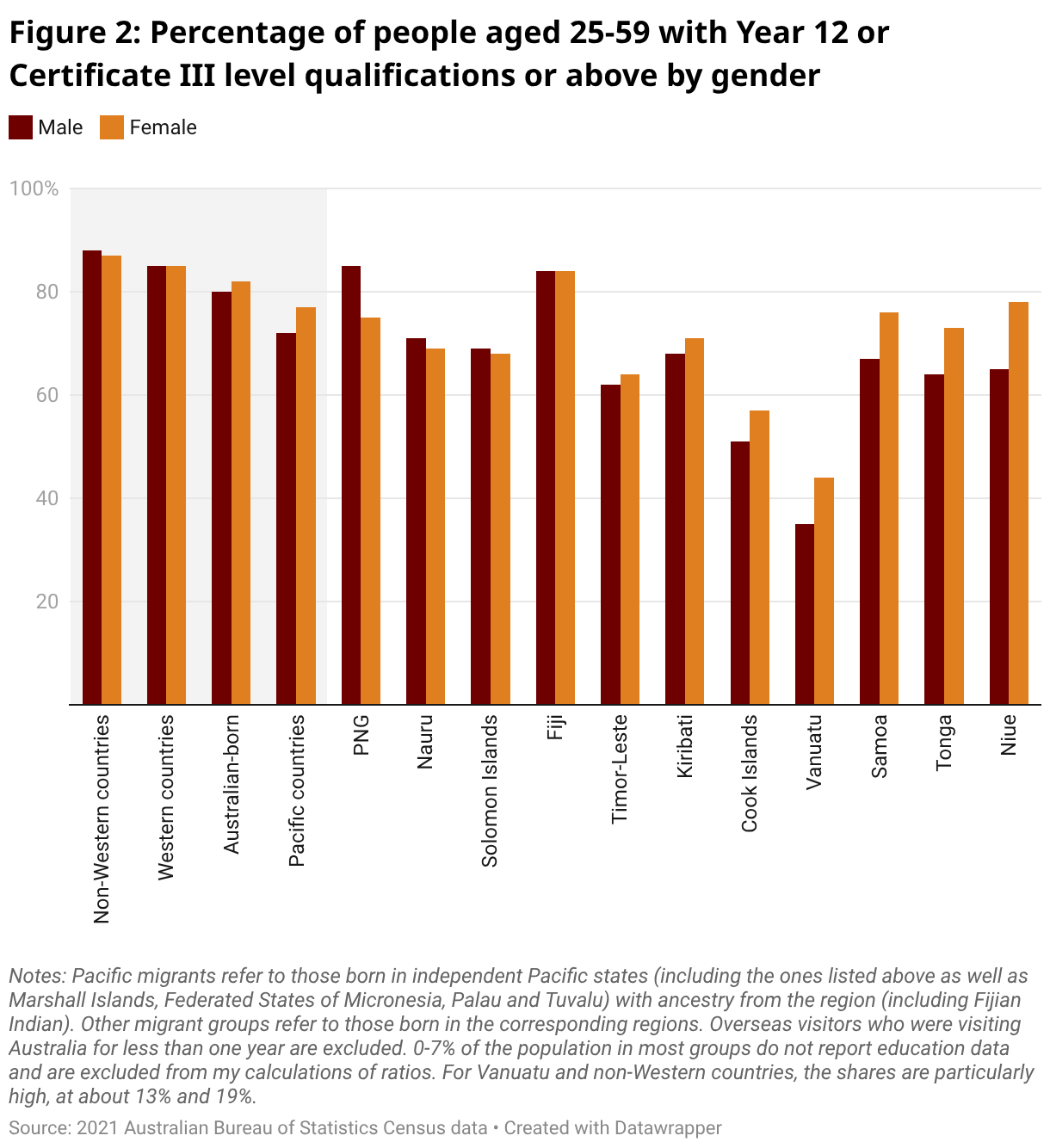
Educational attainment is another important dimension, although it has become less of a driver of gender disparities. Most Pacific countries have achieved near gender parity in access to education, and this continues among Pacific communities in Australia. As seen in Figure 2, more than 70% of both men and women aged between 25 and 59 years have completed Year 12 or hold a Certificate III qualification. Although gender differences within the Pacific migrant population are minimal, Pacific communities overall continue to lag behind both Australian-born and other migrant groups in reaching this key educational threshold. The same patterns persist for higher qualifications: only 14% of Pacific men and 19% of Pacific women have a bachelor degree or higher, substantially lower than in all other migrant groups.
Some Pacific countries have particularly low education levels. For example, in Vanuatu, nearly one-third of both men and women of working age have not completed Year 12 or Certificate III. However, in relative terms, Australia still attracts a more educated share of Vanuatu’s population, as completion rates of upper secondary education in Vanuatu are only around 10% for both genders.
Despite achieving gender parity in education in the Pacific, Pacific women still face greater barriers to employment owing to a lack of jobs suitable for women, and traditional gender norms. In my second article, I will continue to explore whether gender labour market gaps persist among Pacific diasporas in Australia following migration, focusing specifically on earnings, employment rates and household responsibilities.
Read part 2 and the Understanding Pacific communities in Australia series.