


There is a general perception, both locally and internationally, that the capital of Papua New Guinea, Port Moresby, is unsafe. We thought it would be interesting to investigate what University of PNG students think about the safety of the city in which they are living, and so included questions on safety in our second annual survey of UPNG students. Almost 400 UPNG School of Business and Public Policy first-, second- and third-year students were asked about their perceptions of security and crime in Port Moresby in a survey we conducted earlier in the year. Questions about safety within the university campus were not asked.
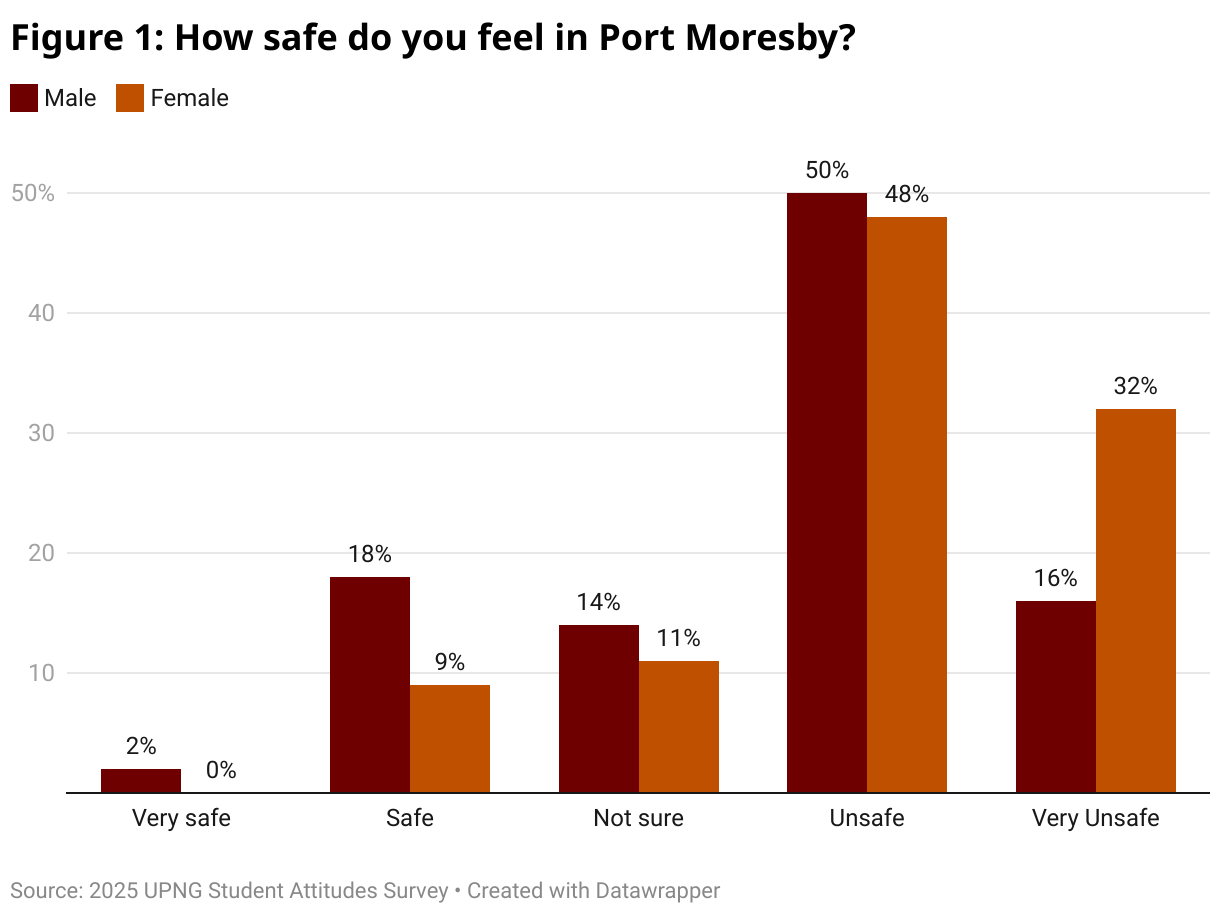
The students were asked to say whether they felt very safe, safe, unsafe or very unsafe in Port Moresby. Almost half (49%) said they felt unsafe and a further 21% said they felt very unsafe. 13% of the students were unsure and 15% said they felt safe. Only 1% of the students surveyed said they felt very safe.
Women felt less safe than men. Twice as many female students said they felt very unsafe (32% vs 16%). And half as many female students said they felt safe (9% vs 18%). No female student said they felt very safe.
The survey also asked whether students had themselves experienced insecurity. 29% of the students reported being a victim of crime during their time in Port Moresby. There was a slightly higher share of female than male students (33% vs 27%), but the difference is not statistically significant. Only about one-quarter (26%) of those who said they had been a victim of crime reported it to the police.
Students were also asked what types of crime they thought were becoming more of a problem. Almost 70% of the students responded that violent crime was getting worse. More than 70% thought a riot similar to the infamous “Black Wednesday” riot on 10 January 2024 was likely to happen in the future. 40% said it was very likely to recur, and 32% said it was likely. Only 10% said it was unlikely and 2% very unlikely.
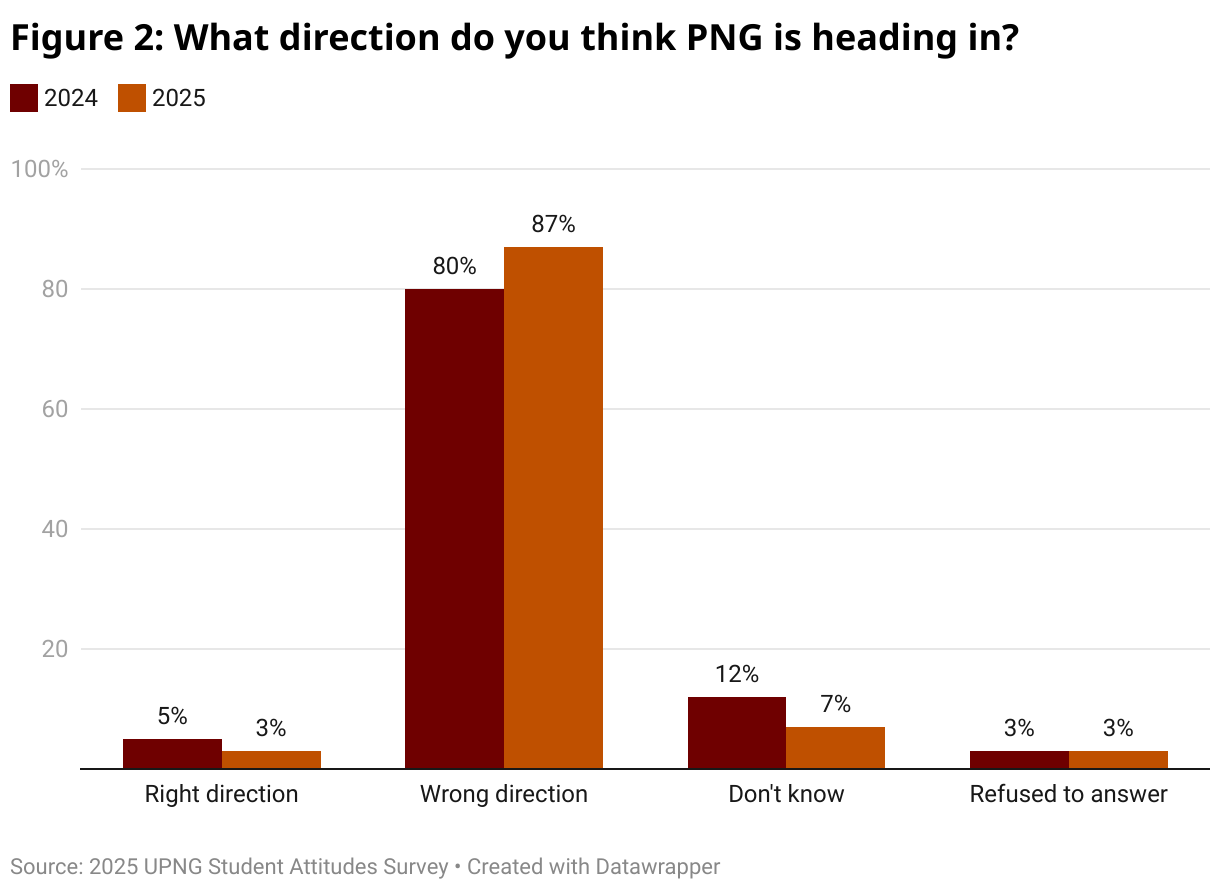
These negative sentiments about security might have fed into responses about the country’s direction. As in 2024, students were asked a standard question asked in attitude surveys around the world: do they think PNG is going in the wrong or the right direction? Last year, 80% said PNG was going in the wrong direction. This year it was 87%. Only 3% said the nation was heading in the right direction. 7% responded with “don’t know” and another 3% said they didn’t want to answer. Although the change in shares between the two years is not strongly significant statistically, it is clear that students are still very pessimistic about the direction in which their country is going.
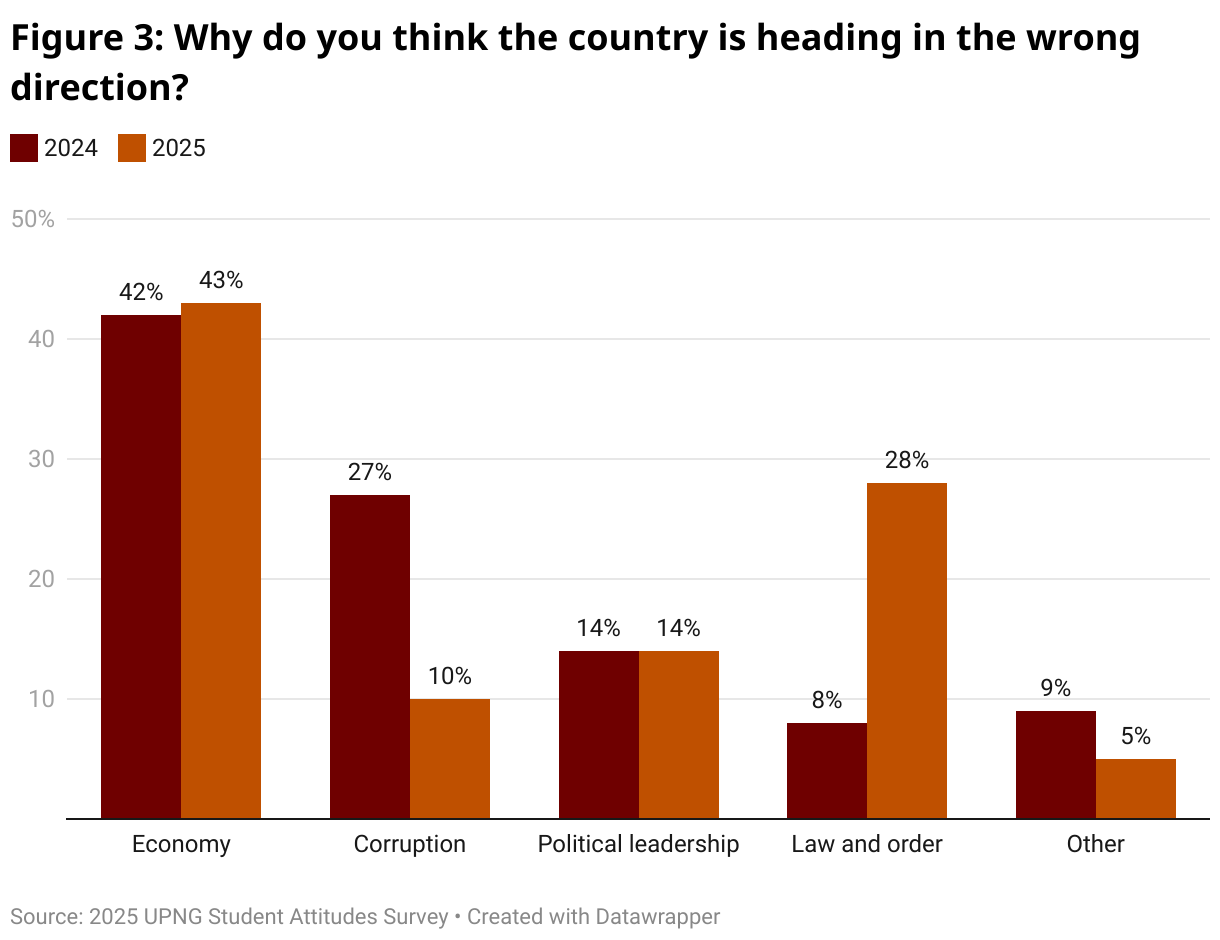
Although we asked the question about national direction before the questions about crime and security, it is clear that perceptions about the latter fed into answers about the former. Students were asked to say why they thought the country was going in the wrong (or right) direction. They could give two reasons, but here we analyse only the first reason they gave, on the assumption that this is their most important reason. (The results didn’t change much when we analysed both reasons.)
While students could give any response they wanted, most responses were easy to categorise. The most popular reason given for thinking the country was going in the wrong direction related to the economy. Students complained of both poor economic management and outcomes (43%, hardly changed from last year’s 42%). They were especially worried about inflation and unemployment. There was a big increase in the share of students who listed a lack of security or problems with law and order as the reason for their negative response: 28%, up from only 8% in 2024. 14% still gave political leadership as the problem, but the share who listed corruption and other concerns fell sharply due to our increased focus on law and order.
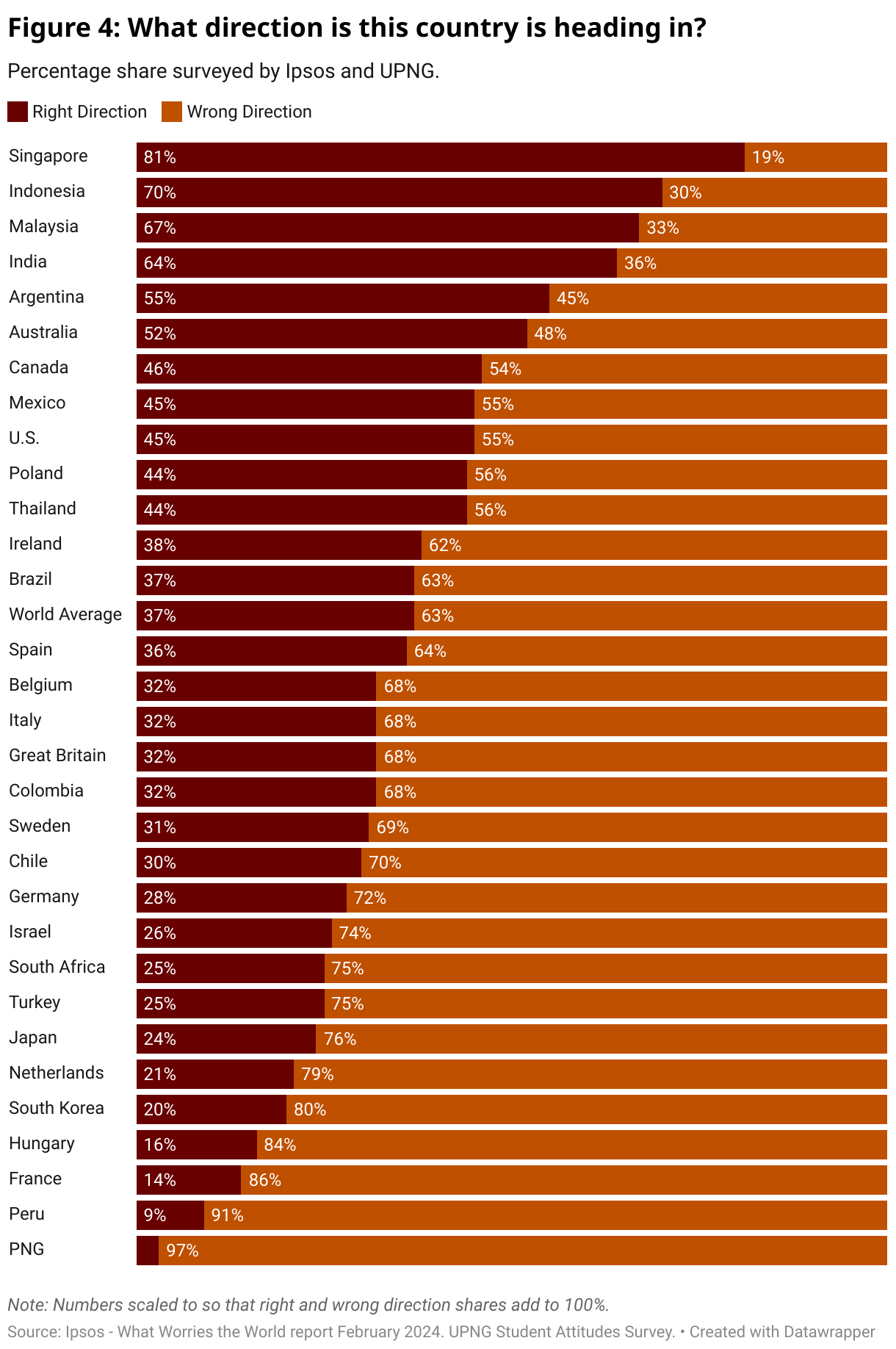
Because this question about country direction is asked in so many countries, we can compare the answers of the UPNG students to those of citizens in other countries. To do this, we take out those who didn’t want to answer or said they didn’t know. As with last year, the PNG students emerge as the most pessimistic compared to citizens of more than 30 countries in the Ipsos February 2024 What Worries the World report, with 97% pessimistic and only 3% optimistic. Perhaps students are more negative than other social groupings. Or perhaps with growing concerns around security and real worries about rising prices and the difficulty of finding a job, PNG as a nation is in a highly pessimistic mood.
This is a finding which, in the country’s fiftieth year of independence, should give us pause.
For other findings from the 2025 survey, see this article series and the 2025 PNG Update presentation. The results of the first survey, conducted in 2024, were reported here. All the differences reported are statistically significant at the 5% level using the Chi-square test except where noted.

To be honest with the outside world, my country is heading into chaos.
Thankyou for the survey completed and the analysis of the survey that brought conclusion to the safety concerns about our city Port Moresby as well giving the high percentage of the wrong direction our country is heading to. Strategic plans have to be listed and implementation has to start.We need to research, discover and learnt to adapt strategies used in best performing nations to help our country.
Researches and surveys are done so that we can identify the root causes of the consequences that we are faced with now. Next step is to identify root causes and come up with possible solutions. Invite interested responsible citizens in this step. Next a committee can be set to deliberate on and propose concerned authorities. I commend the researchers vital information. There’s more to do as responsible, educated citizens.
We are heading in the wrong direction.
Can PNG government and NCDC do something to overcome the problems faced in Port Moresby for the start?
Which group of people were interviewed in the other studies? The group in this study cannot represent the country’s view. It’s somewhat biased.
We cannot blame anyone for the current law and order issues which is contributing to the unsafe environment we live in today. We as a community need to help each other especially those is need by seeking God’s grace first. The only way forward is to embrace those that dont have by helping them in any little way. Our problem is there so much segregation within our communities that we tend to look down on our neigbours and forget that we are all from the same community. Status should not divide us but bind us as we are all equal in the eyes of our maker God Almighty.
The city isn’t safe for especially women and children during Christmas periods. It is worse when police are clearing the street vending. When street vendors see that they is no other way they can earn money, that’s the time when stealing is growing in the centre places like Gordons Market.
Concerning the safety in the National presented here is exactly what is happening on the ground. In my view I believe that the percentages presented here will also be safe if the survey is brought to the general public.
My suggestion:
A change is a change. This report should also include or finding a way for to address this issue. Addressing this might take complex process so, in the meantime the report should highlight the new normal and live up with situation. Making safety measures an individuals business like we did during the COVID-19 pandemic. New Normal actions were encouraged throughout the country to observe while saying that the COVID-19 is here to stay.
Well, Concerning the safety of this nation’s capital, this change is here to stay. Therefore, in such survey reports it’s critical to include new normals and suggested way forwards to combat the problem.
Researches and surveys forms a fundamental basis of facts about a particular agenda,topic or issue . The factual facts gives accurate imformation and reality about the existence and the disadvantages and the advantages which give highlights on how best as innovators, policy makers,scientists ,engineers etc to formulate effective stretagies against treats faced by the particular object of survey for improvements and progress of the particular..
As often researches and survey predicts out come but ignorant and failure towards problem solving causes crash..