

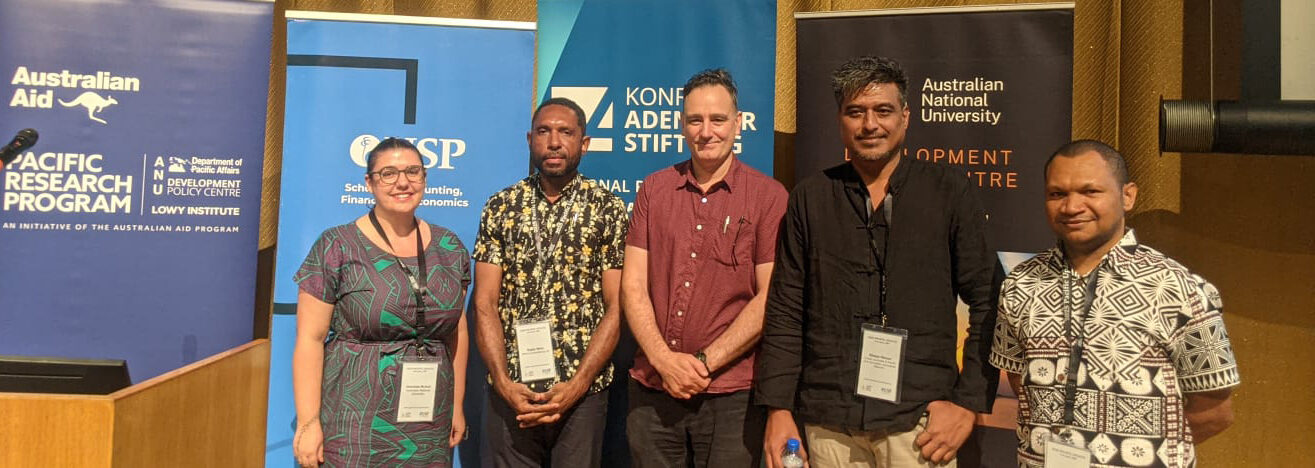
This article is co-authored by Grant Walton, Henrietta McNeill-Stowers, Teddy Winn, Lisa Denney, Michael Kabuni and Filimoni Rokonadravu.
At the 2025 Pacific Update, hosted at the University of the South Pacific in Suva, Fiji, at the start of June, three public panels on corruption, anti-corruption and integrity systems set the stage for a smaller gathering of scholars, policymakers and practitioners. On the second day of the conference, this group came together to confront the region’s corruption challenges, identify gaps in current research and sketch out a possible pathway for future scholarship. This blog captures their discussion and outlines emerging directions for anti-corruption research in the Pacific.
The tone amongst the participants was mixed. Some voiced deep pessimism, warning that corruption was becoming more entrenched and, as a “wicked problem”, resistant to simple solutions. There was a sense that longstanding approaches to reduce corruption had failed to live up to their promise of achieving more responsive and accountable governance. Others pointed to signs of hope, noting stronger leadership and regional cooperation. In particular, they highlighted the Teieniwa Vision, endorsed by the Pacific Islands Forum, as a distinctly Pacific-led call to action on corruption.
Momentum is also visible at the national level, with more Pacific countries establishing anti-corruption agencies, drafting integrity strategies and launching initiatives. Research suggests there are real opportunities to strengthen responses, particularly through:
- increasing education
- targeting anti-corruption messages
- building political will
- increasing international pressure
- strengthening accountability ecosystems
- supporting independent investigative journalism
- countering collective action problems through coalitions of motivated leaders
- improving cooperation to respond to the security risks associated with corruption
- combating money laundering
- addressing faltering prosecution rates, and
- understanding the economic benefits and corruption risks of citizenship-by-investment schemes.
The group discussed some of the priorities for anti-corruption research and noted that, while there was an increasing amount of research undertaken on corruption in the Pacific, there are still critical gaps in our understanding of how to build effective responses. Some of the ways these could be addressed included:
- examining how regulatory frameworks support action at local, national and regional scales
- analysing the risks posed by mobile money and informal transfers
- investigating corruption threats linked to infrastructure
- further scrutinising the use of constituency development funds (building on work already done in Solomon Islands and Papua New Guinea)
- understanding the frequent failure of anti-corruption institutions to prosecute perpetrators
- probing corruption risks tied to climate finance and adaptation, and
- researching the potential for civil society and churches to help fight corruption, as well as their potential to contribute to it.
Participants also called for more focus on success stories. For example, improved fisheries governance through the Parties to the Nauru Agreement demonstrates that progress is possible. More research on such “islands of integrity” could illuminate strategies that work. And identifying positive outliers where social accountability has led to improved service delivery could shed light on strategies that could be expanded and scaled.
Having said this, the group also noted the diversity of the nature of corruption and the formal and informal systems available to combat it. Every country is different and requires a tailored approach. In line with this, some suggested that more research into Pacific definitions was needed (though it was noted that some research had covered this — see here and here), and that it was “time to walk away from traditional (that is, Western) definitions of corruption”.
Participants also spoke about the significant challenges associated with researching corruption. Some spoke about the threats they have faced in writing about corruption in the region, particularly from political elites but also from some members of the public. The group discussed the different value “insiders” — those from the communities in which they are studying — and “outsiders” — those who are not — bring to the study of corruption. There was concern that foreigners could misunderstand the political, economic and cultural complexities of the contexts in which they undertake their research. At the same time, there was a view that the dangers associated with researching corruption were more acutely felt by those who lived and worked within the countries they studied. One noted that it can be difficult to gain access to elites once researchers have written about them. This underlines the importance of locally led corruption research, as well as the challenges it can bring.
It was noted that in some places, fear about corruption had brought about unwieldy rules and regulations that can slow and hamper development. Some were concerned about the auditing requirements of donors, suggesting that while these sometimes overbearing requirements might help reduce corruption, smaller grassroots organisations are less likely to have the infrastructure and personnel to address them. This can squeeze out smaller organisations and networks that are better able to represent local communities and marginalised groups.
In conclusion, while scholarship on corruption in the Pacific is growing, the discussion underscored that much remains to be done to understand both the nature of the risks posed by this “wicked problem”, and to improve responses to it.





Sorry about this. To be fair I did stop myself going on.
Corruption comes in various guises; sometimes it is blatant, sometimes it is disguised. In Nauru, for many years, it has been blatant, but its consequences have been avoided by corrupt means of a different form. Thus, we have seen many years of election corruption that, despite assertions that gift giving is customary, it is patently untrue and, in any event, falls well within the purview of the Crimes Act. But despite being known to the police, nothing is done out of fear of government reaction.
The saga of Getax bribes has been documented. Charges against Nauruans could have been laid because offences took place in Australia. A conviction in Australia named Nauruan recipients of bribes, but nothing happens in Nauru.
The Australian Federal Police take action against the Getax company but the case drags on, raising the impression that the Australian government doesn’t want it heard.
Years ago the Qaqa/Adeang government set about entrenching its place by the passage of the Assistant Ministers Act that empowered the President to appoint any number of Assistant Ministers and set the salary of Assistant Ministers at just short of $12,000 per annum above that of ordinary members. In 2019, the new ‘Aingimea’ parliament replaced the previous Act with the Deputy Ministers Act giving similar powers to the President and providing the Deputy Ministers with an allowance. The rise of David Adeang to the Presidency in 2023 led to a new enactment, the Deputy Ministers Act 2023, that reinforced the power of the President to provide lucrative and influential positions to supporters. Subsequent changes to the Constitution gave the President the power to appoint up to seven Ministers, providing the ability, by the appointment of Deputy Ministers, to have a clear majority of members of Parliament. The result has been that in 2025, there are eight ministers (including the President) and five Deputy Ministers thus, given that the Parliament consists of 19 members, one of whom is the Speaker, the depth of control of the Parliament is clear and significant. That is corruption pretending to be for the better government of the country.
Despite all that has happened, the Parliament did get around to passing a Leadership Code Act that provided for the appointment of an Ombudsman. But that was in 2016. There is still no Ombudsman. It would be in order to assert that government doesn’t want some independent person to look into the activities of its members and cronies.
How the Australian government can close its eyes to the corruption issues faced in Nauru, issues that have gone on for years, is beyond human understanding.
This is a timely article highlighting the media’s critical role in exposing corruption. However, another emerging concern is the risk of corruption of the media itself by the state or the government of the day—particularly given the media’s increasingly vulnerable financial position.
One mechanism is through lucrative public-service broadcasting grants or exclusive state advertising contracts awarded to favoured media outlets.
This trend accelerated in Fiji under the FijiFirst Government, which had exclusive advertising arrangements to the state broadcaster and to one print outlet.
The editorial impact of these arrangements was evident in our content analysis of Fiji’s 2018 election coverage. The two beneficiary outlets not only provided the incumbent FijiFirst Government with overwhelming coverage, but also overwhelmingly positive coverage.
In the lead-up to any election, media scrutinization of the government of the day is at its most intense, not the least because it’s the government that holds executive power and controls the national purse. What we found strange was that opposition parties were subjected to far more rigorous questioning than the government!
Interestingly, media outlets that did not receive government funding also tended to provide favourable coverage of the incumbent.
The only exception to this rule was the The Fiji Times. Our paper explores several possible explanations for this pattern.
To its credit, the current Fiji Government has repealed the Media Industry Development Act and, while it has continued with public-service broadcasting and print contracts, it is now treating all media organizations equitably, without exclusivity or political conditions.
However, there is no guarantee that future governments will not exploit these financial levers to gain political advantage. This trend therefore warrants close monitoring in Fiji and across the wider Pacific, even if similar practices have not yet taken root elsewhere in the region.
No government–media financial arrangement should come with strings attached as it could easily undermine editorial independence—as the lessons from Fiji’s 2018 election coverage indicate.
Here’s the link to our discussion paper:
https://openresearch-repository.anu.edu.au/server/api/core/bitstreams/d078c136-d754-4615-b696-7d49d175f097/content