This article is the second in a two-part series on Wave Two of the Pacific Labour Mobility Survey. Read part 1.
Labour mobility is often presented as a “triple win”, for workers and their families, for sending countries and for receiving countries. And it is. Yet the story is more complex. Evidence from the Pacific Labour Mobility Survey (PLMS) undertaken by the World Bank and the Development Policy Centre at the Australian National University (ANU) in 2022 revealed the gains and pains of labour mobility, highlighting not only its benefits but also the challenges faced by workers and their families back home.
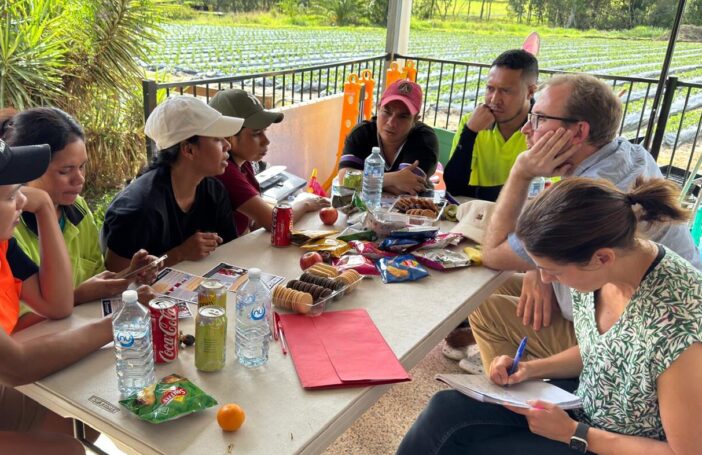
As part of the groundwork for the second wave of the PLMS, the World Bank and ANU team recently conducted consultation visits in Fiji, Vanuatu and Tonga. The team met with village chiefs and church leaders, as well as more than 200 families, returned workers and community members, to better understand how labour mobility is reshaping life in Pacific communities. In this blog, we share insights from these consultations.
In the communities we visited, the benefits of labour mobility are clearly visible. Workers on the Pacific Australia Labour Mobility (PALM) and Recognised Seasonal Employers (RSE) schemes earn several times more than they could at home. Their remittances have paid for houses, school fees, solar panels, water tanks, satellite internet connections, vehicles and household goods, as well as investments in land and small businesses such as taxi and car rental services, shops, commercial agriculture and catering ventures. A Ni-Vanuatu community member put it simply: “Earning in Vanuatu is only for meals; if we want to build a house, labour mobility is the only way.”
Yet beyond these visible successes lie some challenges. For instance, how can the income gains from migration support lasting financial security for migrant families, especially once workers have ceased participating in labour mobility programs? And how can the benefits of the schemes be harnessed to support the development of the Pacific Island countries more generally? The vulnerability of many Pacific Island countries to natural disasters makes future livelihood security even more crucial.
Community leaders we spoke with emphasised the need for financial literacy training so that migrant workers and their families can make better decisions about the use of money earned and ensure they have a plan for life after migration. Yet evidence on what works remains limited, highlighting the need to evaluate and refine these approaches to ensure they are effective.
Even so, we heard encouraging examples on the ground. In Vanua Levu, Fiji, leaders from three villages have developed their own two-month, pre-departure training program that combines teamwork, goal-setting and spiritual preparation for both workers and their families. Such initiatives highlight the value of comprehensive pre-departure preparation in ensuring positive migration outcomes and supporting workers’ smooth return and reintegration into their communities and local economies. Encouraging retirement saving, for example in national provident funds, can also help make the benefits of the scheme more sustainable in an uncertain environment.
Labour mobility might begin as an individual or family decision, but its effects ripple through wider communities. In Fiji, Tonga and Vanuatu, we met returned workers hiring local workers, funding church renovations and supporting village projects. These reports of positive spillovers align with PLMS Wave One findings, where the majority of migrant-sending households in Vanuatu and Tonga said labour mobility had a “positive” or “very positive” impact on their community.
But of course there are trade-offs. Some community leaders commented on “brawn drain”, particularly the loss of productive working-age men and women for agricultural production, communal activities and recovery efforts following natural disasters. As one Fijian village head noted, “We have a man shortage due to labour mobility. We have to ask boys aged above 15 to step up in community activities.” The extent of these pressures varies across countries, depending on how many working-age adults are away. Recent estimates suggest that temporary labour mobility accounts for 15% of the working-age population in Tonga, 11% in Vanuatu and 2% in Fiji.
Questions of fairness also emerged, especially in connection with workers’ obligations to contribute financially to communal projects on top of supporting their own households’ financial security. Community leaders can find it difficult to persuade workers to contribute voluntarily to village-led development initiatives. However, given that workers are already taxed on their PALM/RSE incomes in Australia and New Zealand, such local contributions can feel like double taxation.
Perhaps some of the most profound — and frequently debated — effects of labour mobility are felt by young people. In all three countries, families described how remittances have helped children stay in school longer. In Vanuatu, we met a mother working overseas who proudly told us she was paying for her daughter’s university studies in Fiji. Another Fijian interviewee told us how remittances had been pooled to purchase school buses for 200 children from six villages.
Teachers and chiefs, however, expressed concerns about the impact of labour mobility on children left behind. Some children of overseas workers struggle with discipline or motivation when parents are away. Others aspiring to join the PALM or RSE schemes themselves drop out of school early, because they believe that the majority of jobs are low-skilled with low educational requirements. As one ni-Vanuatu villager said, “My grandchildren do not always go to school. Their goal is to enter labour mobility. They have no plans for the interim except to wait until they are old enough to join.” Parents might also expect their children to work abroad to support the family, creating intergenerational pressure to migrate. In other cases, families weigh the impact on children before deciding to participate in labour mobility, with some parents delaying migration until their children are older.
Our consultations confirmed that labour mobility brings real economic and social gains, but that there are trade-offs in terms of the social impacts on families and communities associated with migrant workers’ extended periods of absence. Sustaining the “triple win” of labour mobility would require policies that balance opportunity with protection, for example further strengthening pre-departure training.
Labour mobility will continue to shape Pacific societies for years to come. It brings great benefits for many Pacific islanders who cannot find work at home. The challenge now is not only to increase participation, but to do so in a sustainable way that helps ensure migration builds stronger, more resilient families and communities across the region. The next wave of the PLMS will contribute to this objective by gathering large-scale, representative data to deepen our understanding of how labour mobility affects individual workers, families and communities and to help shape future policy development in sending and receiving countries.
The contributing authors of this article are Ryan Edwards, Charlotte Bedford and Huiyuan Liu from the Development Policy Centre, and Thomas Walker, Dung Doan, Trang Luu and Robyn Kingston from the World Bank. The consultations were conducted in collaboration with Fiji’s National Employment Center, Vanuatu’s Department of Labour and Tonga’s Overseas Employment Department.