From 23 to 29 September 2025, the annual General Debate of the United Nations General Assembly (UNGA) took place in New York. For six days, heads of state and government, ministers and diplomats from the UN’s 193 member states gathered to deliver their general statements.
It is well worthwhile to take a look at the speeches by the 12 Pacific Island countries (PICs) that are members of the UN for several reasons. One of these is that, amid the current crisis of multilateralism and criticism of the global organisation as expressed by leaders such as Donald Trump, the PICs remain among the strongest advocates of multilateralism and the UN80 reform initiative.
Furthermore, the speeches are an important indicator of national and regional priorities in the Pacific. The UN General Debate is an invaluable opportunity for smaller states to raise their voices on the issues they consider most relevant on the global stage. Looking at the PICs’ priorities at the UNGA this year (Table 1) is particularly relevant, because the General Debate took place only a few weeks after the Pacific Islands Forum Leaders Meeting (PIFLM) in Honiara — which sent some strong messages for regional cooperation and countering great power rivalry.
Table 1: Issues addressed by Pacific Island countries at UNGA’s 2025 General Debate
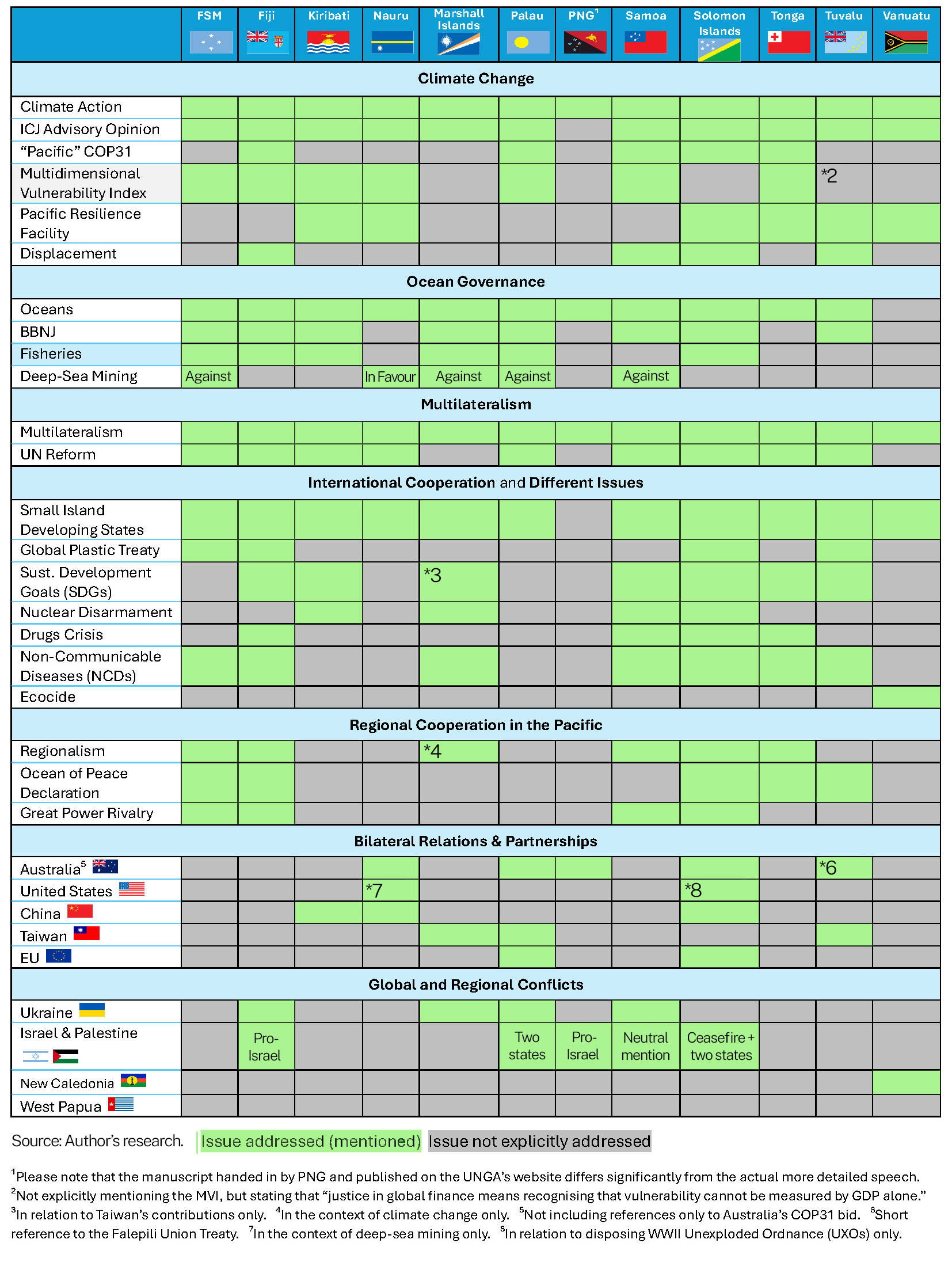
It hardly comes as a surprise that the climate crisis and oceans are the most prominent themes in the PICs’ speeches. With the exception of Papua New Guinea, all PICs highlighted the recent Advisory Opinion on the Obligations of States in Respect to Climate Change, which was issued by the International Court of Justice (ICJ) in response to a 2023 UNGA resolution introduced by Vanuatu. Led by the group “Pacific Islands Students Fighting Climate Change”, who were recently awarded the Right Livelihood Award, the ICJ case can indeed be considered a prime example of Pacific and civil society leadership in international climate politics.
Many PICs also drew attention to the Agreement on Marine Biological Diversity of Areas Beyond National Jurisdiction (known as the BBNJ). Palau was the first country in the world to ratify the BBNJ in January 2024 and the agreement recently reached the threshold required for it to come into force. The Multidimensional Vulnerability Index, a new UN tool to measure vulnerability and complement criteria such as income when categorising states, was also welcomed by many Pacific governments.
It should be noted though that the General Debate once again revealed the deep divisions that exist between the PICs, notably on the controversial issue of deep-sea mining. While Nauru adopted a surprisingly proactive approach to addressing criticism of its leading role in the negotiations on deep-sea mining in international waters at the International Seabed Authority (ISA), other PICs supportive of deep-sea mining avoided the issue in their speeches. Four PICs positioned themselves against deep-sea mining.
Perhaps even more interesting is what was not addressed, or at least not addressed more frequently or enthusiastically. In the context of climate change, this especially applied to Australia’s bid to host the 31st UN Framework Convention on Climate Change Conference of the Parties (COP31) in 2026 as a “Pacific COP” in cooperation with the PICs. Although Australia’s candidacy was endorsed at the PIFLM, it is striking that not even half of the PICs referred to Australia’s candidacy in the General Debate, and virtually none of them discussed the idea of a “Pacific COP” in detail. This suggests that most PICs do not yet feel much ownership of this Australian-led initiative.
Something similar also applies to the decisions of the Forum more generally, including its communique and the Ocean of Peace Declaration. As the next meeting place for Pacific heads of state and government, the General Debate provided an opportunity to emphasise the importance of these agreements and demonstrate regional unity in the face of strategic competition. However, only few PICs even mentioned regionalism or the challenge of great power rivalry in the Pacific. Only Fiji, whose Prime Minister Sitiveni Rabuka proposed the ”Ocean of Peace” concept, and Solomon Islands, as current chair of the Pacific Islands Forum, spoke more expansively about it. With the notable exceptions of Nauru and Solomon Islands, which emphasised their cooperation with China and other states alike, and Marshall Islands, Palau and Tuvalu, which called for Taiwan’s admission to the UN, most PICs tended to avoid references to extra-regional powers at the UNGA.
One example that illustrates the potential for greater PIC cooperation at the UN is Solomon Islands’ candidacy for a non-permanent seat on the UN Security Council (UNSC) for the 2032-2033 term. Their intention to mount a concerted campaign was announced by Prime Minister Jeremiah Manele in his General Debate speech 11 years after the country first registered its interest at the UN. If elected, Solomon Islands would be the first PIC ever to serve on the Council. Yet, while Caribbean Island countries have demonstrated that small states are capable of successful UNSC campaigns, there appears to be no coordination among Pacific states regarding candidacies and no PICs expressed support for Solomon Islands or for Pacific UNSC representation more generally at the UNGA General Debate.
It is important not to overstate the significance of these PIC speeches and the topics they touched on at the General Debate. Mentioning one country or topic, or not, may not always be deliberate. For example, the fact that New Zealand is not mentioned by any PIC in the General Debate should not be misinterpreted as meaning that it is a less vital partner than the European Union, which is mentioned twice. Nevertheless, the speeches taken together do provide an indication of what Pacific speakers and their advisers considered most relevant.
The priorities addressed here are by no means exhaustive. As the more comprehensive, yet still not exhaustive, list in Table 1 shows, the PICs raised many more issues in their speeches that deserve consideration, including Marshall Islands’ and Kiribati’s engagement on nuclear non-proliferation and the PICs’ stances on global and regional conflicts.