

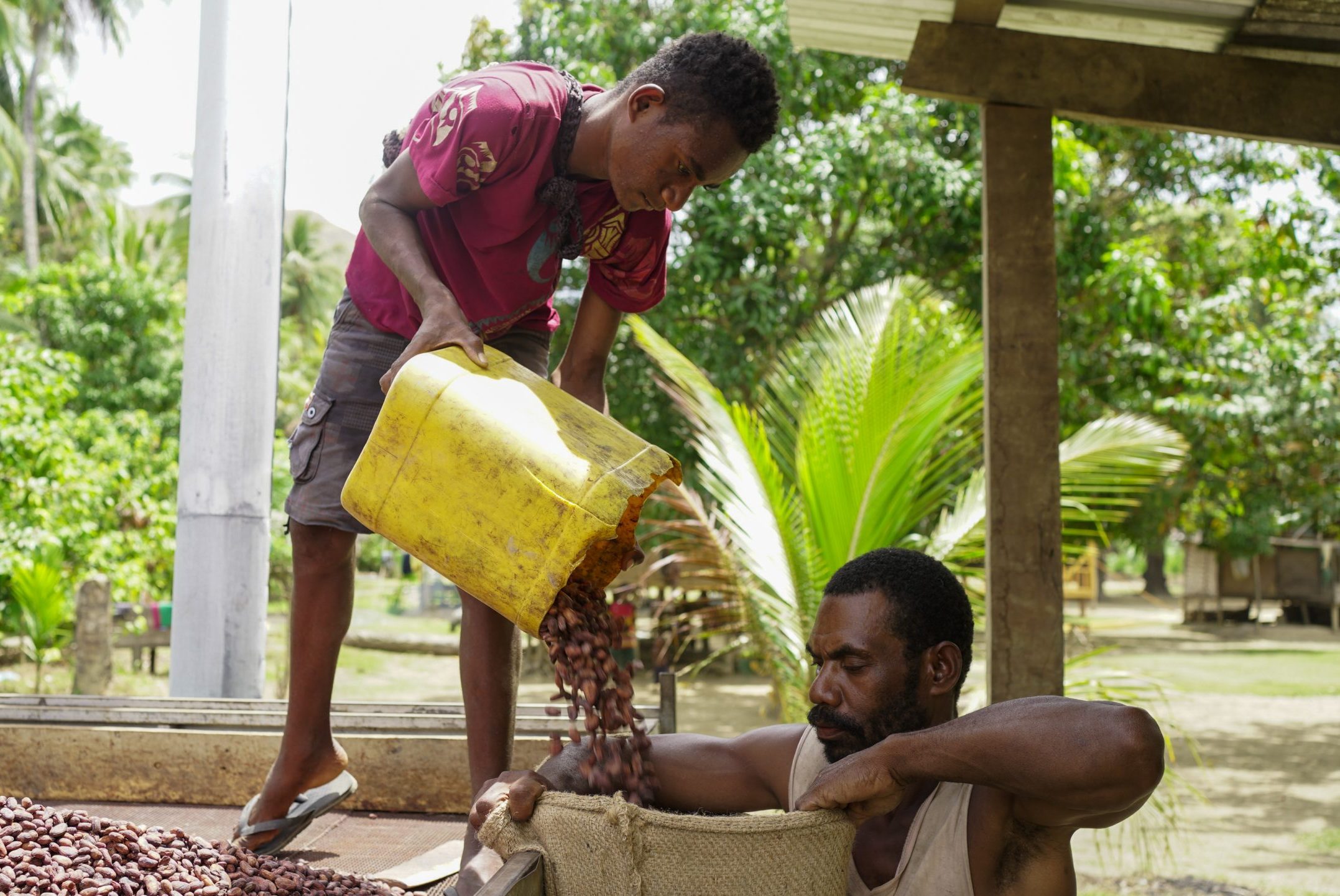
Papua New Guinea’s agricultural production has been in steady decline for more than two decades, and continued emphasis on policies and legislation will not reverse the trend without a fundamental change in how farming is carried out on the ground.
The decline began around 1990 with the Bougainville crisis, low world commodity prices and the weakening of government research and extension services. Since then, successive governments — those of Grand Chief Michael Somare, Peter O’Neill and now James Marape — have tried interventions including the National Agriculture Development Plan (NADP), the Productive Partnerships in Agriculture Project (PPAP), the Papua New Guinea Agricultural Commercialisation and Diversification (PACD) project, the Agriculture Commercialisation Policy and the Small and Medium Enterprise (SME) Credit Scheme. The World Bank and the International Finance Corporation (IFC)were brought in to fund several of these interventions from 2010 to 2025. The results have been dismal.
Agriculture thrived from the colonial era through the first 15 years of independence. Annual output then reached 5,000 tonnes of rubber, 150,000 head of cattle, 150 tonnes of honey, one million green bean bags of coffee, 100,000 tonnes of coconut and 50,000 tonnes of cocoa.
This was sustained by a commercial backbone: the plantation system, the World Bank and later Asian Development Bank-funded Agriculture Settlement Scheme (semi-commercial farms for nationals), the Chan Government’s 10–20 hectare blocks of the 1980s, and Agriculture Management Companies and Agriculture Bank loans tied to commercial farming. Blocks employed 20 to 50 workers each, while plantations employed thousands of people — Ramu Sugar 6,000, New Britain Palm Oil 25,000, Carpenter’s 3,000, Mainland Holdings 2,000, Zenag 1,500, Agmark 1,500, Galley Reach 1,200, Colbran 1,000 and Hargy 2,000 (data from a Farmers and Settlers Association member survey in 2022) — with thousands more in supplier businesses. Crucially, plantations, blocks and settlement schemes supplied seeds, training, employment and reliable buying outlets for surrounding smallholders.
That ecosystem has gone. Across the 25 years from 2000 to 2025, despite funding through the Public Investment Program (PIP), functional grants, the Agriculture Commercialisation Fund, the SME Credit Scheme and the World Bank’s PPAP and PACD programs, 2025 figures put rubber exports at 3,100 tonnes; coconut at 94,216 tonnes; coffee at 789,000 green bean bags; and cocoa at 53,000 tonnes (Farmers and Settlers Association figures based on PNG Customs export data for 2025). For oil palm, FAO and industry sources place output at 600,000 to 700,000 tonnes a year and continuing to grow. A Farmers and Settlers Association industry survey in 2022 puts cattle at 46,000 head and honey at 80 tonnes. It should be noted ihere are concerns about the reliability of industry statistics issued by the various commodity boards rather than the National Statistical Office. The FAO has done projections, while the Department of Agriculture and Livestock has not provided any production or export statistics for the World Bank Agriculture Partnership Program funded from 2010 to 2025.
In short, only oil palm is increasing in acreage, production and employment.
Prices for most crops have tripled or quadrupled, but production has not doubled. Smallholders growing rubber, coffee, coconut or cocoa do so on a subsistence basis. There is no shortage of land in Waghi, Arona, Markham or Cape Rodney, and the people are not lazy. They run kaukau, taro, tapioca and banana gardens for their own consumption and sell enough to meet immediate education or health costs. Ask them to plant more and they decline — they are content and they do not go hungry. The way to double or triple output is to emulate the settlement scheme, block and plantation model that once anchored the sector.
Commodity boards were nominally geared to smallholders, but the volume, productivity, employment, innovation and buying support actually came from plantations and blocks. The Prime Minister is a strong advocate of evidence-based decision making, and the evidence is plain: the PIP, functional grants, World Bank and IFC loans through PPAP and PACD, commodity-board levies and an expanded SME Credit Scheme have all provided resources — yet production and sector employment have fallen.
The remedy in my view is to redirect these funds and the supporting interventions — roads, law and order, loans and management services — into plantations, blocks, Agriculture Settlement Schemes and mechanised farming, managed under a single government entity. Smallholders can retain the PIP, functional grants and commodity-board extension and research services. With a review in year three and a full assessment at year five, Prime Minister Marape could be credited with turning the sector back into an engine of employment, income and rural services.
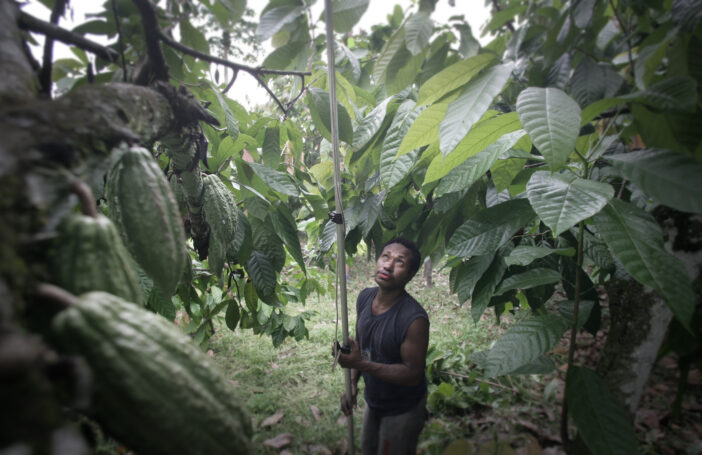
Rehabilitation of existing plantations and block-holder areas is the fastest practical way to lift export volumes. Rubber is the clearest opportunity: it remains a plantation crop, with Agriculture Settlement Scheme holdings in East Sepik Province and Gulf, and 20,000 hectares in Central Province. Rehabilitating 2,000 hectares for rubber in Abau, Central, and 3,000 hectares for coffee in the Arona Valley, Eastern Highlands Province, or 3,000 hectares each for coconut, cocoa and grains, would deliver immediate additional volumes.
Beyond rehabilitation, the country needs large-scale nursery development, coordinated planting programs and stronger extension services to carry farmers through the crucial pre-harvest years. The most effective route is to lease land and provide secure law and order to established operators — Galley Reach, Zenag Farm, Carpenter’s, Hargy, Agmark, Colbran, OK Corporation, Rumion Farms, Mainland Holdings, Colbran Coffee, New Britain Palm Oil and Ramu Agri Ltd — so they can plough and plant thousands of hectares using machinery, with extension officers supporting growers through the three to four years before harvest. The plantation model creates the scale, consistency and production discipline that smallholder schemes alone cannot deliver.
Fifteen years of World Bank and other PIP support to coffee and cocoa have not changed the story. Donor-funded programs need an honest review, and the loans from the World Bank, Asian Development Bank and IFC should be redirected to commercial agriculture. Continued discussions around policy frameworks and strategies, without action on production, will not address the sector’s core problem.
Restoring productivity through practical, coordinated action at farm level is the only sustainable pathway to reviving PNG’s agriculture sector and its export performance. A 40% to 60% lift in tree-crop output from 2027 onwards is achievable — but only if we get back to commercial agriculture and mechanised farming.



In a society where communal land ownership was settled hundreds if not thousands of years ago, the notion that a state lease confers a right for an outsider to occupy and exploit land for economic gain is a complete fallacy. With few exceptions the plantation sector learned the hard way that their views and that of traditional owners can never be compatible. I hope that chapter is behind Papua New Guinea and a more enlightened generation of planners seek to boost food security and economic empowerment within the established order that constitutes the bedrock of PNG society.
This is an important topic and Bryant makes an important point. Though it seems simpler than this, notwitstanding data limits. Per FAO (gross ag production index), from 2005 to 2023, this increased 32%, or about 1.5% a year. Slower since 2015, but clearly positive. Value measures also appear to have steadily increased. Production volume declines can be seen on a crop-specific basis for some crops, with increases for others, and if you express the first measure in per-person terms, on any of the recent population estimates, we do see a stronger decline. The piece would have benefited from these distinctions, in my view, as the hook at the start seems rather misleading without such conditions attached to it.
The most important agricultural production in PNG is subsistence production which provides over 8 million people with the majority of their carbohydrate and protein. There is a reasonable amount of evidence that food production by rural people has kept pace with population increase, so it has more or less doubled since 1996. So it is misleading to say PNG’s “agricultural production has been in steady decline for more than two decades”. Subsistence production must be distinguished from commercial production.
Indeed. This article does not consider the viewpoint of the villager, or of the women whose lives and labour are vital both to the agricultural workforce and the community. The proposal that ‘The most effective route is to lease land and provide secure law and order to established operators’ is merely a return to the plantation system.