


In Struggle, Reform, Boom and Bust: An Economic History of Papua New Guinea since Independence, Stephen Howes and colleagues have produced an excellent book.
Having worked in PNG during the 1997–2003 reform years — and on and off since — I found this the most thorough and well-researched account yet of PNG’s economic path.
It’s essential reading for anyone trying to understand why development outcomes remain poor, despite decades of donor support and resource wealth. The deterioration in service delivery — cited throughout and especially in Section 10.11 — should be a wake-up call.
The book charts PNG’s path from post-independence optimism through reform, boom and stagnation. It’s particularly strong on how volatile resource flows, shifting aid approaches and “hyper-politics” have entrenched a low-growth equilibrium — hard to shift, yet remarkably stable.
Where it leaves readers wanting more is on what to do next. That’s not a flaw — just a reflection of the challenge. What’s needed is a deeper grasp of PNG’s political economy: how power and patronage shape reform, and how to build coalitions for accountability and better performance. Chapter 12 and Figure 1 could be the foundation for this.
This chart shows how Papua New Guinea is caught in a “weak but stable” trap: politics is hyper-competitive and clientelist, with elites using violence and resource rents to win short-term power rather than build institutions; insecurity erodes trust, property rights, and investment; and the state survives but never strengthens, delivering stability without capacity. The result is low, resource-dependent growth and persistently poor development outcomes, a vicious cycle where politics, insecurity and weak governance reinforce each other.
This dynamic must be better understood if the trap is to be broken, because only by recognising how hyper-politics, insecurity, and poor growth and development outcomes reinforce one another can reformers identify real entry points for change.
Figure 1: A political economy model of Papua New Guinea – the hyper-political, insecurity trap
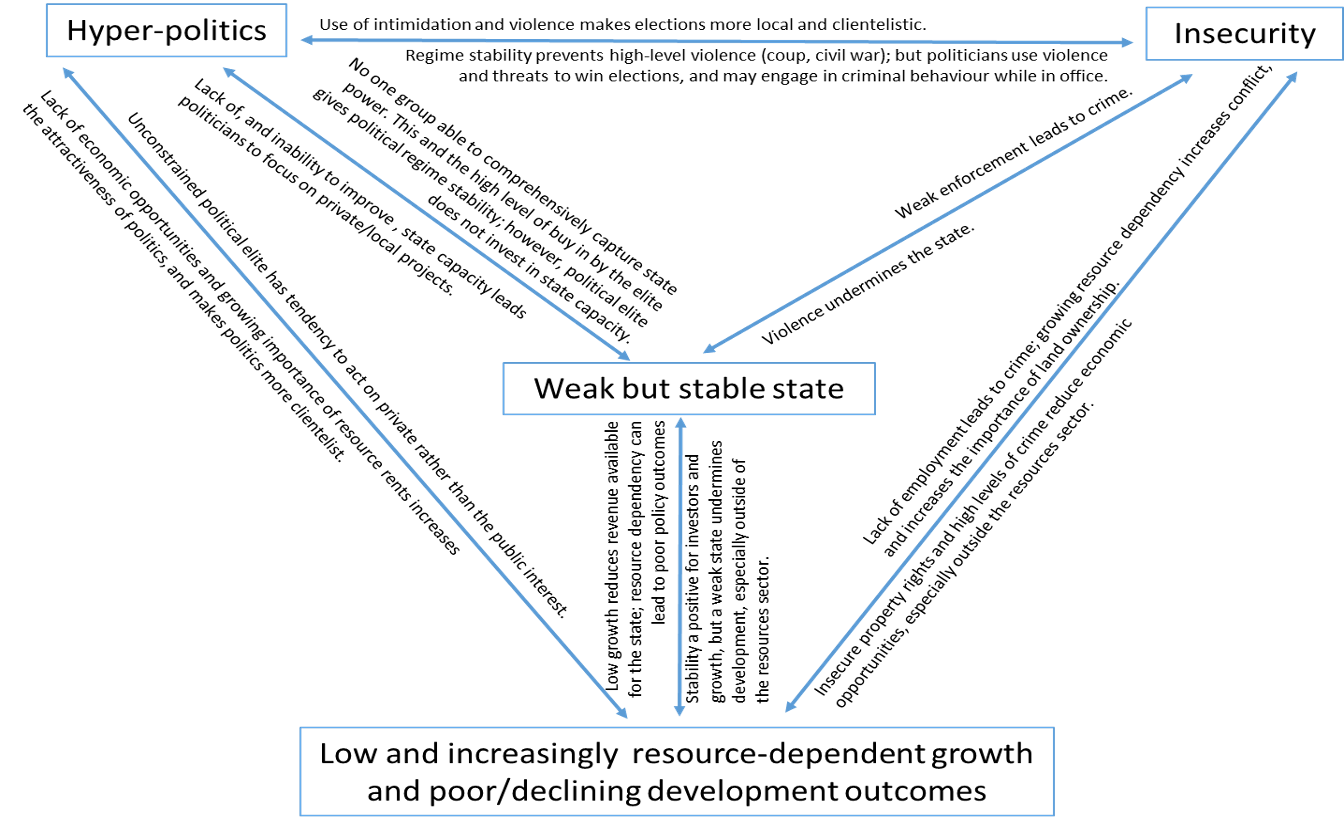
Source: Struggle, Reform, Boom and Bust, Figure 12.3 on p.291.
Aid also needs scrutiny — not because it holds the answers, but because it’s a lever that external actors control. Too often, it has reinforced dysfunction: bypassing systems, fuelling fragmentation and enabling political avoidance. Section 7.2.6 captures this well and it is a thread throughout the book. Rethinking how aid supports local accountability is overdue.
We also need clearer-eyed accounts of how reform actually unfolds. The Pioneer Industry Act (p.104) is an example. I was involved in its repeal in 1998 — it wasn’t due to political will but through a quiet line in the budget legislation. It looked like a win but was easily undone. There are many reforms like it. (And the book documents many reforms that were later undone.)
The failures we see in PNG aren’t a reason to disengage or give up hope — but they are a reason to rethink how we engage.
My takeaway: this book prompts us to ask harder questions — about what’s worked, what hasn’t and what must change.
For donors, policymakers and practitioners, the challenge is clear: engage more honestly, act more strategically and stay the course when things get politically uncomfortable.
A sincere thank you to Stephen Howes and his team – Martin Davies, Rohan Fox, Maholopa Laveil, Manoj K. Pandey, Kelly Samof and Dek Joe Sum – for an excellent book.



Thanks, Stephen and team for the artful work into this book. As a development practitioner engaging extensively in the donors’ programs in PNG, I would like to share few thoughts and observations.
I had seen the unfolding nature of development in the country with different leaders in the political and bureaucratic institutions of this country, as a child in the 80s, as a schooler in the 90s, as a development practitioner in the 2000 and current.
The category would be this; the early leaders – the makers of this nation, the developers, the reformers, the users and invaders using systems to legitimize illegitimate public goods.
Whilst observing the turnover of times, there is the population boom, the urban migration, the deterioration of infrastructures and the increase development of the resource industries and emergence of social insecurity – limited and weak law enforcement institutions and increase in law-and-order issues and the reminiscence of regionalism among diversity.
With the above features, more money from donors, resource sectors and public tax poured into development, but it continues to sink in deep pockets, and it seems will not end. Everything the current systems and players are doing is extensively exposed through the availability of technology – provides both facts and fake to the public domain.
The development in ARoG into self-determination will create a major shift in the regionalism of diversity across the country. Not a majority political party government will sustain stable government while all development will take on reactive approach to emerging situations and not a long-term solution.
The call now for PNG is – what were the thoughts and minds of the makers of this nation? This should be the evaluation question of the PNG 50th Anniversary (apply basic principle of project design- objective vs outcome evaluation). At least many of the forefathers are not around to provide this evaluation feedback, but what we still have are the foundational institutions, constitution and the enabling legislations which still provides the conner stone of the thoughts and minds of the nation makers.
The risks are that users and invaders (politicians) of today are trying to continuously attack the very foundations, (amendments to laws and duplications of institutions) with selfishness. This is a bad trend for PNG.
The old terms like political patronage and clientelism would fade and new jargons will emerge like – systemic and systematic action, legitimizing the illegitimate, selective warranting and weaponizing legislation and allocation.
Thanks