

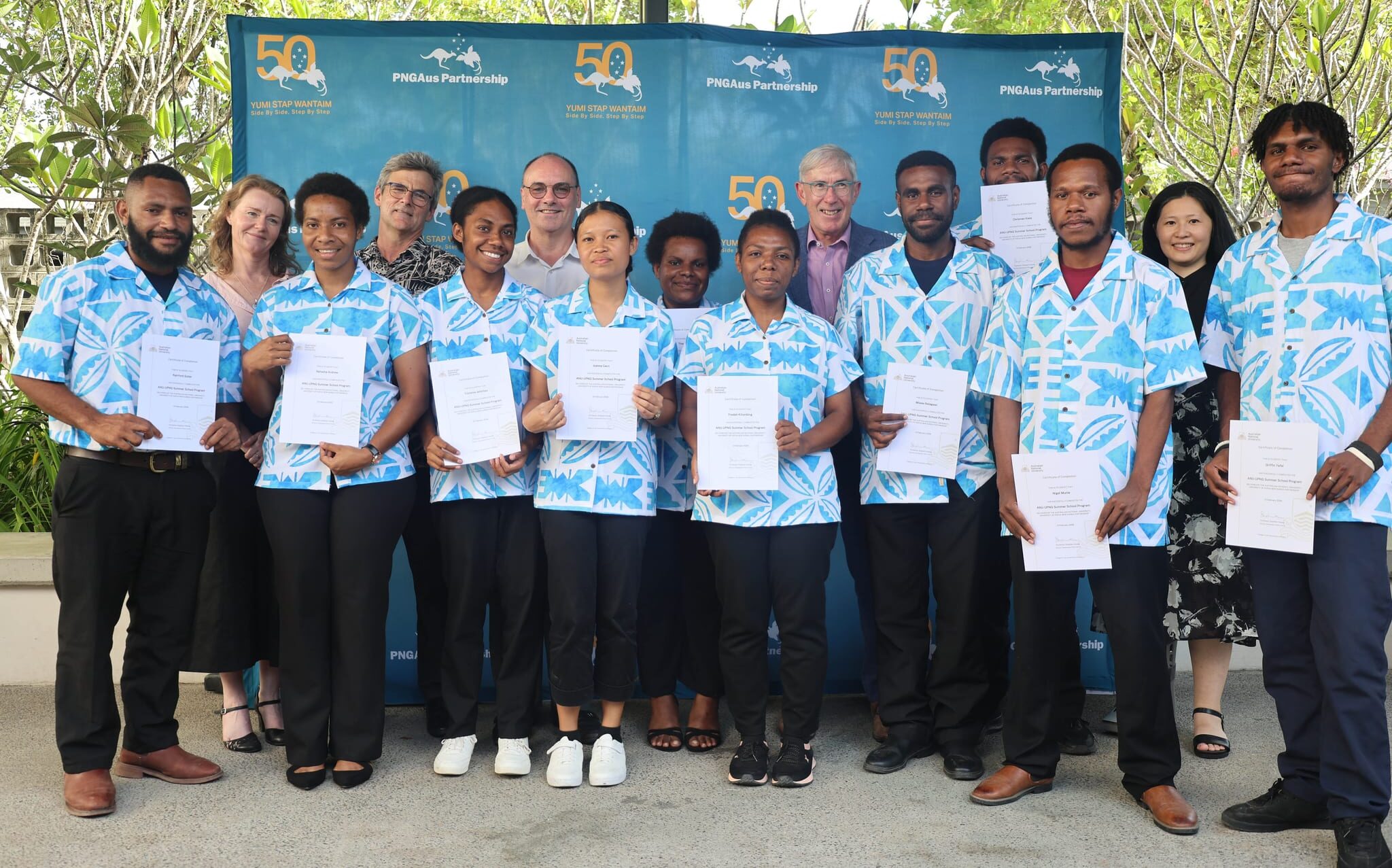
This is an edited version of a speech delivered at the launch of the third phase of the partnership between the Australian National University (ANU) Crawford School of Public Policy and the University of Papua New Guinea (UPNG) School of Business and Public Policy on 8 April 2026 at the Australian High Commission in Port Moresby.
High Commissioner and colleagues from the Australian Department of Foreign Affairs and Trade, Vice-Chancellor and colleagues and students from UPNG, ANU colleagues, Australia-PNG Economic Partnership staff, government officials, and friends.
Thank you everyone for coming here today to join in the launch of the third phase of the ANU-UPNG partnership, and thank you to Diana Ni and her team for organising this event.
Although this is the third phase, it is the first launch, which I guess means we must have done something right.
I actually think it is good we have held off on having a launch until now. Too often, we celebrate announcements and initiatives. Today we can celebrate a decade of achievements as well as looking forward to another four years of the same.
Of course, ANU and UPNG go a long way back. But this partnership dates back to 2012, when Professor Pillai who is here today and who until recently was the Dean of the School of Business and Public Policy, Professor Mellam the former UPNG Vice-Chancellor and myself started to collaborate. We resurrected the PNG Update which had become defunct. And we started working to place a couple of volunteer lecturers in economics at UPNG, at a time when the economics division had basically collapsed.
That was 2012. Fast forward to 2014. The ANU Vice-Chancellor was summoned to Parliament House for a breakfast meeting with the then Foreign Minister, Julie Bishop, who told him she wanted ANU, specifically the Crawford School of Public Policy, to do more with UPNG. The Vice-Chancellor then summoned me as the only person in the Crawford School working with UPNG, and told me I needed to do more.
At first I resisted, realising how much work it would be. But over time, I relented. One of the things that made me relent was when Professors Mellam and Pillai came to the ANU to sign a memorandum of understanding specifically outlining a partnership with the Crawford School. They did that on their own initiative and at their own cost. And I thought if they were that keen, then I should reciprocate.
Ten years on I’m certainly glad I did. When I look at how the PNG Update has taken off, when I get to experience the annual ANU-UPNG summer school, when I look at the research now being produced, from books to blogs and from databases to journal articles, when I meet some of the hundreds of undergraduates and postgraduates we have taught, when I reflect on how we have contributed to the rebuilding of expertise on PNG in Australia, I’m definitely proud of all that.
I’m also proud of our policy work. We now have a joint ANU-UPNG team collaborating with the RESET@50 team, and we have also been asked by the Department of Planning to review the Fourth Medium Term Development Plan.
But above all, I’m proud of the students we have been able to train at ANU — and now at UPNG through the Masters of Economic and Public Policy — who, after studying, return to UPNG to lecture. Many people told me that these lecturers would leave UPNG after returning from ANU since they could command a much higher salary elsewhere. But in fact they have all stayed the minimum agreed five years, and only one of the eight who have so far graduated from ANU in economics has left for another job. We often talk of capacity building through the aid program, but our partnership has actually built capacity.
So I want to especially thank those lecturers, many of whom are here today, for your commitment and your effort over the years. In fact I want to thank everyone, whether at ANU or UPNG or in the Australia-PNG Economic Partnership or in the Australian High Commission or PNG Government — all those in this room and many others — who have contributed to the success of our endeavours. A lot of people have put in a lot of hard work to make this partnership what it has grown into and I thank them all.
For me, this partnership has not only been an opportunity to improve the teaching and expand the research of economics and public policy in PNG. It has also been an opportunity to put into practice some of the aid effectiveness principles I have espoused over the years, in the various aid reviews I have been involved in and in my writings and lectures.
I will conclude with four.
First, for aid to succeed, for localisation to work, you need local champions. We have had, as I have already mentioned, strong champions within the university. The School of Business and Public Policy has welcomed us with open arms. But we have also had champions within the PNG government. I especially want to thank the PNG Treasurer Ian Ling-Stuckey, who unfortunately could not be here this afternoon but who has been a strong and vocal supporter for many years.
Second, in a difficult environment, you need to try different things, and, if something works, you should stick with it. Australia has been giving foreign aid to PNG for 50 years, and probably will for another 50. Projects should be supported in multiples not of years but of decades, as long as they are delivering results, as we are. I give credit to the Australian government for supporting this partnership now for over a decade. Over that time, I have seen several aid initiatives come and go, often with barely a trace. To have a durable impact, you often need to have a durable intervention.
Third, you need to be realistic. We are not trying to change the world. We are not even trying to change UPNG. We are working with one school, and even within that school we have been selective, focusing largely on economics and public policy. It is only in recent years we have expanded to other divisions, first to strategic management now to accounting. This year, we have our first UPNG accounting lecturer studying at ANU. Also this year, we are for the first time opening up summer school selection to students from across the School of Business and Public Policy, and we will be supporting all eight of the School’s student associations.
Finally, aid works better when implementers have skin in the game, and where development assistance builds off and leverages existing efforts and relationships. Speaking personally, it has been a privilege for me, and a highlight not only of my career but of my life to have been involved in this partnership for as long as I have been, especially on account of the friendships I have made along the way.
I want to end by thanking the Australian government and its representatives here for your support over the last decade, and for extending that support for another four years. While we have achieved a lot, we still have much to do. We have some exciting plans for the next four years. There is no shortage of challenges, both to preserve gains already made and to extend them. And there are plenty of opportunities.
Thank you very much.
You can read more about the ANU-UPNG partnership in a booklet published in 2025 on the ANU Development Policy Centre website. For more information, including external evaluations of the partnership, visit the PNG Project website and to stay up to date subscribe to our monthly PNG Project newsletter.




Congratulations Professor Howes on securing another four years of funding for this valuable initiative. I feel fortunate to have been part of it for a few years. My sincere thanks to all those who are continuing to work on and support this important partnership.
Thanks for this post and for all your efforts. There is much to celebrate. Well done. This partnership (along with your four principles for aid effectiveness) provides an important and much-needed model for other contexts and programs.
It is very encouraging to see the emphasis on aid effectiveness and the distillation of the four key factors in the blog from the UPNG experience. These factors align with the findings from research and experience elsewhere. I hope I am wrong but I fear aid effectiveness in education sector projects and support will decline in coming years as two factors come into play.
First, the dilution of attention away from improving and sustaining change in education towards other broader matters, as important as they may be, such as climate change. I believe the concept of focus, as stressed in the blog, is so very important.
Second, in Australia’s case in particular, the abandonment of a development policy focus on sustainability in the main aid ‘quality criteria’ which are now limited to effectiveness, efficiency, gender equality and disability equity. I fail to see how development aid can be considered to be ‘effective’ in the broadest sense unless benefits from development interventions are sustained, and hopefully scaled and deepened as illustrated so well in this case study of ANU’s work at UPNG.
The reporting of the sustained success of work in the university sector is a powerful example of how universities can be assisted to achieve successful and sustained change. Universities have often responded poorly to development assistance compared to schools and the technical and vocational education sectors.