


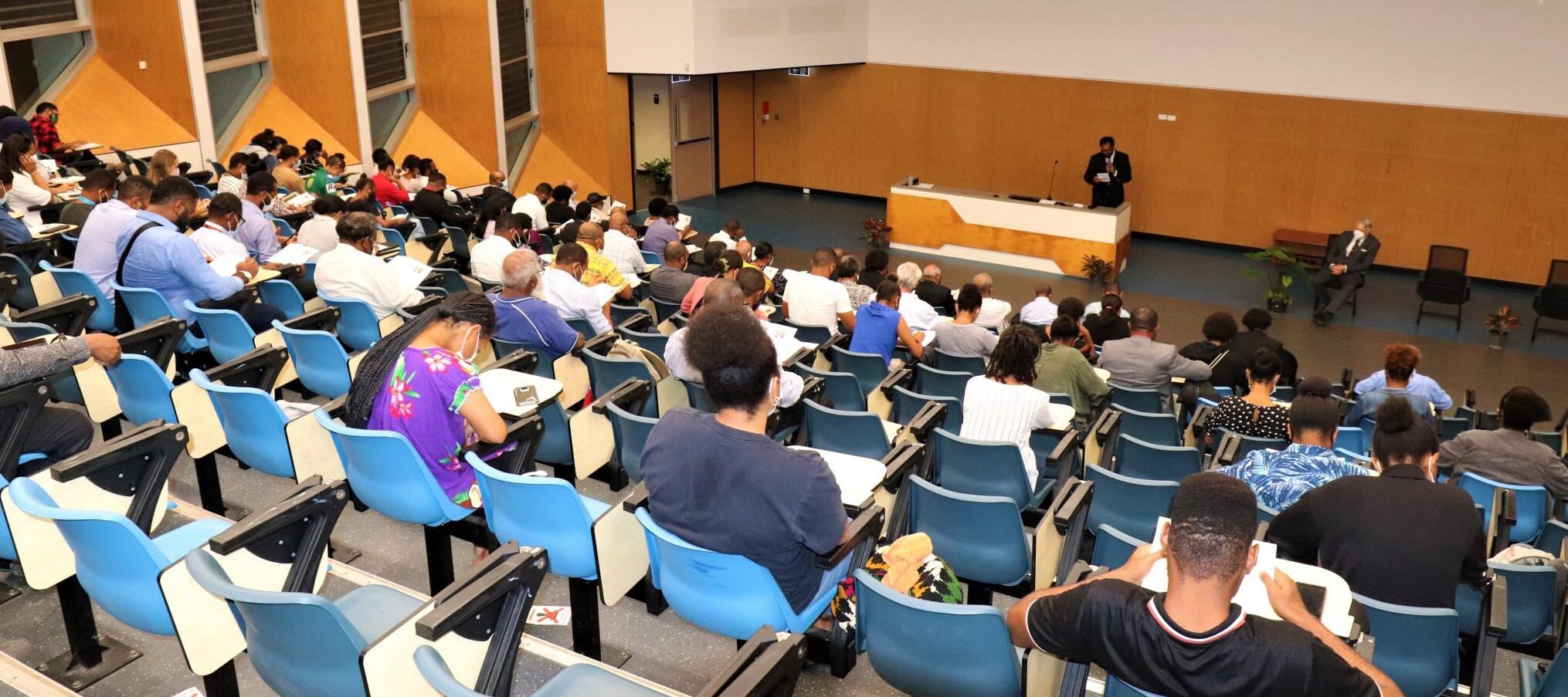
“Education is the most powerful weapon which you can use to change the world,” declared South African President Nelson Mandela in 2003. Fifty years after independence, Papua New Guinea would not be where it is today were it not for education. In spite of the many challenges and issues the country faces, it is a milestone achievement to have come this far as a sovereign state. Education is the lifeline of PNG’s Vision 2050 that drives the nation forward and tertiary education in particular plays a transformational role in national development, shaping leadership, workforce readiness, innovation and identity.
The findings summarised in this post are drawn from a critical review of PNG’s tertiary education system since 1975 that we presented at the 2025 PNG Update conference. The review used the Gross Enrolment Ratio (GER) for the tertiary sector to benchmark PNG against other countries in the region and around the world. It had three objectives: to assess the historical development and current state of tertiary education in PNG from 1975 to 2025, to evaluate the effectiveness of public and private tertiary institutions in meeting national development goals and to identify key challenges and propose strategic recommendations for the sector.
The University of Papua New Guinea (UPNG) is the country’s first university and was founded in 1965. In that same year, the PNG Institute of Higher Technical Education was established in Port Moresby. In 1967, the institute moved to Lae, Morobe province, and in 1970 was renamed the PNG Institute of Technology. It was officially upgraded to the PNG University of Technology (Unitech) in 1973. By the mid-1980s, the country still had only two universities, with tertiary access concentrated in urban centres, and education was largely state-driven.
The period between 1990 and 2000 was an era of expansion and diversification, during which faith-based (private) tertiary institutions gained formal recognition. Divine Word University (DWU) and Pacific Adventist University (PAU) both attained university status in 1996. They had existed in other forms since the early 1980s.
By the early 2000s, PNG’s public tertiary network had expanded to four main universities: UPNG, PNG Unitech, the University of Goroka (UOG) and the University of Natural Resources and Environment (UNRE).
From 2010 to 2020, major governance reforms transformed the sector, notably the passage of the Higher Education (General Provisions) Act 2014, which created the Department of Higher Education, Research, Science and Technology (DHERST).
In 2014, the Institute of Business Studies (IBS) submitted a proposal to become a university under the Act, and in late 2016 IBSUniversity was formed. The Lutheran University of Papua New Guinea (LUPNG), a faith-based institution, was created in 2022. It was created as a merger of three existing Lutheran institutions: Balob Teachers College in Lae, Martin Luther Seminary in Lae and the Madang Lutheran School of Nursing. It started enrolling students in 2023. The Innovative University of Enga (IUE) was formally established under the IUE Act 2022 and welcomed its first intake in 2024 with over 860 students in 2024 and graduated 166 students in 2025.
There are currently 10 higher educational universities — six public institutions, three faith-based institutions and one private university — plus over 100 technical and vocational colleges. In 2024, more than 30,000 Grade 12 school leaver applicants and about 2,268 non-school leavers competed for places, yet only around 11,500 secured tertiary placements for studies in 2025, leaving over half without access to formal post-secondary pathways.
By 2025, the number increased with more than 38,000 grade 12 students sitting final exams. Interestingly, the results of a national online selection process reported that over 23,000 students had been selected to study in different tertiary institutions in 2026 — an impressive increase of more than 11,000 compared with 2024. This is due to the increase in the number of tertiary institutions, institutional reforms, improvements in the higher education online selection system and the expansion of quotas for each program offered in each institution.
Despite decades of transition, enrolment capacity remains low and regional disparities persist in access to tertiary education. PNG’s GER for the tertiary sector remains lower than that of other comparable lower-middle income economies around the world. PNG’s GER has been fluctuating at a much lower rate between 2% and 2.8% since 1999, which is far lower than that of the Philippines (47%), Morocco (48%) and Nicaragua (30%), and relatively closer to Eritrea (3%), if higher than Haiti (1%). In the region, PNG’s GER is extremely low, while Australia hits the target of universal education for all. Fiji, Tonga, Indonesia and Malaysia are also doing well, with GERs above average.
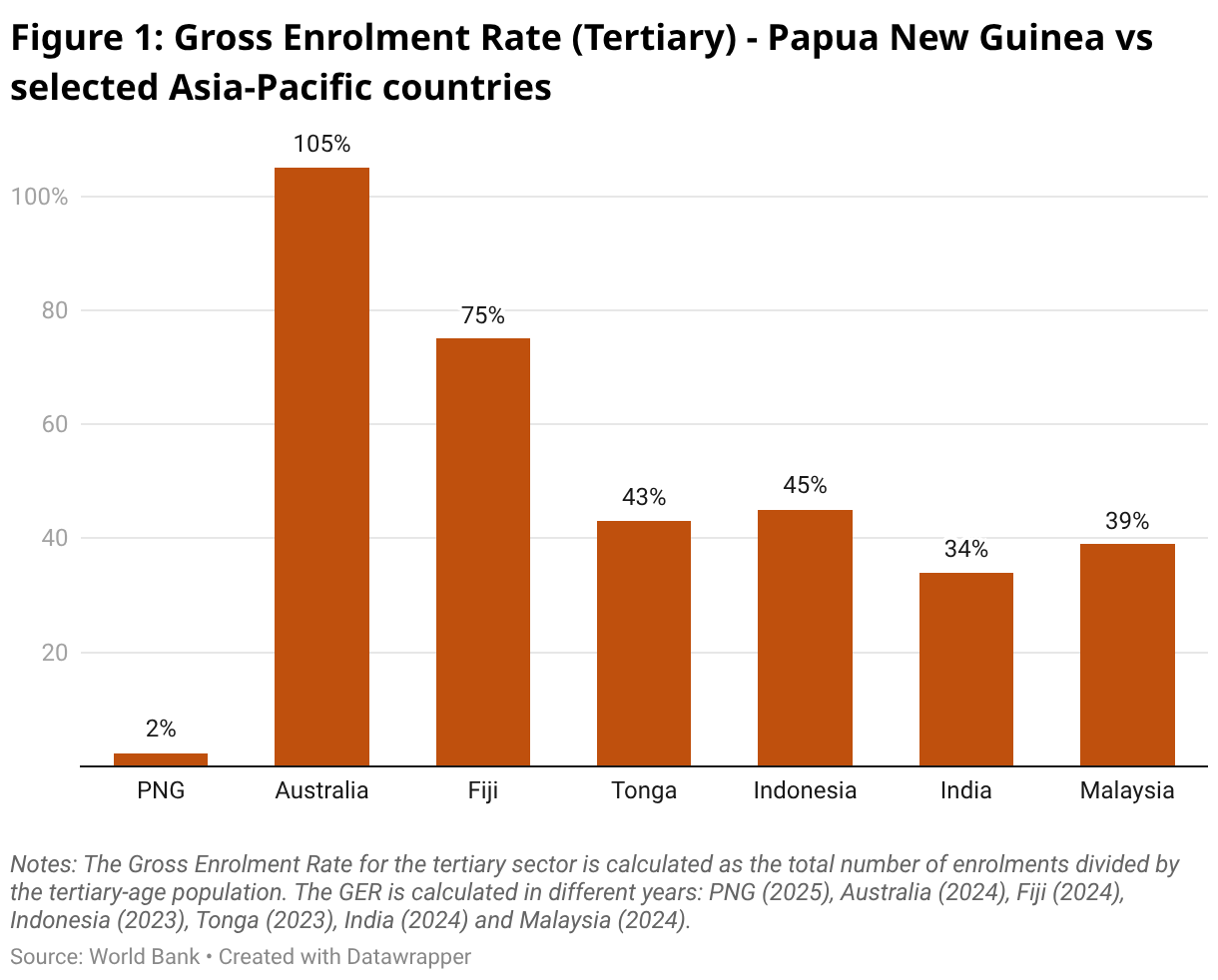
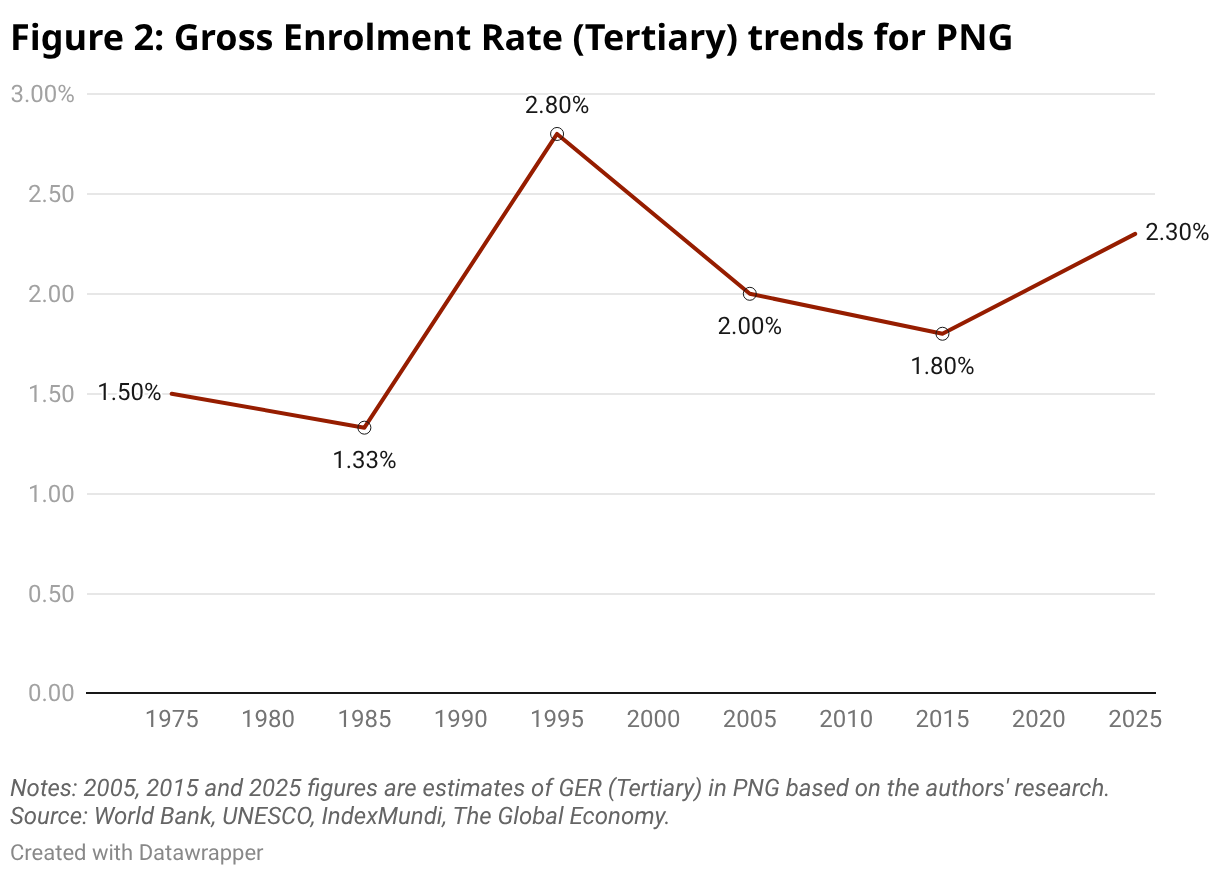
Since 1975, the tertiary-age population has increased as the country’s population has grown. However, GER is progressing at a slow pace. To understand why PNG’s GER fluctuates, it is important to visualise how it is calculated. GER is calculated as the total number of enrolments divided by the tertiary-age population. Even when the total number of enrolments goes up, if the population grows even faster, the GER will actually go down.
This is exactly what we see between 1995 and 2015. While the education system is expanding, it is not expanding at the same speed as the youth bulge in the population. Demand for higher education is growing much faster than the available seats and infrastructure. PNG remains an outlier in the Pacific, with extremely low tertiary participation. Clearly there is a mismatch between national aspirations and educational capacity, given the youth population bulge and demand for higher education. The pressure is even greater now with the no age limit policy for non-school-leavers.
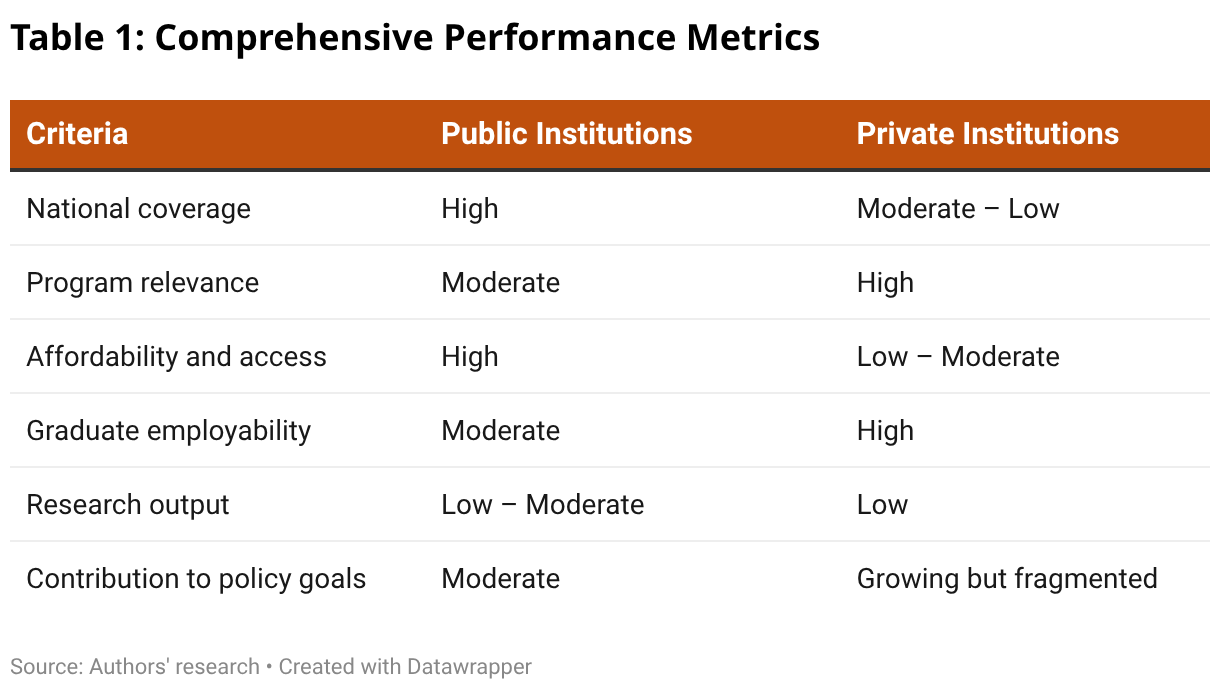
Public and private tertiary institutions demonstrate clear differences in how they accord priorities to their various goals and measure success. Public institutions, which are state-owned and government-funded, ensure extensive national coverage and high levels of affordability and access, particularly benefiting rural communities. However, they often demonstrate only moderate relevance of programs and graduate employability, alongside lower research output due to limitations in funding and resources.
Private institutions, by contrast, are generally fee-based and predominantly urban-oriented, and they provide more market-relevant programs and stronger graduate employability, facilitated by adaptable curricula and closer ties to industry. Nonetheless, their reach is more restricted and access is limited by financial constraints, resulting in moderate to low national coverage.
While public institutions consistently contribute to national policy objectives through centralised systems, the contributions of private institutions are increasing but remain fragmented due to their varied ownership and operational structures.
Despite improvements in some areas, key challenges persist. The rural-urban divide means education is limited to certain parts of PNG, where there is a gendered imbalance in access and low-quality, outdated curricula. Weak governance, poor infrastructure and graduate unemployment also hinder the system’s capacity to provide inclusive, relevant and high-quality education aligned with national development requirements.
Consequently, comprehensive strategies should give priority to the expansion of scholarships and inclusive policies to enhance access, while also utilising digital and distance learning models like the PNG National Open University. At the same time, curriculum reform must be guided by industry demands and bolstered by skills audits, internships and stronger employer engagement to improve graduate employability.
Governance and institutional performance can be strengthened through regular policy and performance audits, leadership development and merit-based appointments. Addressing infrastructure deficiencies will require coordinated investment through public-private partnership models and donor support, along with the implementation of e-learning platforms and self-financing initiatives to ensure sustainability.
Tertiary education is the foundation of PNG’s human development and national progress. A holistic approach is needed to put in place bold reforms, inclusive strategies and a commitment to excellence in the sector for the next 50 years and beyond.







Thanks for this helpful report. It is striking how low the enrolment rate is compared to other countries in the South Pacific.
Here are some comments.
1. All the reviewers are from a Business management background. It would be helpful to have perspectives from humanities, social sciences, science, and engineering.
2. Although it is desirable to increase enrolment, this does not necessarily increase educational outcomes. Australia may have high enrolment levels but low student engagement. Anecdotal evidence is that attendance at lectures is now between 5 and 30 per cent of enrolment.
https://www.theguardian.com/australia-news/2025/feb/19/teaching-to-an-empty-hall-is-the-changing-face-of-universities-eroding-standards-of-learning
2. There is an iron triangle of access, quality, and cost for education (and health care). If you change one, you change the others. For example, if you increase access but keep costs the same, quality inevitably decreases.
https://doi.org/10.3200/CHNG.41.2.30-35
3. In the Majority World, unfortunately, increasing quality does not necessarily improve nation building due to the potential brain drain. Most graduates from elite institutions in South Asia take jobs with multinational companies in the West.
4. Public debate in PNG often promotes Christian values. How might these shape its vision for its public universities? I recently published a paper, “What is a university for? A Christian vision for the modern secular university”. You can access it here
https://revelation4-11.blogspot.com/2026/05/what-is-university-for.html
Thanks again for initiating this important discussion.
While commending the team for providing such a comprehensive and thought-provoking review of the tertiary education landscape in PNG. Drawing on the insights presented, I would like to ask few questions:
1. While the study identifies a “gendered imbalance in access” as a critical challenge, it would be highly informative to further explore the “specific cultural and physical drivers of this disparity”. It will enable us to answer very important questions like: can administrative reforms like the “online selection systems” truly bridge the gap if the primary barriers to female enrolment are rooted in safety concerns or traditional family priorities rather than just the selection process itself?
2. The push for digital learning and e-learning platforms is a forward-thinking recommendation. However, without massive, parallel investment in national telecommunications and power grids, there is a significant risk that these models will inadvertently exclude the rural population and worsen the existing rural-urban divide.
3. While the study rightly recommends “merit-based appointments” to address “weak governance,” the research is relatively silent on the external political pressures that often create these governance issues. It would be valuable to critique the role of political patronage and the influence of provincial governments on institutional management, particularly in the context of newly established institutions.