On 6 July 2026, China launched a second intercontinental ballistic missile (ICBM) test in the Pacific Ocean, following a previous test in 2024 that ended a four-decade hiatus. This latest sign of military modernisation forms part of a competition for primacy with the US.
Beijing described the test as part of a routine annual training exercise, using nuclear-capable but unarmed weapons, and not directed at any specific country or target. This official explanation has not reassured Pacific governments. For a region still shaped by the memory of nuclear testing and external strategic control, long-range missile testing cannot be treated as routine.
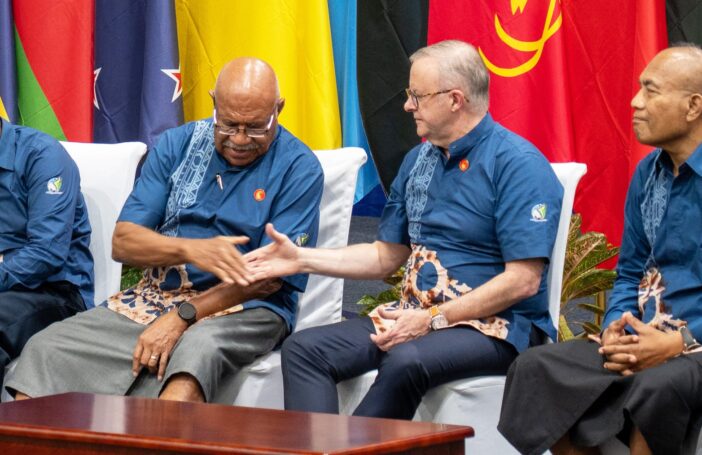
On the same day, Fiji and Australia signed two major treaties in Suva: the Vuvale Union and the Ocean of Peace Alliance, known as the Veitacini Treaty, which creates a mutual defence obligation between the two countries and is open to other Pacific states.
The missile test and the treaty signing together put pressure on the Pacific’s own Ocean of Peace vision, a regional commitment intended to keep the Blue Pacific free from coercion, rivalry and conflict.
These developments give rise to several broad reflections.
First, the political messaging of the Chinese missile test is almost certainly directed at the US and its allies.
While the 2024 test measured distance, its flight path roughly matching the range between the Chinese mainland and the continental United States, the 2026 test landed in the approaches of US military assets in the Pacific. Both missiles landed in very narrow high-sea pockets, a mark of precision for a country with less offshore practice than some others. This accuracy allows targeting of strategic sites.
The timing reinforces the political message. The ICBM landed in the middle of the five-week Rim of the Pacific (RIMPAC) biennial exercise. RIMPAC is a US-led drill designed to bolster interoperable aero-naval capabilities and represents a tangible concern for China. China and Russia opened their own Joint Sea–2026 drills the same day. The missile test had been planned months ahead: if RIMPAC set the broad timeframe, the Australia-Fiji pact signing may have determined the exact day.
Australia is, after all, limiting China’s strategic access to islands through exclusive Pacific agreements.
Second, the test could push Pacific Island countries (PICs) toward a regional security architecture that ultimately generates insecurity.
China is trying to present what could become recurrent as routine. China has cultivated closer ties with several Pacific Island countries than Western powers have, yet it is still prepared to test missiles in the region, and may well do so again. If missile testing in the Pacific is normalised, the threshold for militarisation has already shifted.
The aim of ICBM testing is to validate capability and perhaps counter corruption scandals in the People’s Liberation Army (PLA) Rocket Force. But missile testing is never a politically neutral activity. China’s leadership cannot prevent rival countries from perceiving the missile test as a deterrent.
The test provides further ammunition for some powers to portray the Chinese state as destabilising and to argue for deeper defence integration with Pacific countries.
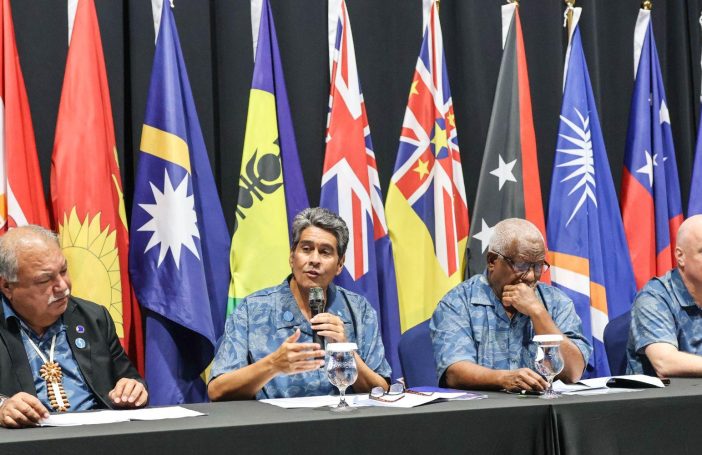
Fiji’s Rabuka first proposed a “Zone of Peace” in 2023, aimed at shielding the Pacific from major-power rivalry. However, when Pacific leaders endorsed the Blue Pacific Ocean of Peace declaration in Honiara in 2025, they chose to omit demilitarisation provisions, even as militarisation intensified.
With the Veitacini Treaty, Fiji and Australia’s concept of peace is the flip-side of “armed attack”. This kind of regional military architecture is predicated on a state-to-state threat. From which state other than a rival of Western allies could this threat come? In any case, Oceania could not resist aggression from the People’s Liberation Army unless the US were willing to intervene.
Bilateral security agreements with Australia may pull PICs into the orbit of the Australia, New Zealand, United States Security Treaty (ANZUS), and US-led containment could in turn incentivise China to add strategic infrastructure hosted in the Pacific islands to its target list.
This is the logic of exposure through alignment: a defence pact reassures one partner while implicating another more directly in great-power competition. This is the spiral Pacific leaders have been trying to avoid: accepting one form of insecurity as protection against another.
In effect, the military threat facing PICs has moved from negligible to something they can’t ignore.
Third, the test may have the effect of accelerating diplomatic polarisation in a region that has worked to preserve room for manoeuvre.
Pacific Island states have built agency through diplomacy, regional solidarity and norm-setting. This “friends to all, enemies to none” posture has not always been easy or consistent, but it has given PICs the space to avoid being locked wholly into one camp.
Given China’s missile test, the balancing act is more complicated. Pacific leaders will find it harder to stay silent, with the next Forum meeting hosted in Palau, which has a pro-Taiwan government. Chinese tests draw more attention because they are rare and happen in open water. The US, by contrast, tests frequently, with missiles landing in the waters of their Compact partner, the Republic of the Marshall Islands.
China’s expanding nuclear arsenal sits awkwardly next to its own 1987 signing of the South Pacific Nuclear-Free Zone protocols, but only Western countries have detonated nuclear weapons in the region.
Condemning Chinese testing while staying quiet about US militarisation, nuclear legacies and an expanding alliance architecture would confirm Pacific leaders’ alignment with the Anglosphere.
Picking a side would close off the “China alternative” that has given Pacific countries greater leverage with their “traditional” partners since 2006.
A conversation that starts and ends with China also misses the security concerns to which Pacific peoples themselves give priority: climate, debt, extractive development, transnational crime, gendered violence, colonial legacies and nuclear trauma.
The Pacific is not empty space. For Beijing and Washington, it is the theatre in which their respective armed forces would operate in a crisis. For Pacific countries themselves, each act like this recent missile test increasingly makes the region, not an ocean of peace, but a stage for someone else’s deterrence.