


Please note that this article contains a description of violence that could be distressing for some readers.
Rosa Yakapus was tortured and murdered by a group of men who believed she killed her estranged husband by removing his heart and eating it without leaving a mark on his body. The location was a remote and deeply impoverished corner of Papua New Guinea’s Hela Province. Rosa’s three-day ordeal in early July 2025 progressed from interrogation while stripped naked, to torture by being tied between two poles spreadeagled over a fire built beneath her genitals, to assassination by a gunshot to the head that sent her huddled body rolling into a river. It was all captured on video using mobile phones and then posted to Facebook and sent around via WhatsApp.
These videos were brought to the attention of journalists and the story featured in The Australian and made headlines in one of PNG’s major daily newspapers, the Post Courier. Such was the public outrage and shame at the tarnishing of PNG’s public image that politicians and PNG’s police commissioner committed to arresting and charging all those involved in this brutal act of sexualised violence. Police had been made aware of Rosa’s torture while she was still alive and had made attempts to rescue her but were unable to complete their mission because they couldn’t obtain enough diesel for the Landcruiser vehicle needed to make the journey through the rough, mountainous terrain.
If the problem was simply a question of money then increased funding should soon be available. In 2023, Australia committed $200 million — Official Development Assistance (ODA) and non-ODA — over four years as part of its Bilateral Security Agreement to support PNG’s internal security priorities. These priorities include building PNG’s law and justice capabilities with combined investments in law, justice and policing that will increase from $60 million per year (ODA) currently to $110 million per year (ODA and non-ODA) by 2026-27. On 19 June 2024, Australia’s Minister for Foreign Affairs, Senator Penny Wong, announced a set of initiatives to strengthen Papua New Guinea’s internal security and law and justice priorities as part of the $200 million agreement. The media release gave details directly relevant to the current case:
“We will deliver additional support for stability in the PNG Highlands, including a new program to help PNG improve weapons management and a partnership with the International Committee of the Red Cross. We will also provide further assistance to PNG in ‘non-traditional’ security areas, such as cyber, biosecurity, and to address gender-based violence.”
Following the exposure given to the assault by PNG and international media, properly funded and logistically coherent efforts were made to apprehend, arrest and detain a total of eight men from the area where Rosa Yakapus was tortured and killed. These men should have been clearly identifiable from the video that was circulated of them torturing and killing Rosa, which had been filmed by people who were themselves participating in the event. On 7 July, Prime Minister James Marape “applauded the swift arrest” of the eight suspects who were taken to police cells to await trial.
On Friday 25 July, all eight suspects were released following an order from the Tari National Court. The court ordered their release because no charges had been laid since their detention. According to police sources in Tari, there had not been any investigation to identify the perpetrators and instead the police had rounded up seemingly random members of the community to give the appearance of taking action in response to political pressure.
On 31 July, the Post Courier reported that Police Commissioner David Manning had issued instructions for the rearrest of the eight suspects, adding that they were being protected by their community who were now hiding them from police. But if the court ordered their release because they had been arrested at random without investigation, then their rearrest does not make any sense. Are these eight men the actual culprits? At this point, it is worth underlining that if police had had sufficient fuel to reach the area at the time of the assault, Rosa Yakapus might still be alive.
This incident is by no means unique. Suspects are so regularly released that communities are too afraid to report even the most violent crimes to police for fear of reprisals. Australia is making funding commitments to a system that’s in a state of collapse. Between Australia’s aid program and the PNG government, it is difficult to know which regime of governance is more disconnected from this reality.
And we have seen this before. The collapse in law and order in the PNG highlands was brought to international attention in February 2023 when an Australian archaeologist and his team were kidnapped and held for ransom. Again, it was media attention and the subsequent shaming of the PNG government that resulted in concerted action being taken. Again, this action has not produced any meaningful results as the kidnappers continue to terrorise local communities in the same area.
In a recent article, the Australian Strategic Policy Institute points out that “the PNG Defence Force [PNGDF] is largely accepted as having a law-and-order role to assist in maintaining internal security alongside the Royal Papua New Guinea Constabulary”. This is certainly the case in relation to the initial police effort to rescue Rosa Yakapus — it included PNGDF assistance because the group that was holding Rosa was heavily armed — yet the mission was so poorly resourced it couldn’t afford fuel.
Not all police and soldiers in Hela Province are poorly equipped or face the risk of running out of fuel. ExxonMobil funds three platoons of soldiers to protect its PNG LNG Project. We were able to speak to some of these soldiers when they came to Tari to do their banking. When questioned as to their role in the province they deliver a standard response, “we are here to protect state assets”. These state assets amount to the biggest resource extraction investment in the history of the Asia-Pacific region. The PNG LNG Project is estimated to be generating between US$3 billion and US$4 billion in revenue per year. Hela should be the wealthiest province in the nation.
It is a little over 100 kilometres by road from the PNG LNG state assets at Hides to the location where Rosa was tortured. Australia is two years into its $200 million bilateral security agreement. It should be clear by now that PNG’s internal security problems, notably including the failure to prevent the public torture and execution of Rosa Yakapus, are not being caused by a lack of money. Perhaps we could begin with the understanding that the most valuable assets of the state are its people.





Thank you Michael for the back story on the group. I admire your fortitude. Yes their friendship comes shining through. There are no brigands in that group. I worked years ago in agriculture extension between Mendi and Tari. My recollection of the people of the Huli valley is one of a great warmth and sense of humour. I always felt welcome in their “haus lains.” Like you I had my moments but that was in the Nebilyer Valley and around Mendi, never Tari.
Regarding the impact of inequality. Exactly. To assume that a young demographic, (by some estimates 60 percent are 25 years or less) will be fine with a life of subsistence farming, fishing and gathering is beyond naive. A lack of essential services combined with an absence of opportunity has angered rural populations who have now waited two generations for promises to materialise. In my view, given the cultural paradigm and ill advised top down development trajectory of the past 3-4 decades they were always at risk of this happening . Indeed the current model of development in the absence of community empowerment has proven to be part of the problem.
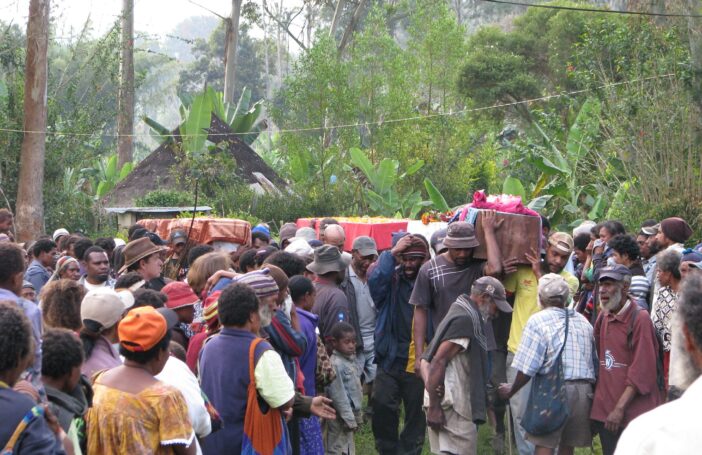
On an occasion when returning from Nipa to Mendi I drove past a newly painted coffin mounted on poles by the side of the road. Knowing what that mean’t I was pondering the ongoing tribal conflict when a small boy ran out to see my passing vehicle. In that moment I wondered how things might be for him when he reached twenty-five. We know the answer now.
Finding viable and inclusive pathways forward, especially for the young demographic is a challenge that must be met if PNG is to remain viable. In my view there is a need to rethink closely held theories of change and get behind a more bottom up people first agenda. We have the tools to do that. I agree that the nation’s greatest resource has for too long been overlooked. The hope and good will so apparent in the post independence years has evaporated and time is running out.
The chaps hamming it up in the picture are all smiles for the camera. Dressed more appropriately for a meeting in Port Moresby they would present a very difference picture. I don’t know any of them but I am prepared to bet that individually they are decent blokes.
The sad thing is that after five decades of failed service delivery coupled with a complete lack of participation in local activities that should have constituted nation building, they have reverted to the pre independence rule of law only this time with guns.
In the first decade, maybe decade and a half after independence this sort of behaviour was at a much lower level, the exception rather than the rule and restricted to only a few places in PNG as people placed a great deal of faith in their elected leaders to deliver. But by the late 1980s the signs that community patience with unfulfilled promises was wearing thin was apparent. In my view the window closed in much of the highlands by the mid to late 1990s. Today youth in some of the most peaceful locations imaginable such as Milne Bay province have given up and taken the law into their own hands with a recent purge by the police resulting in the deaths of many young men. This action has left many in the affected communities seething, their trust in government gone.
The writing was on the wall three plus decades ago but the warnings were not heeded by local government or partners focused upon strengthening systems that were alien and antithetical to PNG culture. The voices of the “common person” were simply ignored. Big resource developers who hid behind the letter of the law only exacerbated an already fragile situation. Bougainville needs no introduction but it is not alone.
If we truly believe in the concept of a stable and peaceful Pacific family, then I would urge our own leaders to start listening to more family members. There is on old and wise saying in PNG. There are some big trees in the forest and lots of smaller ones. You have only spoken to the big ones. You need to speak to all of them.
That photo was taken a while ago but it was a day after a couple of those guys had stepped in to save my life at considerable risk to themselves. Extremely decent blokes in my view. That location is in the foothills of Mt Sisa between Mt Sisa and Komo. I would say that rather than reverting to old ways things have moved towards an unprecedented time of extreme inequality that is combined with guns and a decline in services, including law and order services. Inequality destroys the social fabric of any country and in PNG it is extreme. Resource economies do not work when profits are sent offshore and cash is allowed to distort the national economy and breed corruption. This development paradigm has collapsed.
Having said that the story then becomes unimaginably complex. The one thing development partners should have realised by now is that 118 members of parliament cannot adequately represent 850 language groups and thousands of clans each with its own land and unique story – each essentially an independent nation. Nor do provincial or local level government representatives make a jot of difference in this reality. Nation building in such a complex environment has to be a two way street that recognises the traditional power structures in communities. Sadly that has not been the case. Until communities have agency over their own futures in an equal partnership with the State, very little is likely to change.
Last paragraph sums it up. The shortage of diesel excuse has been used since Moses was a boy. These events took place 100km from a huge natural gas extraction plant operated by ExxonMobil, Santos, TotalEnergies, and JX Nippon. There is not a shortage of resources to fund human capital development. There is a shortage of will.