


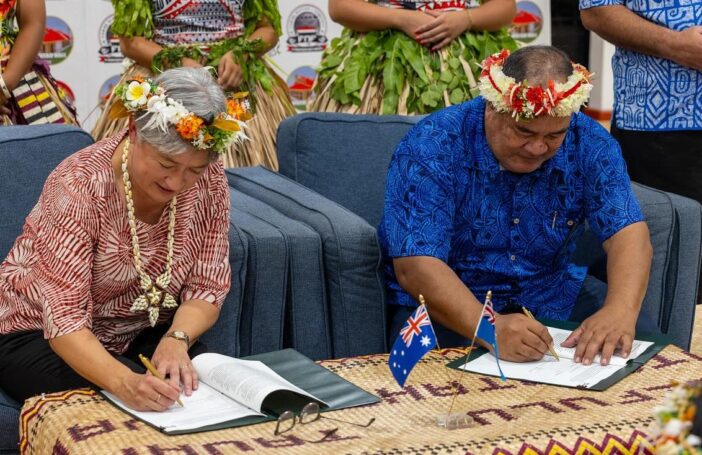
Tuvalu celebrated the official activation of its submarine cable, the Tuvalu Vaka Cable, on 24 October 2025. Funded by Australia, the United States, Taiwan, New Zealand and Japan and supported by Google’s inclusion of Tuvalu in the Central Pacific Connect system, the activation of the cable is a major milestone in Tuvalu’s connectivity journey.
Throughout its history as an independent nation, Tuvalu has steadily enhanced its internet connectivity. Yet, the country had previously been dependent on satellite systems that were vulnerable to bad weather, heavy rain and outages. Satellite bandwidth was also extremely expensive, limiting the amount of capacity the government could afford and making it difficult for agencies, schools and communities to fully embrace digital technologies. At one point, only 73 Mbps of bandwidth was available for the main Government Building.
This challenge became critical during the COVID-19 pandemic. When Tuvalu entered lockdown, the government needed to maintain uninterrupted communication with the outer islands, support remote schooling and continue essential public services. Tuvalu’s dispersed geography meant that disruptions in connectivity risked isolating communities and cutting off vital information flows. An agreement with Kacific in June 2020 increased national bandwidth to 640 Mbps through the deployment of multiple satellite dishes. This represented an almost twofold increase from Tuvalu’s pre-2020 baseline of 340 Mbps. Connectivity was further strengthened when the Starlink Community Gateway was introduced in 2025, delivering up to 3 Gbps of capacity (10 to 40 times more than pre-pandemic levels).
The cable marks a significant step forward with room to scale up to more than 10 Gbps, providing the high-speed, affordable and reliable connectivity needed to drive Tuvalu’s long-term digital transformation. It empowers the government to rapidly digitise public services, enable citizens to easily conduct online business, support cross-border transactions and provide access to platforms that were previously difficult to reach through satellite connectivity.
For nations like Tuvalu that are severely affected by climate change and sea-level rise, the cable is also critical to plans for future-proofing Tuvalu against a worst-case scenario where land is lost to rising seas. With the growing threats posed by climate change and natural disasters, Tuvalu must look toward sustainable and resilient digital solutions. Cloud-based and online services are essential to ensuring that Tuvalu’s data and operations remain accessible and secure no matter what happens to the physical environment. The cable can also boost Tuvalu’s resilience by allowing key systems to be hosted and backed up online.
In 2021, one of the authors (Kofe) announced the launch of Tuvalu’s Future Now Project. As part of the project, he described an initiative to create a Digital Nation, which involves building a digital government administrative system that can allow the country to shift its government operations to another location in the event of a worst-case scenario where Tuvalu’s land is lost due to climate change-induced sea-level rise. To date, the Digital Nation concept has blossomed into a multi-faceted initiative to digitally preserve Tuvaluan objects, stories and values in a Digital Ark database; create a Digital Twin of Tuvalu’s physical landscape; and develop wide-ranging e-government services to truly make Tuvalu a Digital Nation. On a small scale, we have already had success in creating digital stories about objects significant to Tuvalu’s history that had not previously been documented. The goal of the Digital Nation is not only to ensure the beauty of Tuvalu’s culture, land and sea is perpetually available but also to make digital technologies more accessible throughout Tuvalu.
For e-government services, one of the most significant initiatives now underway is the development of a national digital ID system, which will allow every Tuvaluan — whether living on the islands or abroad — to securely access government services online. The digital ID will simplify interactions with government, reduce paperwork and support fully digital services such as e-health, online education and online payments. It will also enhance inclusiveness by ensuring that all Tuvaluans, regardless of location, can participate in the country’s social and economic life. If Tuvalu’s land is lost to sea-level rise, fully digitised government systems additionally mean that Tuvalu can continue to provide government services for its citizens in a secondary location.
The submarine cable is critical to these efforts. Creating a digital copy of Tuvalu might be feasible outside of the nation, but how could we in Tuvalu enjoy and interface with it without improved connectivity? E-government services certainly cannot progress without the proper infrastructure, and our national effort to digitise cultural objects and values will only be successful if every Tuvaluan feels empowered and has the tools to actively participate in this movement.
Critically, while the Future Now Project and Digital Nation plan for a worst-case scenario where Tuvalu’s land has been lost, these initiatives do not constitute acceptance that this grim future will befall Tuvalu. The future we want is one where Tuvaluans can enjoy Tuvalu’s culture, values and physical abundance in Tuvalu while also having access to first-class digital archives and services. The submarine cable allows us to prepare for both the worst- and best-case scenarios.
Improved internet connectivity is not a cure-all, and the submarine cable may mean increased cyber-security threats, scams and cyberbullying, all of which Tuvalu must protect against. Yet, for a nation previously challenged by unstable and costly internet connections, the submarine-cable launch marks a new era for Tuvalu and its capacity. It gives the country more opportunities to prepare for the impacts of climate change, circumvents issues of size and geographic location previously seen as limiting Tuvalu and jumpstarts the country’s connections to the global marketplace.
The Tuvalu Vaka Cable is not simply about technology — it is about securing Tuvalu’s future. It helps Tuvalu build a Digital Nation while also improving day-to-day life for those living in the physical nation.

This is a thoughtful and inspiring discussion about Tuvalu’s digital future. The launch of the Tuvalu Vaka Cable clearly represents more than just improved internet—it empowers citizens to engage with e-government services, access cultural archives, and connect with the global community. While challenges like cyber-security and scams remain, the potential benefits for education, commerce, and climate-change preparedness are immense. For nations exploring ways to leverage technology while safeguarding citizens.