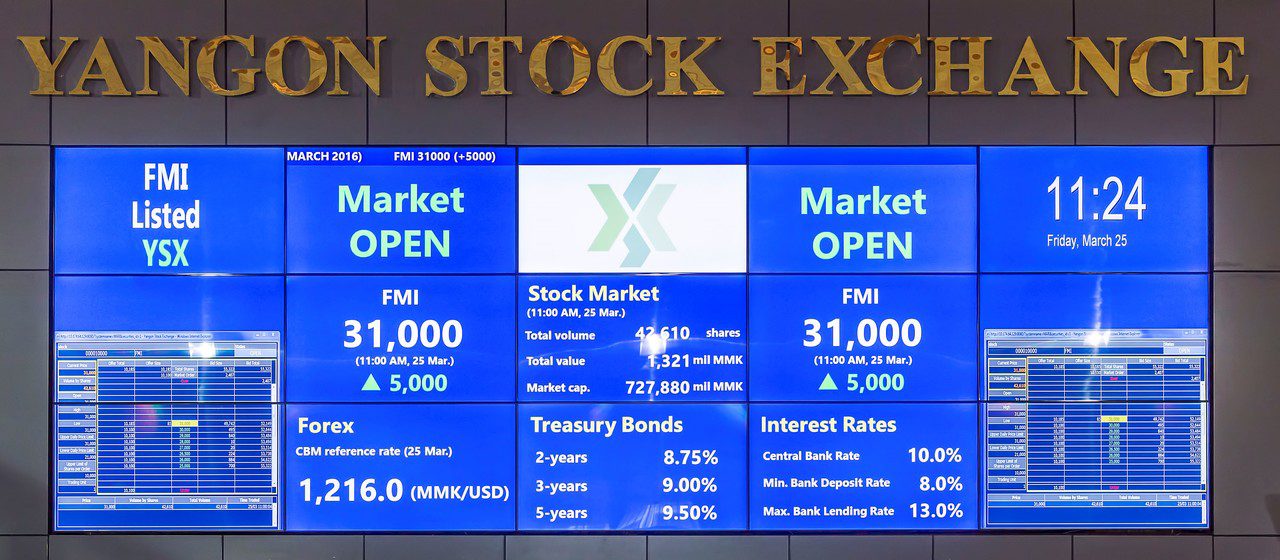
The establishment of the Yangon Stock Exchange (YSX) in 2015 was a beacon of Myanmar’s deepening economic liberalisation. Moving in tandem with political liberalisation, its launch by the outgoing military-backed Thein Sein government arrived shortly after Aung San Suu Kyi’s National League for Democracy won a landmark election, ushering in a period of genuine civilian rule.
Yet, between the YSX’s opening and the military takeover in 2021, activity on the bourse was underwhelming. While it was initially reported that 200 companies were aiming to list, only six ultimately did so. When the military seized power, it was feared that economic contraction, sanctions and disengagement would cause the YSX to slide into irrelevance, like its undistinguished predecessors.
The country’s capital market history justified this scepticism. The Rangoon Stock Exchange, established in the 1930s, traded very few stocks before being forced to close in 1962, when General Ne Win’s military government nationalised public companies. Its successor, the Myanmar Securities Exchange Centre, opened in 1996 but lacked a physical trading floor. It featured just two listed companies, the Forest Product Joint Venture Corporation and the Myanmar Citizens Bank, and was effectively dormant.
Because those early exchanges were so inactive, they were written off as vanity projects designed to lend a veneer of legitimacy to authoritarian regimes under colonial and dictatorial rule. However, a similar analysis does not fit the modern YSX. Although military rule has fuelled cronyism and monopolisation, it has not been accompanied by the total dismantling of market reforms. For instance, an April 2026 amendment to the Securities Exchange Law signalled institutional evolution by giving foreigners a clearer legal basis to participate in the securities market, while clarifying some grey areas for the mandate of the regulator, the Securities Exchange Commission.
Trading and listing activity are acutely modest, yet the YSX’s continued functioning keeps key elements of a modern capital market machinery intact rather than allowing them to become stranded.
Prior to the military takeover, in 2020, 4,093,866 shares were traded on the exchange for a value of Ks20.77 billion (US$15.73 million), according to the YSX’s annual report. Trading plummeted the following year as the military seized power, dropping to 944,578 shares valued at Ks4.81 billion (US$2.70 million). Trade grew year-on-year until a dip in 2025 before recovering rapidly in 2026. As of the end of July 2026, 3,365,766 shares changed hands for US$3.86 million (at the open market exchange rate), already surpassing the value of all trading in 2025.
New companies have listed under military rule. Hotel and tourism services company Amata Holding (current market capitalisation US$9.94 million) listed in 2021, followed by the agricultural market development firm Myanmar Agro Exchange (MAEX) in 2023 (US$36.24 million). The YSX’s Pre-Listing Board (PLB), designed as a less stringent testing ground to prepare companies for a main board listing, has, after long delays, welcomed its first listings: Myanma Agricultural and General Development in 2024 (US$14.42 million) and G.B.S Agricultural Services in 2025 (US$91.50 million).
The additions of MAEX and G.B.S bring weight to the market, representing medium- and large-capitalisation listings relative to the size of the exchange. Moreover, while trading remains far below 2020 levels, this does not make it insignificant. It must be viewed in a context where 2020 pricing was based on optimism about an economy forecast to reach middle-income status by 2030, while today’s pricing is based on the circumstances of a country experiencing the world’s second-most intense violent conflict.
As of the end of July 2026, the YSX main board’s market capitalisation stood at Ks1.57 trillion (US$358 million). This is dwarfed by regional peer exchanges such as those of Laos and Cambodia, which each host 12 companies with market capitalisations of US$1.09 billion and US$3.11 billion respectively. It is noteworthy though that authorities in Laos and Cambodia orchestrated the listing of dominant state utilities, telecoms firms and state-backed banks. Myanmar’s state took a far more hands-off approach. This left the YSX without state-backed anchor assets, but shows that activity on the exchange has been driven more by perceived commercial utility than government direction.
Looking ahead, state media claimed in April 2026 that an electronic and health device trading firm is slated to list this year, while several other companies are preparing to join the PLB, including the telecoms and machinery firm Asia Pacific Business Group.
Given that Myanmar’s broader economic outlook remains tepid, with the World Bank cutting its growth forecast, one could assume that firms aspiring to list would defer doing so. With limited growth opportunities, it seems unwise to take on the underwriting, compliance and regulatory burdens of a public company, particularly since firms might fail to achieve the initial public offering prices they could have commanded had the economy been performing well.
However, listing on the YSX continues to hold appeal for three reasons.
The exchange offers an avenue to raise capital. For investment-starved companies, listing provides an alternative to debt markets, which might otherwise compromise financial stability. Tellingly, the companies that joined the YSX and PLB since 2023 all operate in agriculture. This sector has tight margins that would be wiped out by debt interest, so auctioning equity is an attractive option.
Listing also provides reputational advantages. Companies are hoping that the rebranding of military rule as civilian rule, following the sham elections that concluded recently, will be a precursor to greater stability and renewed international engagement. Public companies would be well-placed to benefit from eventual re-engagement, leveraging their listed status to showcase strong governance, operational capacity and market leadership.
Finally, diversifying equity ownership and submitting to the governance standards associated with listing can serve as a structured succession plan for family enterprises. Partly inspired by Singapore-listed Yoma Strategic Holdings, some family-run conglomerates in Myanmar view listing as akin to safeguarding their legacy. Listing ensures that when the business transitions to the next generation, it is bound by corporate governance standards and accountability mechanisms, reducing the risk of its value being squandered.
Ultimately, while activity remains modest, the YSX has not been rendered irrelevant like its predecessors. It importantly carries aspiration through open-market principles, transparent reporting and opportunities for retail investment in a market that has historically been highly exclusionary, and has the potential to be a rare counterweight in an economy that is otherwise showing patrimonial tendencies.