


As Papua New Guinea celebrates 50 years of independence, we reflect on progress made in improving health and strengthening relationships.
Our experience through a major program on maternal and child health, Healthy Mothers Healthy Babies (HMHB), is that having strong, resilient health systems is a key foundation for independence — and the partnerships that sustain our region.
Since independence there have been many important gains in the health of PNG’s people. For example, life expectancy has increased substantially, and infant and childhood mortality rates have progressively declined.
However, PNG faces major health challenges. The maternal death rate is among the highest in the world, with infant mortality rates the highest in the region. Up to half of all children under five years old experience poor growth — known as stunting — alongside poor nutrition in many parts of PNG. Children also experience a heavy burden of malaria, respiratory infections and diarrhoeal diseases, as well as gaps in immunisation coverage. Health issues such as a high burden of anaemia, malnutrition and infections have major economic, social development and educational impacts on families across the country.
More than ten years ago, we established the HMHB program, which brought together researchers, national and provincial health managers, frontline healthcare providers and community leaders. The aim was to uncover the causes of poor maternal and child health in PNG and to develop effective and sustainable solutions.
This partnership included the Burnet Institute, the PNG Institute of Medical Research, the East New Britain Provincial Government and Health Authority, Catholic Church Health Services and local health services across East New Britain, the University of PNG and the PNG National Department of Health.
Partnerships work best when they respect local leadership, build capacity and are grounded in people’s lived realities. The HMHB program showed that when we work together in a long-term commitment, progress follows.
Addressing the major challenges in maternal and child health required strong collaborations, supported by a strategic program of research that was aligned with local and national priorities, and community needs.
The program approached health challenges comprehensively. We all understood that enhancing maternal and child health required addressing not only specific medical conditions, but also the wider interconnected systems, barriers and enablers that influence health and well-being.
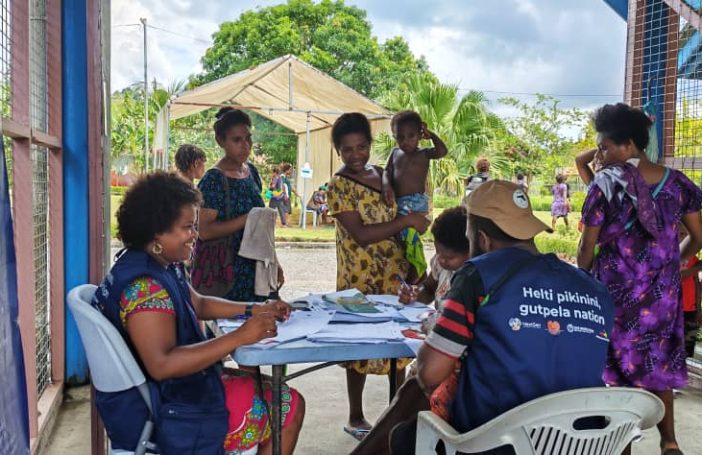
HMHB integrated its work within the existing health infrastructure and services, rather than working separately. Research was embedded in hospitals, health centres and communities, including remote and hard-to-access areas.
Taking a comprehensive view was crucial to understanding the extent to which women and children face multiple, overlapping health issues.
For example, we were able to quantify the burden of malaria and sexually transmitted infections during and after pregnancy.
The program also identified new causes of low birth weight and childhood stunting, and the related problems of nutritional deficiencies and anemia, revealing that interventions to combat stunting ideally need to start during pregnancy rather than after birth.
In parallel with research activities, the program piloted new interventions and strategies. These included improving quality of health care for mothers and babies during and after pregnancy, and evaluating new diagnostic tests.
A strong health system and healthy population will greatly contribute to PNG’s independence, resilience and growing prosperity. Preventing health emergencies, such as epidemics and pandemics, helps safeguard political and social stability.
An important focus into the future is reducing maternal and newborn deaths by continuing to strengthen access to quality antenatal, childbirth and postnatal care; tackling childhood stunting and malnutrition; and addressing the ongoing burden of infectious diseases such as malaria, respiratory infections and sexually transmitted infections in mothers and children. With such a large population of young people in PNG, addressing adolescent health is also a priority area for a strong and healthy future.
The measure of progress is not only political sovereignty, but the health of women, children, and communities more broadly. The next 50 years depend on acting together to build on this progress.
The authors would like to acknowledge the contribution of Tasha Wibawa to this blog.




Thank you, BI PNG team, for this report, as highlighted in your second last paragraph there is more to be done to decrease the mortality rate of maternal and newborn child. However, the population is increasing every time, and the available services are not adequate to cater for every needs. People in authorities need to do something.
Reply to Sue Funnell: I agree that family planning is very important for maternal and child health and something we did address in Healthy Mothers Healthy Babies. We have previously published the findings from our studies of unplanned pregnancies and family planning – Peach E, et al, Scientific Reports 2021 – https://doi.org/10.1038/s41598-020-79103-6
In brief, we found that just over half women had pregnancies that were unintended or unplanned. Very few women reported ever using a modern method of family planning and over half of women felt they had insufficient knowledge about family or how to access it.
Thank you for the reference. I had seen the article some time ago but it is helpful to have a reminder. I recall seeing the finding that unintended pregnancies were more prevalent amongst educated women. That seemed counterintuitive and I wondered if there was some causal mechanism or third factor contributing to the correlation.
Healthy mothers healthy babies: I’m surprised that you didn’t mention the importance of access to modern contraceptives and family planning – being able to choose when to have children, how many children to have, spacing them and reducing adolescent pregnancies is important not only for child and maternal health but has so many other benefits as well for individuals, their families and communities. Amongst these are increased capacity of girls and women to continue their education, reduced drain on limited resources arising from smaller families, gender equity in decision making and so on. Context: I manage the grants program for a small philanthropy that funds Australian registered NGOs such as Australian Doctors International to deliver improved access to family planning in PNG ( and other Asia Pacific countries). The projects we fund include not just delivery of contraceptives as part of the work of outreach teams but also working with and enhancing capacity of Provincial Health Authorities and volunteer health workers as well as community education related to family planning. Typically they operate in difficult to reach communities in remote regions rather than in cities. I appreciate that increasingly some family planning work is occurring post partum but additional focus on family planning for the wider population before pregnancy would also be helpful. Has this been part of the HMHB program and if not what opportunities are there to place a greater focus on Family Planning for the wider population of PNG?