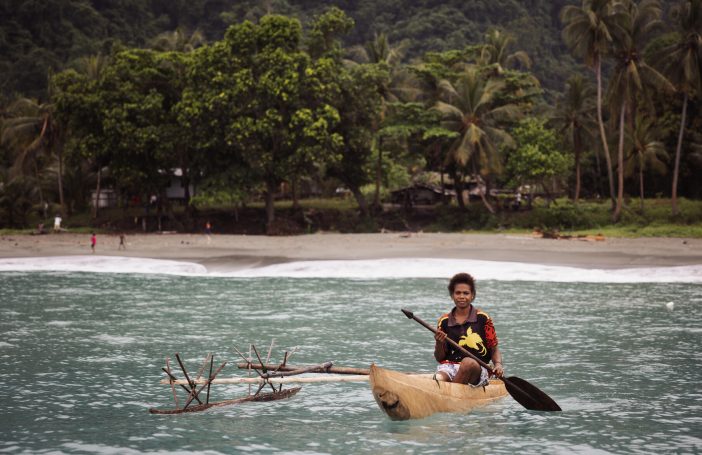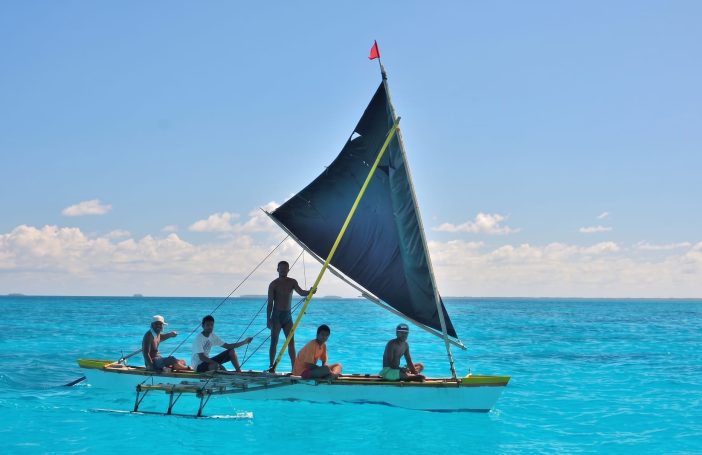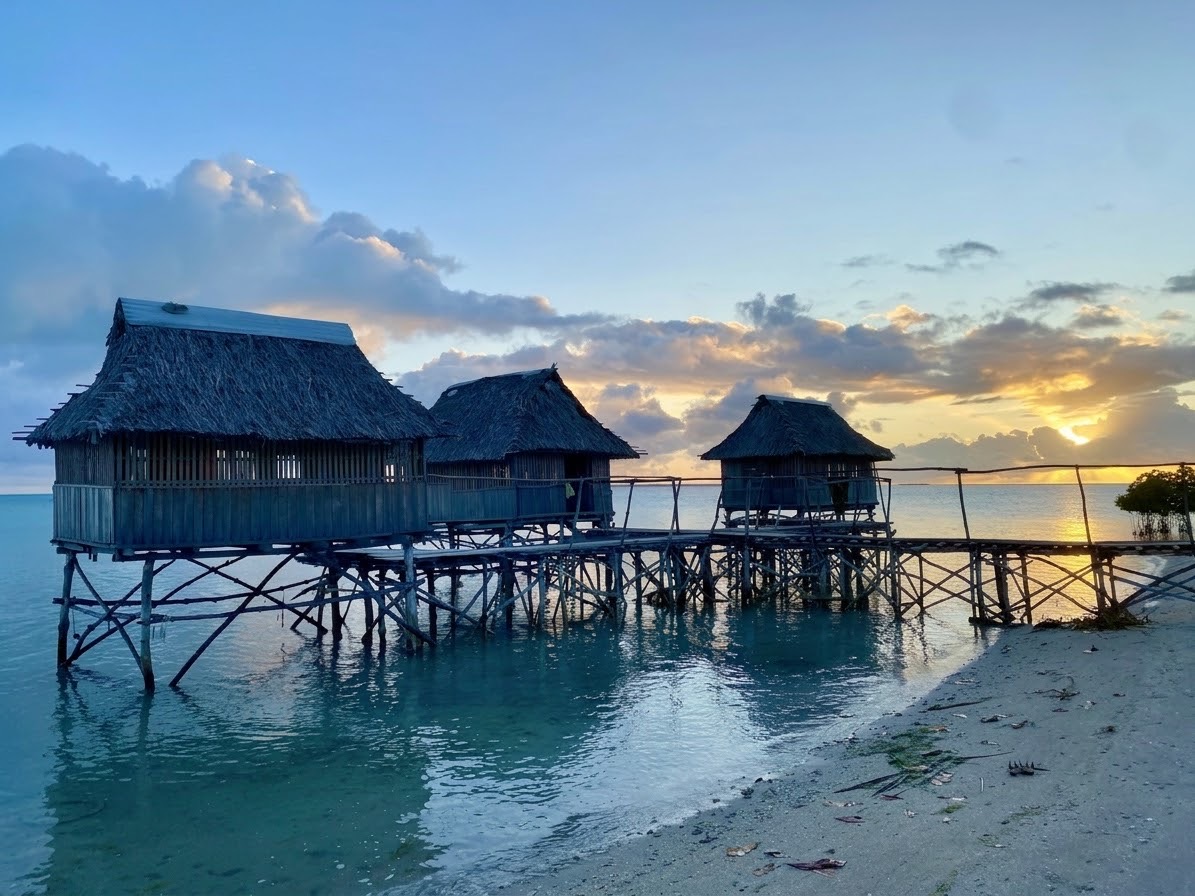
In the ancestral oral tradition of Kiribati, survival at sea has never been passive. Gilbertese tradition honours Nei Nimanoa, the voyager goddess and guardian ancestress of te tia borau (navigators). The voyaging tradition she guards calls for decisive action on unpredictable waters: reading the deep swells, adjusting the outrigger and bailing water from the canoe before the hull is swallowed. When the ocean crests over the gunwales, the crew balances the craft and acts immediately to save everyone aboard.
Today, across the low-lying atolls of Kiribati, the ocean is cresting over the land. A very strong El Niño, declared across the Pacific in June, is compounding sea-level rise, lifting sea levels in the central Pacific and driving extreme king tides, coastal erosion and storm surges that sweep into homes and maneaba, destroying food crops and wells, while heavy rains bring flooding and contamination risks. With most land no more than two metres above sea level, Kiribati’s narrow strips of coral sand leave no high ground to which families can retreat. Saltwater breaches shallow wells and poisons the underground freshwater lenses that sustain life.
Families are already moving houses back from the shore and rebuilding wells, while international climate finance still moves through lengthy procedures. Kiribati’s own engagement with the Green Climate Fund (GCF) readiness process has stretched over nearly a decade. This gap between climate urgency and institutional pace would be an inconvenience elsewhere. For atoll nations, it places homes, water and livelihoods at risk. Kiribati welcomes the GCF’s new nine-month target. For frontline coral atolls, climate finance delayed is protection denied.
The challenge is shared across Small Island Developing States (SIDS). Under conventional multilateral climate finance rules, funding operates almost entirely on an ex-ante, or upfront, approval model. Before a single dollar is disbursed to fortify an eroding coastal bund, elevate a causeway or install emergency water desalination, governments must work through multi-year feasibility studies, baseline analyses and accreditation processes. Climate risk is moving faster than those timelines.
Women, young children, older persons and persons with disabilities in remote outer islands carry the heaviest load when approvals are slow, and they also hold much of the knowledge needed to respond. When king tides breach village barriers, it is women who must trek farther across flooded terrain to find drinking water. Caregivers must carry elderly relatives and children over submerged causeways, and persons with disabilities find their mobility severed when paths wash into the sea.
For presentation at Pre-COP31 in Fiji, the Leaders’ event in Tuvalu (5 to 8 October) and at COP31, Kiribati proposes a dedicated Ex-Post Reimbursement Window linked to a vulnerability-informed access gateway within existing multilateral funds, such as the GCF and the Adaptation Fund.
The mechanism operates within the existing accredited entity system, avoiding a politically fraught overhaul. Accredited entities currently work mainly at the front of the project cycle, where projects can spend long periods in feasibility redesign. The Kiribati proposal shifts their role to post-completion technical and financial verification.
A qualifying SIDS government facing acute hazards funds urgent resilience works upfront using national contingency reserves or a short-term concessional bridge facility. Eligible works would be drawn from an agreed list: coastal defences, saltwater intrusion barriers, water security infrastructure and the climate-proofing of community shelters and evacuation centres. After construction, a regional direct access entity, such as SPREP or the Pacific Community (SPC), conducts an on-site audit. Upon certification, the fund secretariat reimburses the bridge facility, with a proposed turnaround of 90 days from submission of a verified claim. Women’s organisations and organisations of persons with disabilities could help set the list of eligible works and take part in on-site verification. The 90-day period and the initial list reflect Kiribati’s current thinking and are offered as a starting point for discussion with partners, not as settled rules.
Ex-post reimbursement on its own favours economies with stronger balance sheets, leaving smaller, debt-constrained island states behind. The design answers this with two safeguards. The bridge facility and the guaranteed reimbursement timeline exist so that capital-constrained states are not asked to carry prolonged financial exposure while awaiting replenishment. Access is then limited by a vulnerability index covering physical and geographic exposure, such as low elevation, shoreline retreat and outer-island isolation; structural economic exposure, such as narrow revenue bases and debt-servicing capacity; and sub-national social exposure, including gender-disaggregated water vulnerability, disability access and the needs of older people and children. Because the index can be applied below the national level, it could identify which states, or which parts of a state, qualify, which is important for remote outer islands whose exposure is hidden in national averages. The methodology draws on the Multidimensional Vulnerability Index adopted by the UN General Assembly in August 2024, and remains a working draft to be co-developed with SIDS. Existing windows stay open to all.
The proposal gives practical effect to the specific needs of SIDS and least developed countries recognised under Articles 4.8 and 4.9 of the UNFCCC, and to Article 9.9 of the Paris Agreement, which calls for simplified approval procedures for both groups. Kiribati’s design translates these provisions into differentiated fiduciary arrangements, simplified baseline requirements and expedited review timelines.
Kiribati will work with Pacific partners, the Pacific Political Climate Champions and platforms such as the UN Commission on the Status of Women to advance the mechanism’s social equity protections. We are asking three things of partners.
First, in-principle support for including a vulnerability-informed, ex-post reimbursement window in the Pacific Islands Forum Leaders’ communiqué from the Tuvalu meeting.
Second, that SIDS and Pacific representatives on the GCF Board table a pilot of the window for low-lying atoll states and others facing acute vulnerability.
Third, that support be broadened beyond the Pacific through the Alliance of Small Island States and, where appropriate, the Least Developed Countries Group, so the proposal enters the UNFCCC process with a wide base of sponsorship.
The objective is COP31 guidance to the operating boards of multilateral funds to establish the window, anchored in the New Collective Quantified Goal (the global climate finance target agreed at COP29) and in the guidance issued to the financial mechanism, and building on COP30’s call to at least triple adaptation finance by 2035.
Our islands are changing shape, and our people are changing with them. Our ancestors read the swell and acted. We are asking the world’s climate funds to do the same: approve the ex-post rules, release upfront liquidity and back frontline nations as they protect the islands their families have cared for over generations. As President Maamau told the UN General Assembly in September, “national action must be matched by international action.” Everything this proposal asks for is already agreed in principle. What remains is implementation.