Over the last decade, Chinese lending behaviour in the Pacific has shifted considerably. Increasingly, its financial assistance to the region is in the form of grants rather than the loans it had previously provided, with new lending now being concentrated in Melanesian countries. However, for countries such as Tonga, loans taken out in the late 2000s are now entering the steepest phase of their repayment cycle, putting fiscal pressure on recipient governments.
While China has cancelled a significant amount of developing-country debt, this has almost entirely consisted of interest-free loans administered through the Ministry of Commerce and latterly the China International Development Cooperation Agency — an instrument reserved for smaller-scale projects and technical cooperation. The debt now straining Pacific budgets, Tonga’s above all, is fundamentally different.
Tonga, Samoa and Vanuatu received loans for large-scale infrastructure projects: a wharf, road networks, government buildings and the regeneration of an entire central business district.
These were financed by the Export-Import Bank of China (Eximbank) on terms Beijing classes as concessional (2% interest, around five years’ grace, twenty-year maturity) but which fall short of the 35% grant-element threshold the International Monetary Fund (IMF) and World Bank use to define concessional borrowing. Beijing subsidises the interest rate, but the principal sits with Eximbank, which carries the exposure on its own balance sheet and answers to its own financial sustainability requirements. By the time a borrower needs relief, the question of what relief is available has already been determined by the choice of instrument.
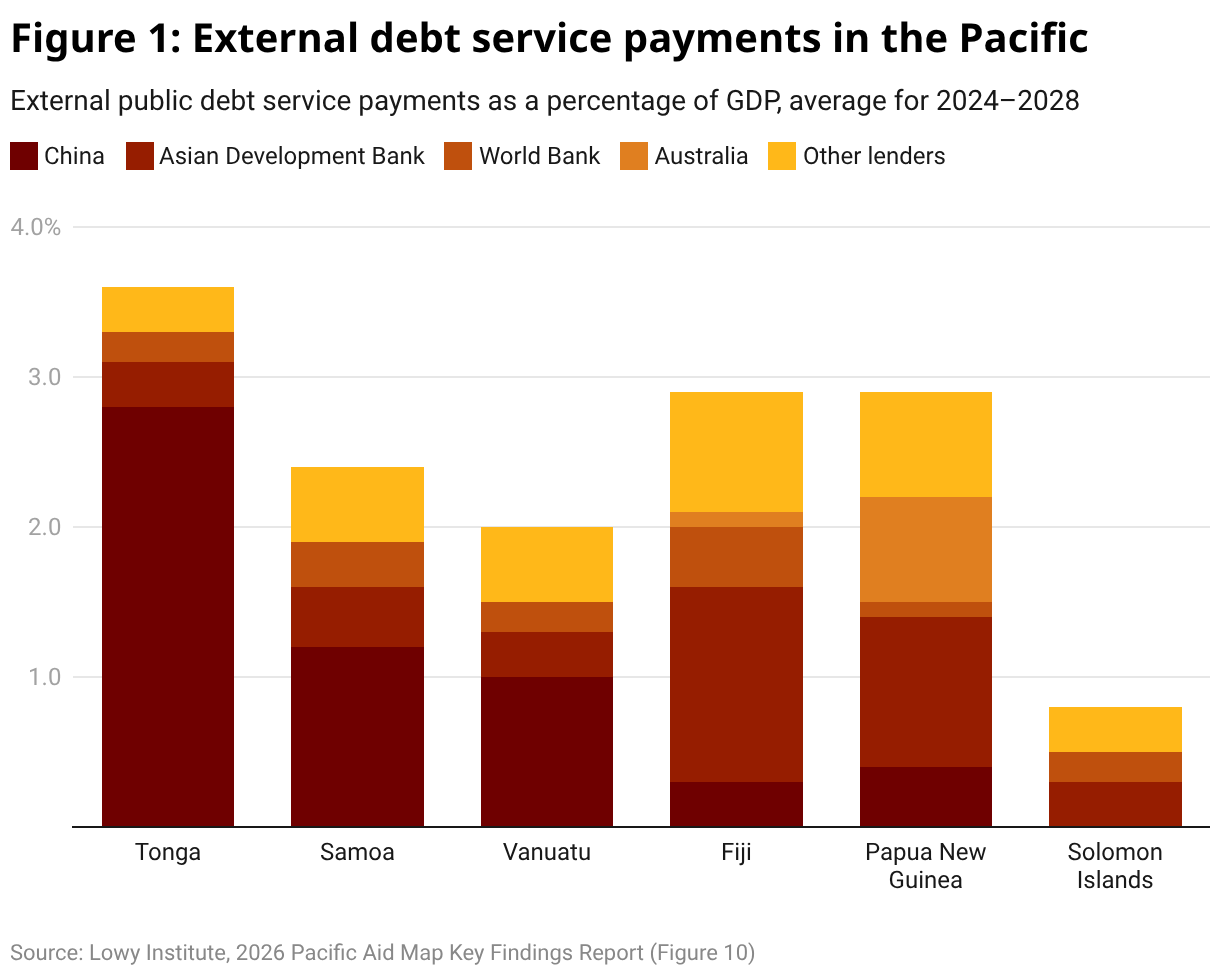
Tonga is the extreme case. Samoa and Vanuatu are in less acute positions: Samoa is not assessed at high risk of debt distress, and Vanuatu’s external risk is rated moderate, although its overall risk of debt distress remains high. Samoa faces repayments to China averaging 1.2% of GDP over 2024–2028, which represents approximately half of its external debt service. Vanuatu’s average is around 1.0% of GDP, and its repayments are forecast to stay elevated for longer than Tonga’s or Samoa’s, on a profile consistent with Chinese lending having continued past 2017.
Tonga is the clearest illustration of the mechanism described above. Its two outstanding Eximbank loans — US$96.1 million (in 2023 dollars) in 2007 to rebuild the Nuku’alofa central business district following the 2006 riots, and US$55.3 million in 2010 for the third phase of the national road improvement program — together amounted to approximately 30% of the country’s GDP.
Both loans carried standard Eximbank terms: a five-year grace period, 2% fixed interest and twenty-year maturity. Repayments began only in the 2019 financial year, after the grace period had already been extended twice, with the heaviest falling due from the 2024 financial year (FY2024). Over 2024–2028 they are forecast to average 2.8% of GDP a year, approximately 80% of all Tonga’s external debt service.
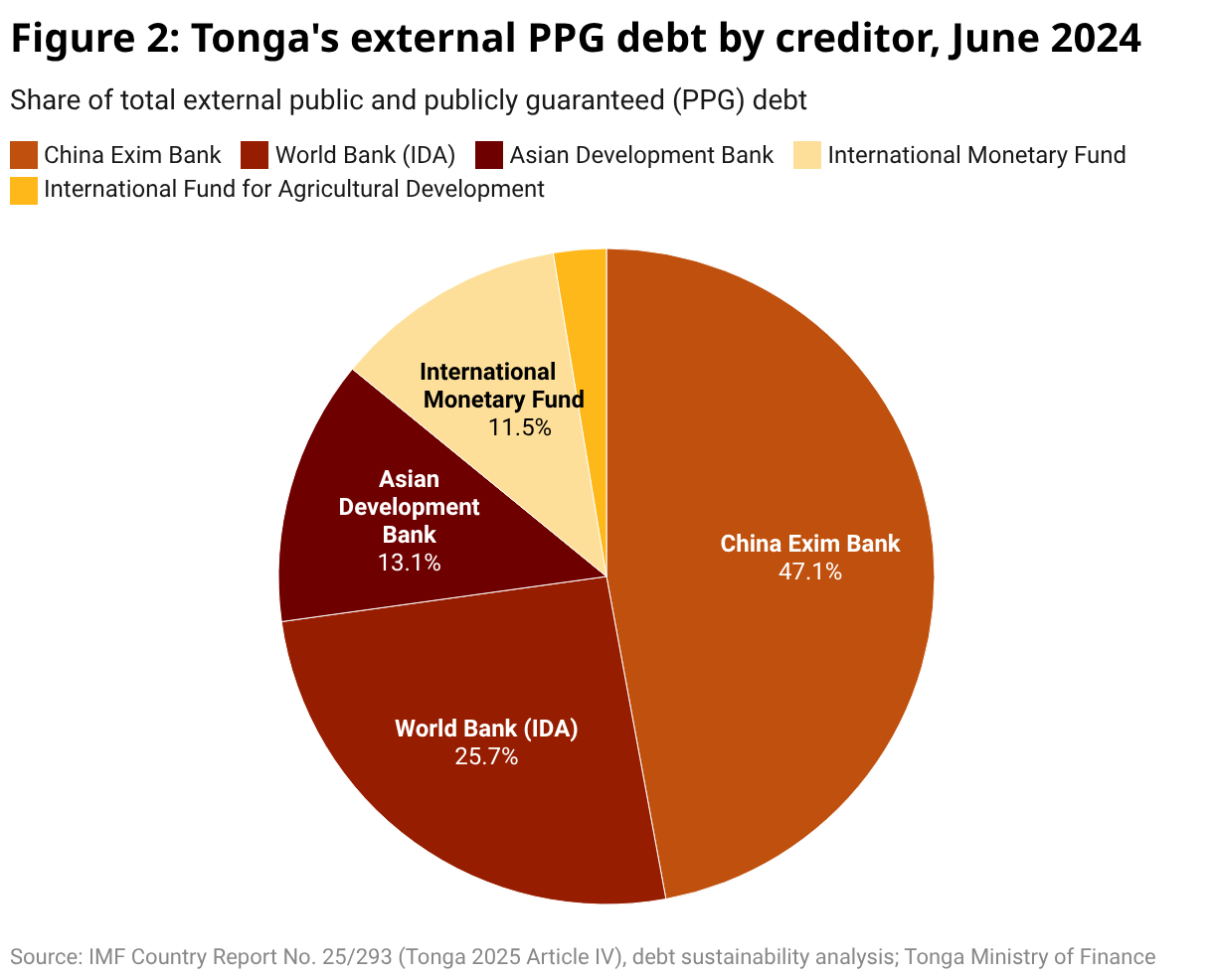
Tonga’s outstanding balance is a rounding error against Eximbank’s wider exposure in South Asia and Africa, and so writing it off would cost the bank relatively little financially. However, any moves toward restructuring or forgiveness are priced in part by the precedent they establish. Eximbank lends on materially identical terms across dozens of developing countries, many of which have taken out loans of larger magnitude and face repayment pressures at least as acute. Forgiveness in one case risks increasing pressure to replicate write-offs elsewhere, where larger sums in play threaten to undermine the commercial logic which drives the bank’s business model.
Compounding this is the absence of a mechanism that would allow Eximbank to treat Tonga as a special case. Unlike Paris Club creditors, Chinese lenders operate under no requirement of comparable treatment and within no framework that compensates a lender for accepting a loss on public-policy grounds. A decision to write down would have to be taken on Eximbank’s own account, justified against its own financial sustainability requirements, and defended against every debtor who may read it as an opening to negotiate their own balance.
The Debt Service Suspension Initiative illustrates the consequences of this institutional landscape. Beijing participated in the arrangement, and Tonga’s request to halt its 2020 obligations to Eximbank was accepted and later extended through 2021, representing a temporary respite equivalent to 1.4% of GDP in the 2021 financial year (FY2021). Yet the underlying fiscal burden remained unchanged. The February 2021 joint World Bank–IMF debt sustainability analysis compares repayment projections before and after the suspension: liabilities in FY2021 dropped to zero, while subsequent obligations rose from 0.8% to 1.1% of GDP in the 2023 financial year, and from 2.8% to 3.1% in FY2024.
Rather than granting substantive relief, the framework merely shifted payments into periods already burdened by severe servicing requirements. Short-term forbearance cost Eximbank nothing in present-value terms and required no decision about the loan itself. The initiative was designed to defer payments, not to extend maturities: the concession that would have imposed a real loss, and forced a creditor to reopen the loan terms, was never part of the arrangement. The system accommodated the concession that was costless and withheld the one that was not.
This is where the question becomes Australia’s. Canberra has already provided additional budget support that helped ensure the viability of Tonga’s repayment schedule, and Tonga has separately sought Australian help in securing a restructuring from Beijing. The second has limited prospects for the reasons set out above: Australia has no more purchase on Eximbank’s balance sheet than Tonga does, and advocacy that cannot change the lender’s calculation buys little beyond the goodwill of being seen to try.
What remains is the first. Budget support is fungible, so no Australian funding can be tied to an Eximbank repayment. But money that keeps the Tongan budget solvent while 2.8% of GDP a year leaves it for Beijing makes Canberra the indirect payer on debts it had no part in incurring. This is cheap relative to the alternatives, and it keeps a close partner in the Pacific solvent. But it is currently happening by default rather than by design, and as repayments stay elevated through the rest of the decade this arrangement will likely continue. It is worth asking whether Canberra intends this as a basis for Australian engagement in the region, and for how long it is prepared to operate on these terms.