The $4 billion Australian Infrastructure Financing Facility for the Pacific (AIFFP) is Australia’s largest single development financing vehicle. The AIFFP currently comprises up to $3 billion in non-concessional loan and guarantee capital and up to $1 billion in aid grants. While spending under the latter can be fully counted toward Australia’s Official Development Assistance (ODA) budget, only the “grant-equivalent” proportion of the loan disbursements can be counted as ODA, provided it meets minimum levels agreed among OECD donors. Announced by the Morrison government in 2018, the AIFFP became operational in 2019. According to its 2023-24 annual update, the facility now finances or cofinances 28 individual infrastructure and climate projects in ten Pacific Island countries and Timor-Leste.
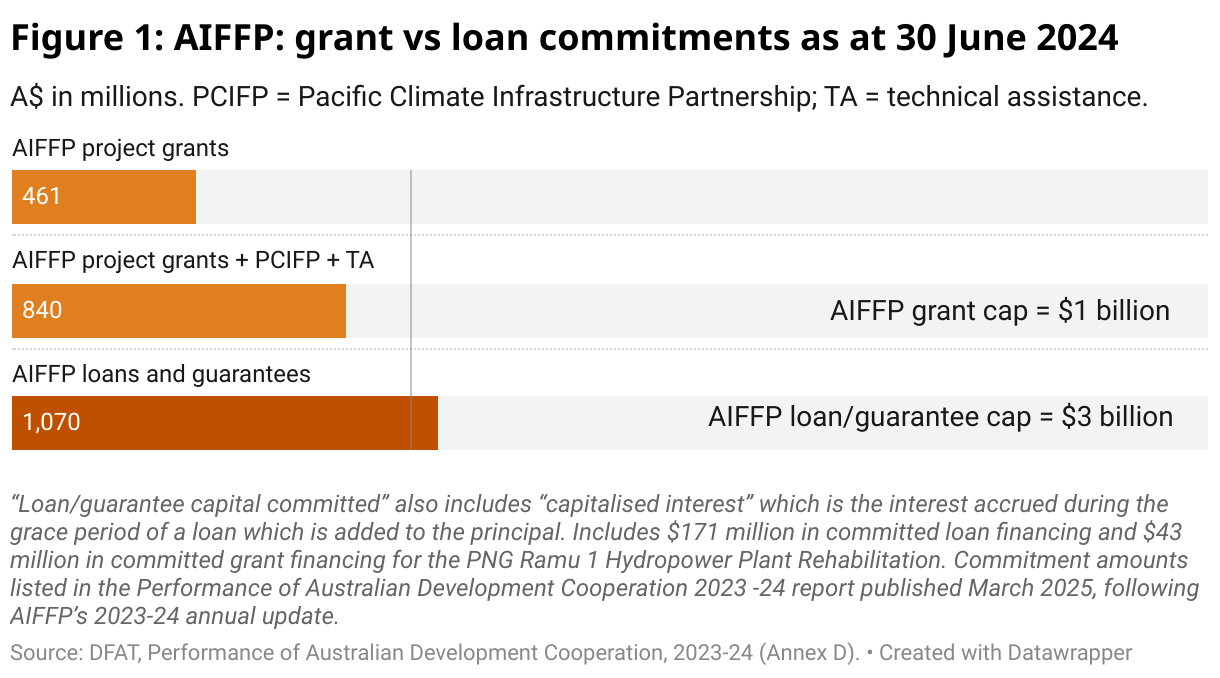
Looking at the most recently available data, what is most striking is the extent to which the AIFFP — notwithstanding its establishment as a largely non-concessional lending facility — is heavily reliant on ODA grants in practice. As at the end of 2023-24, DFAT reported that the AIFFP had loan and guarantee commitments valued at $1.1 billion and grant commitments valued at $840 million (see Figure 1). This means that the AIFFP will hit its current $1 billion grant financing cap much sooner than it will hit its $3 billion loan financing cap. Indeed, depending on its 2024-25 spending outcome, the facility may have already reached the grant cap.
There are two factors largely responsible for the faster growth in the AIFFP’s grant funding commitments, one on the supply side and one on the demand side.
The first, supply-side factor is that, in addition to the $461 million in grants committed either to soften the terms of loans or to wholly fund capital works, AIFFP grants are also being used to fund the Albanese government’s Pacific Climate Infrastructure Partnership (PCIFP), as well as the AIFFP’s technical assistance (TA) costs. The latter include “project preparation and implementation costs such as feasibility studies, and monitoring and evaluation expenditure”.
The $350 million PCIFP was announced by Labor during the 2022 federal election campaign. Since its establishment in 2023, it has mainly been directed toward funding for small-scale renewable energy projects. These projects are unlikely to generate a commercial return and are therefore unable to be funded via loans. All ten of the PCIFP projects listed in the AIFFP’s 2023-24 annual update are fully grant-funded.
In terms of technical assistance, the AIFFP’s 2023-24 annual report says it now has 64 staff working in five countries — Australia, Timor-Leste, Fiji, Solomon Islands and PNG. A large proportion of these staff are likely to be in roles funded by the AIFFP’s grant component. The consulting firm Tetra Tech currently holds a contract with DFAT worth $44 million (2021-2026) for the provision of AIFFP “investment preparation and support services” and additional contracted technical staff are assigned to individual projects or work within DFAT.
The second, demand-side factor is that of all the countries eligible for AIFFP finance, only PNG, Fiji and Timor-Leste are currently classified by the World Bank as “blend countries” that can borrow on non-concessional terms. This reflects the traditionally weak credit ratings of most Pacific countries due to their small economic size and vulnerability to external shocks, as well as the region’s worsened fiscal and debt outlook in the wake of the COVID-19 pandemic. Seven Pacific countries, including PNG and Fiji, are currently rated by the World Bank and the International Monetary Fund as being at “high risk” of debt distress. And, as other regional lenders would likely attest, it is not as if there is a surfeit of highly bankable, large-scale infrastructure projects waiting to be discovered across the region.
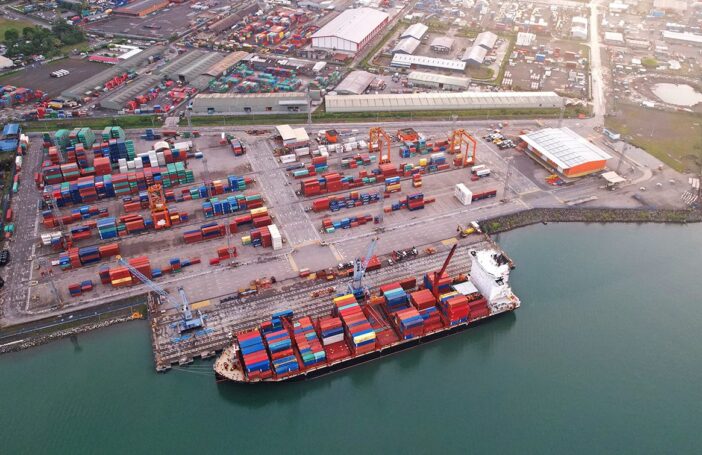
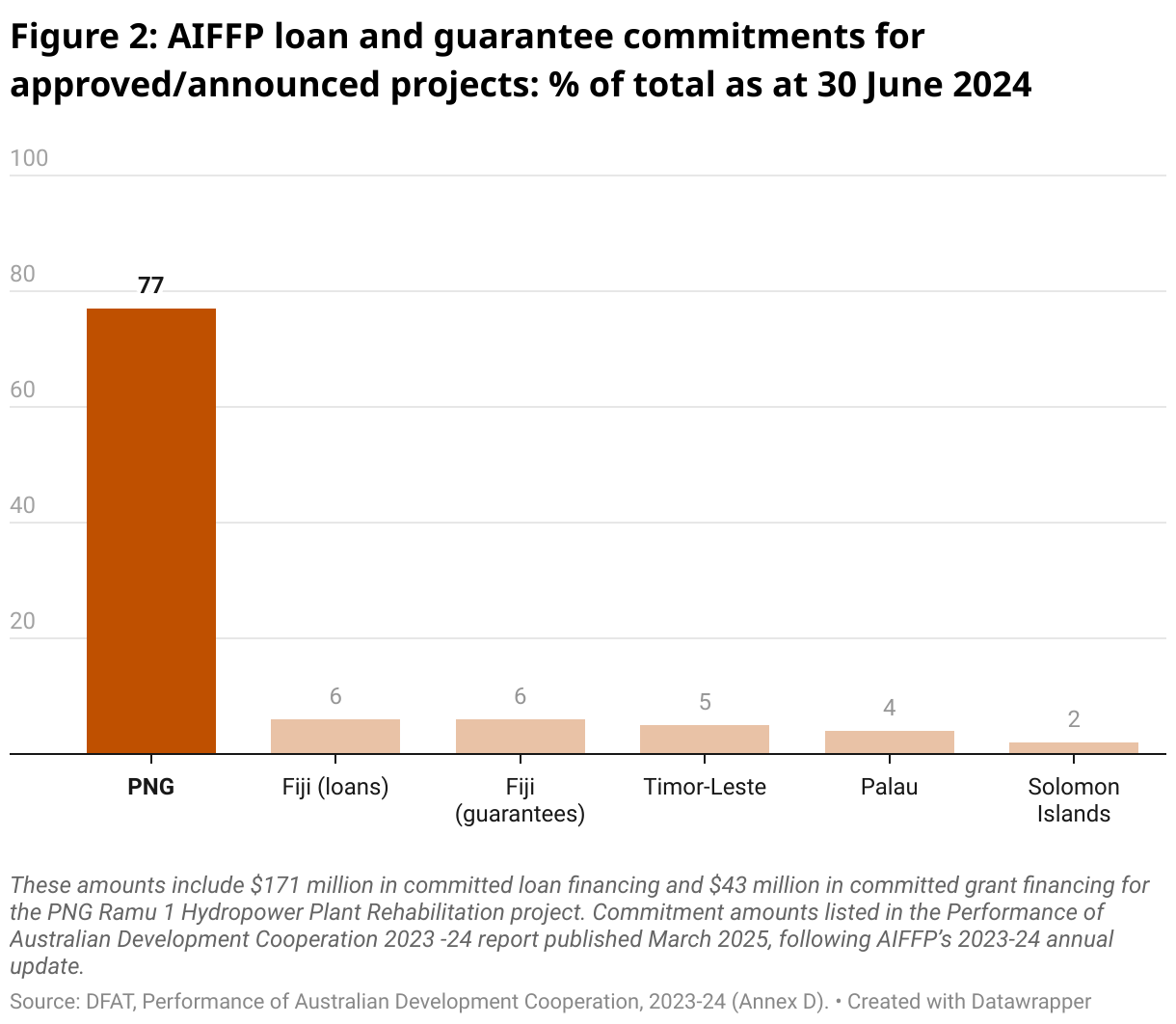
Moreover, while maintaining the AIFFP’s character as largely a non-concessional lending facility, the Albanese government has also repeatedly said it will not place “unsustainable financial burdens” on Pacific countries. The result is that of the $1.1 billion in AIFFP non-concessional loan commitments, PNG accounts for over 77%, or $828 million (Figure 2). Of this, almost 60% ($521 million) is for a single project — the Upgrading Ports Across PNG project, which also includes a grant finance component of $100 million.
The reliance on grant finance is also evident when one looks at spending rather than commitments. In 2023-24, the AIFFP spent $101 million through its grant component and disbursed just $34 million in loans. This is a spending ratio of 3:1 in favour of grants, the exact reverse of the AIFFP’s establishment ratio of 3:1 in favour of loans. Cumulatively, after six years, the AIFFP had spent $191 million in grants (19% of the cap) and disbursed $254 million in loans (8% of the cap).
None of this should be viewed as unexpected. Writing in 2019, Stephen Howes and Matt Dornan contrasted the Morrison’s government establishment of the AIFFP as a largely non-concessional loan facility with the Howard government’s decision to lend $500 million in project finance to Indonesia, an economy with a much bigger capacity to borrow than Pacific countries. The Indonesia loan facility lent at very concessional rates in the wake of 2004 Indian Ocean tsunami. Howes and Dornan concluded that “very few Pacific Island countries are able to borrow on non-concessional terms” and that “this raises questions about the ability of the Pacific to absorb more debt, and in particular to absorb more non-concessional debt. In turn, this raises further questions about the largely non-concessional nature of the AIFFP.”
Despite these questions, the Morrison government proceeded with its model and the Albanese government has retained it. The Liberal-National Coalition even went so far as to double down during the 2025 election campaign, promising to increase the AIFFP’s non-concessional lending cap from $3 to $5 billion, with no accompanying increase in the grant cap.
Ultimately, and unsurprisingly, the result of the Pacific’s limited ability to absorb non-concessional debt — along with growing TA costs as AIFFP’s portfolio expands, as well as the use of AIFFP grants to fund small-scale climate mitigation projects — is that more grant finance will need to be allocated to the AIFFP if it is to be able to expand its investments, particularly outside PNG.
On current commitment trends, the AIFFP’s loan to grant ratio is 3.0 to 2.4, or almost 1:1. If this trend persists, AIFFP would need another $1.4 billion in grant finance to meet its $3 billion non-concessional lending cap. It is not clear whether additional grant finance for AIFFP has already been provisioned for within DFAT’s internal allocations. Either way, this will have to come at the expense of other Pacific, regional or global aid programs given the government’s decision in the 2023 budget to keep overall ODA flat in real terms for at least the next decade.