“What does accountability mean?”
A volunteer treasurer in Fiji asked us this in the opening minutes of a mentoring session we had planned as a quick refresher on financial management. We had assumed the basics were in place. For that organisation, they were not.
At the 31st Conference of the Parties to the UN Framework Convention on Climate Change (COP31) in Antalya, the Pacific has again put finance at the centre. The Taku Pakasoa Declaration, adopted on 6 October 2026 during the Pacific Pre-COP31 held in Tuvalu and Fiji, calls for a substantial increase in climate finance, particularly for adaptation in capacity-constrained countries.
But finance reaches a village only through an organisation or institution that can receive, record and report on it. Our argument is that the usual approach of getting organisations “ready” before they receive money fits poorly with how community organisations build durable capability. They build it by using finance, with someone alongside them. The question for locally led finance discussion in the region is not whether community organisations are ready for more climate finance, but whether the way finance is delivered leaves them more capable after each investment than before.
The gap between rhetoric and delivery is wide. The International Institute for Environment and Development’s 2025 tracking study found that, even in the best year, less than 0.5% of reported climate finance could be deemed locally led, despite more than 150 governments, institutions and NGOs endorsing the locally led adaptation principles. Developing countries are estimated to need USD310–365 billion a year by 2035 for adaptation, while international public adaptation finance flows reached only USD26 billion in 2023, down from USD28 billion in 2022. More money will not fix the last mile on its own.
The conventional response to weak local capacity in the region is a generic readiness model: a one- or two-day national workshop, one slide deck, then funding for those deemed ready. The approach assumes basic systems exist. In the Pacific, many frontline organisations are volunteer-run, with treasurers who keep the books after family and community work, and with largely paper-based records. They hold community trust, but often lack the administrative scaffolding that donors take for granted.
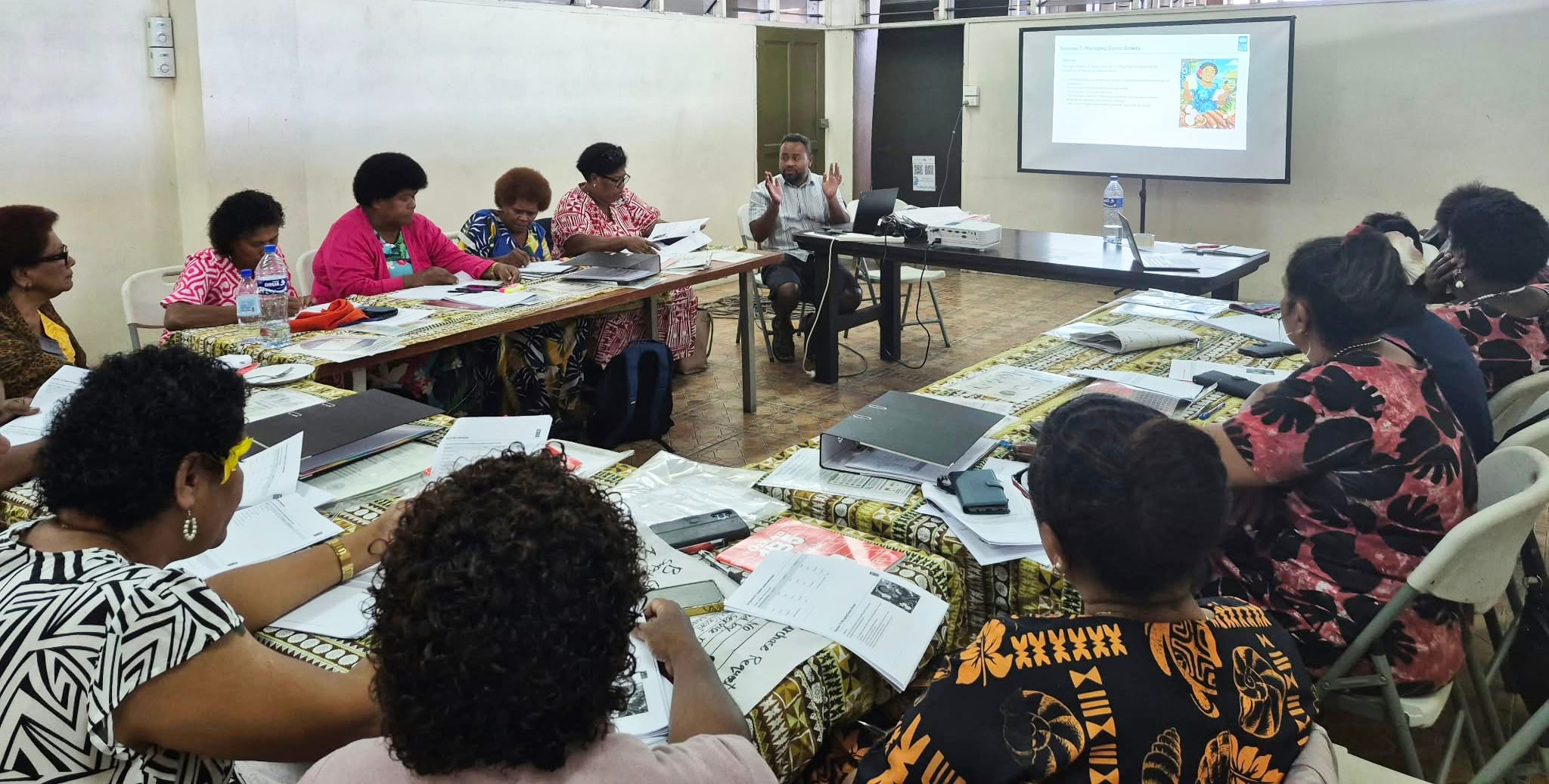
We see this in the United Nations Development Programme (UNDP) Small Grants Initiative (SGI), which funds 25 local civil society organisations across Fiji, Solomon Islands, Vanuatu, Tonga and Tuvalu. The Rocky Mountain Institute (RMI), where we work, is its capacity-building partner. Our baseline showed highly uneven starting points, so we used it to tailor support rather than as a test. From February 2026, instead of national workshops, we ran sequenced online mentoring, mostly one-to-one or in small groups, with each session tied to a grantee’s live project. We have completed 27 sessions for 20 organisations so far, and support continues as projects are implemented until the program ends in May 2027.
Of the 27 sessions, 15 delivered to ten organisations have already produced tangible, if early, results. The remaining sessions cover topics such as good governance, advocacy and influencing, which are at an earlier stage and whose results will take longer to show. In Fiji, nine sessions with eight organisations moved participants from unfamiliar jargon to raising payment vouchers, filing records and preparing financial reports, with the first batch submitted in June. In Solomon Islands, three sessions on proposal development helped an organisation in Temotu Province secure new funding from outside the UNDP system. In Vanuatu, a grantee has begun drafting a fundraising strategy after three sessions on fundraising.
This works because support is built into delivery. It creates a safe space for questions that feel personal: asking what a voucher is, or who should sign off a payment, is hard in a room of peers and donors. It lets us demonstrate routine behaviour rather than describe it, with one transaction raised, approved, recorded and filed from start to finish. And it supplies tools such as receipt books, cash ledgers and filing materials as onboarding deliverables rather than assumed assets.
The grant then does two jobs at once. It finances a community outcome, and it provides the live setting in which organisational capability is built. That is closer to an apprenticeship than a training course, and to what the locally led adaptation principles mean by patient funding.
Organisational capability should be treated as infrastructure. Climate finance primarily pays for physical infrastructure such as solar systems, water supply and coastal protection. Locally led finance also depends on organisational infrastructure, including financial controls, record keeping, procurement, reporting and governance. If community organisations are part of how locally led climate finance is delivered, investing in their capability should not be treated as an overhead. It is part of the infrastructure needed to deliver it.
That infrastructure is neither cheap nor fast. It needs diagnostic skill, tailored materials, mentors’ time, devices and data, and patient follow-up. Against a small grant it will look expensive. But a grant that cannot be properly acquitted costs more, in late reports, lost trust and stalled projects, and unlike a workshop, the investment stays with the organisation when the project ends. The program is still under way, so the real test is whether these organisations manage their next grant, from any funder, with less help than this one.
The same applies to the Pacific Resilience Facility (PRF), which the declaration commends. It will deliver small grants to communities and had more than USD200 million pledged as of 15 November 2026, leaving roughly USD300 million to raise against an initial capitalisation target of USD500 million due by the end of 2026. Other parties have been invited to associate themselves with the declaration. We suggest three ways to give its call for speed and scale practical meaning.
First, when announcing contributions to the PRF and other regional or national funds, donors should signal that a share will pay for multi-year mentoring built into grants, not a separate readiness program.
Second, the emerging action plan on access to finance should let support be sequenced to each organisation’s starting point.
Third, funders should work towards a common capability baseline, starting from existing ones such as the SGI’s, so organisations are assessed once and evidence on what lifts capability, and at what cost, can be compared.
Pacific community organisations are not short of commitment. They are short of the organisational infrastructure that lets commitment count in a grant system. If the Pacific and its partners use COP31 to insist that every locally led investment leaves stronger institutions behind, the declaration’s call for speed and scale will have something solid to stand on.