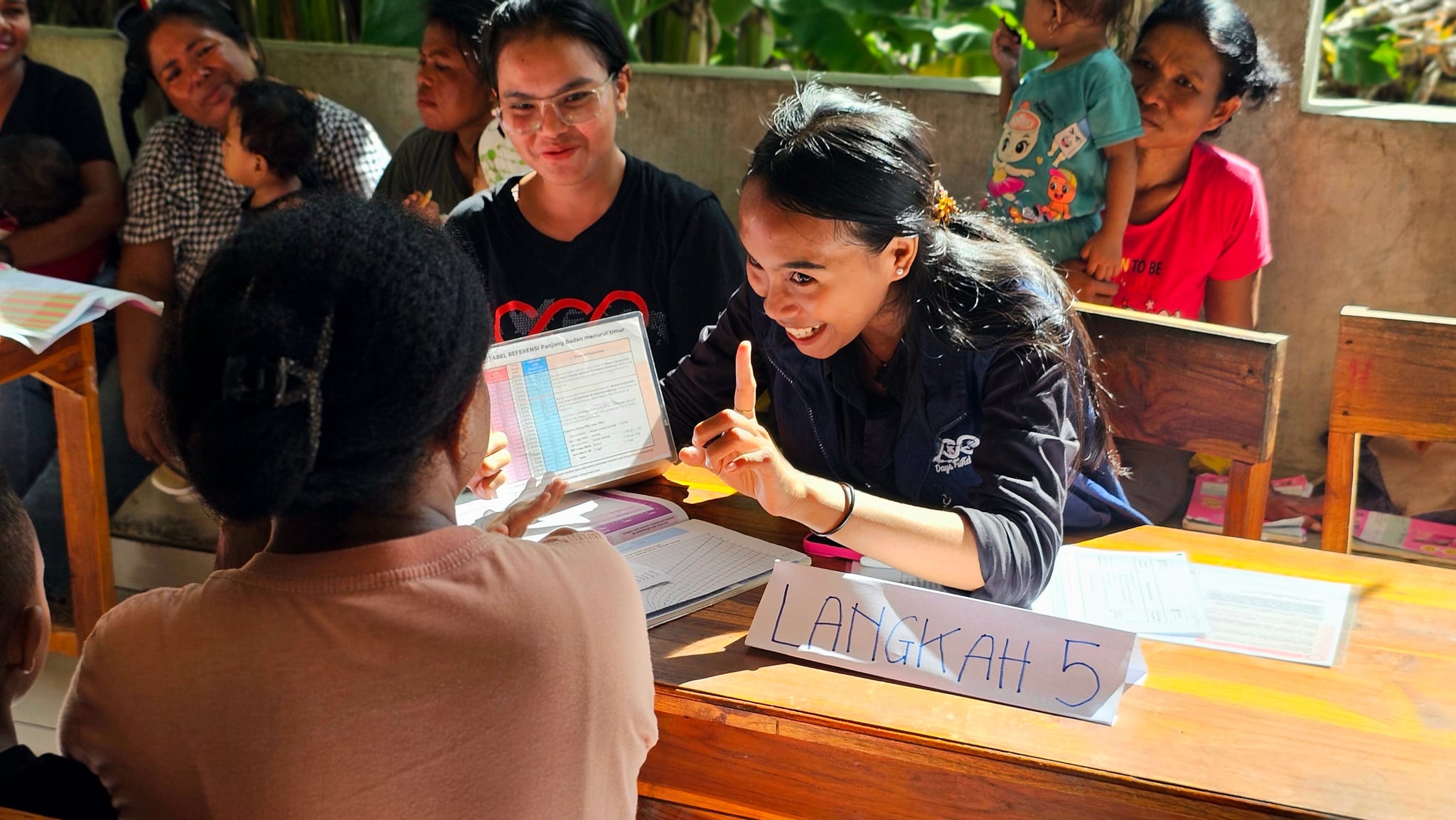
Around the world, care work keeps families alive yet often goes unpaid. In Indonesia, this is the case with Community Health Workers (CHWs) and their work in stunting prevention. An analysis of 1,819 households in 177 villages finds a positive link between CHWs’ capacity and family health outcomes, even though the work of CHWs is largely taken for granted.
In 2018, the International Labour Organization (ILO) estimated that people spend 16.4 billion hours a day on unpaid care work globally, with women doing 76.2% of it. If valued at the minimum wage, that work would equal 9% of global GDP. The ILO finds that unpaid care work “remains mostly invisible, unrecognised and unaccounted for in decision-making”.
The economists Balwant Singh Mehta and Aasha Kapur Mehta point to one reason: labour statistics do not count people who provide unpaid care as workers at all.
Care work stays unpaid or underpaid across many settings. At home, mothers raise children without compensation; meanwhile, advocacy for domestic workers in Indonesia extended over 22 years, from the first draft bill in 2004, before protection was recognised in law by Indonesia’s parliament, the Dewan Perwakilan Rakyat, in April 2026. The health system relies on the same dynamic. Women in Global Health counts at least six million women working unpaid or “if lucky enough” underpaid in community health roles worldwide, titled “volunteer”.
Indonesia’s 1.5 million CHWs, known in Indonesian as kader and in English as cadres, face a structural paradox under the Ministry of Health’s technical guidelines for village health service units (Juknis Unit Pelayanan Kesehatan Desa/Kelurahan). They are formally embedded alongside certified health workers (doctors, midwives, nurses) and subject to demanding requirements, including physical and mental fitness, literacy, digital competence and prior experience. This is codified in the Ministry of Health’s curriculum for Posyandu CHWs, which specifies 25 basic skills and stratifies CHWs’ competencies into three formal levels (basic/purwa, intermediate/madya and advanced/utama).
In practice, CHWs deliver on these high expectations as the backbone of local healthcare. They run the monthly posyandu (community health post) session, where they weigh and measure children and counsel mothers, and they also conduct door-to-door home visits to provide information about stunting.
Where a mother or baby needs more attention, CHWs are often asked to cook and deliver supplementary food, known as Pemberian Makanan Tambahan, directly to households. A commentary co-authored by staff of the 1000 Days Fund (TDF), a non-profit working on stunting prevention in Indonesia, describes them as the primary drivers of community nutrition across Indonesia, and community nutrition is the main means of preventing stunting. Nonetheless, the state continues to treat CHWs as volunteers.
TDF’s own research in two villages in North Lombok reveals what happens under that label. Of the 130 CHWs surveyed, 92% were women. The median CHW gave about 26 hours a month to community health work for a median incentive of USD10.10. Hours varied widely: the middle half of the sample reported between 16 and 59 hours a month, and a minority worked much longer, so the average was about 47 hours.
The study valued that average month of work in two ways. At the 2023 minimum wage for North Lombok district (IDR2,367,323 a month, or about IDR14,796 an hour on a 40-hour week), 47 hours comes to IDR691,076, or about USD46.54 at the World Bank official exchange rate for 2022. Valued instead at what CHWs reported earning in their other jobs, the same time is worth about USD13.81, a figure the authors note understates the value of CHWs’ time because 55% had no other occupation. The CHWs also spend a median of USD2.90 a month out of their own pockets on the work, mostly on transport. Most of them report financial strain while doing this “voluntary” work. Despite small incentives, most CHWs continue their service, citing the traditional Indonesian spirit of mutual cooperation, gotong royong.
While the gotong royong spirit holds village life together, it also leaves an uncomfortable question: what is the payback? By expecting women to do care work for almost nothing in return, district and village governments effectively erase this component from their budgets, leaving women to cover the gap through their own pockets and time. Peace researcher Johan Galtung called this kind of systemic exploitation “structural violence”, a harm “built into the structure and shows up as unequal power and consequently as unequal life chances”. A health system that extracts skilled labour while labelling its workers “volunteers” fits that description, leaving CHWs and their families to shoulder the burden.
The same commentary reports that 20% to 30% of CHWs drop out each year, and attributes that turnover to inadequate incentives and an unmanageable workload. Every time a cadre steps down, the village loses part of the local capacity that the research below measures.
A second, larger study bears on what that capacity is worth. It was carried out jointly by TDF, which supplied the program monitoring data, and a researcher from Udayana University in Bali, who analysed it. Their preprint, not yet peer reviewed, covers 1,819 households in 177 villages across six provinces. This is a different sample and a different question from the North Lombok survey, which measured what the work costs the CHWs themselves.
In that sample, 45% of households had knowledge about stunting and 43% had used posyandu services, with wide variation between villages. Many factors account for those differences, including Indonesia’s regional disparities. The research team tested one: CHWs’ capacity.
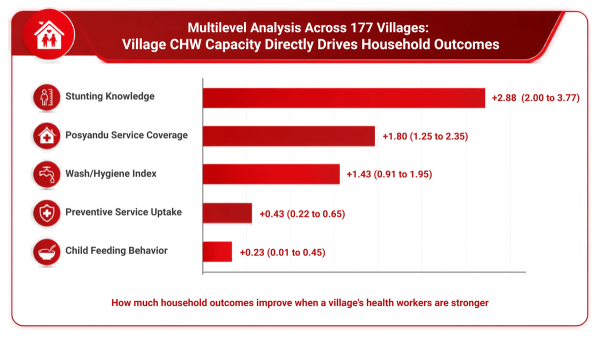
To measure it, they built a CHW capacity score from five parts: (1) the CHWs’ formal education; (2) years of service; (3) training received; (4) their own knowledge of stunting; (5) how complete their equipment was. They then compared that score against six household outcomes: stunting knowledge, posyandu service coverage, water, sanitation and hygiene practices, antenatal care, child feeding and uptake of preventive services including vitamin A supplementation, deworming and ownership of the Maternal and Child Health Handbook.
Households in villages with higher CHW capacity scored better on five of the six outcomes. For every one-standard-deviation increase in the CHW capacity score, household outcomes were associated with the following changes:
Source: 1000 Days Fund.
The associations held after the team accounted for household income, education, age and employment. They held again when the team dropped villages where a single CHW supplied the capacity data, and when it dropped the one village that made up a fifth of the sample. Antenatal care showed no association, which may reflect a ceiling effect: nearly every respondent in that small group already had the top score, leaving little variation to detect. The data capture a single moment, so they show association rather than cause. The authors conclude that CHW capacity is something governments can act on directly, through training, equipment and retention, and that doing so is likely to improve household health outcomes.
CHWs carry Indonesia’s stunting prevention efforts into village homes. A gender-responsive approach starts by calling care work what it is: skilled, measurable and worth paying for. It means treating these women not as casual help, but as professionals who earn a living wage and have a voice in the programs that rely on them. Ultimately, the success of stunting prevention depends on whether the women who drive it can afford to stay.
Cadres are volunteers on paper and a workforce in practice. It is time public budgets reflected that reality.