In recent years, adaptive management (AM) has become something of a buzzword in the aid sector. It differs from more traditional aid approaches by its ability to detect and respond both to a program’s own “learning by doing” and to windows of opportunity or threat. These windows might open in response to the appearance of a new leader; a crisis that shakes the status quo and makes decision makers suddenly become open to new ideas; or a new social movement or other organisation that offers new possibilities of change. Rather than sticking to the original plan, AM encourages staff and partners to pivot in response to these new signals from the wider system.
To do this, the level of analysis and decision-making required to remain relevant and incorporate learning is markedly higher than in traditional aid programs.
AM’s promise, or hypothesis, is that adaptive programs will yield better results because they “dance with the system”, enabling aid dollars and relationships to be brought to bear with greater effectiveness in a complex and uncertain world of shifting political players, social norms and social organisation.
So far, however, many of the best-known examples of the explicit use of AM have been in relatively small programs. DT Global’s Tracking Adaptive Management Initiative (TAMI) aims to fill that gap by working with larger-scale Department of Foreign Affairs and Trade (DFAT) programs trying to apply AM. We want to better understand the distinct challenges or advantages they face, and make recommendations to DFAT, DT Global and the wider development community about how this learning can lead to improved practice.
The three programs are Building Community Engagement in Papua New Guinea (BCEP) — a largely civil society-focused program; Partnership for Inclusive Prosperity (PROSIVU) — an economic governance program in Timor Leste and Tautai — an economic governance program in Samoa.
To kick off the TAMI study, we compared the enabling and constraining conditions for AM across the three programs at inception, and what was learned from applying an “intentional approach” to AM from the outset. All three programs baselined their adaptive conditions, using DT Global’s AM framework, then agreed a level of ambition — how adaptive they could and should be, and a strategy for achieving this. This common approach allows some level of comparison across the programs, despite differences in political contexts, program histories and budgets.
The baselines showed that all three programs faced mixed initial conditions for adaptive management, with several significant factors at times frustrating efforts to be adaptive.
BCEP had the advantage of a good design based on existing components and partners across a wide range of actors that should collectively be able to influence change. However, a heavily pre-allocated budget greatly limited the flexibility needed to respond to emerging opportunities.
PROSIVU had the advantage of some good existing relationships, staff and activities, but faced the challenge of transitioning from being a technical assistance program to a more politically informed program, coupled with minimal budget flexibility.
Tautai had the advantage of high flexibility but faced challenges in creating relationships with a new government and therefore identifying entry points with real transformative potential.
Some of the above factors were within DFAT’s control (for example, budget size and flexibility) while some were within DT Global’s control (for example, getting the right staffing and monitoring, evaluation and learning (MEL) systems in place). Context-related factors were more often outside the control of the program.
Yet positively, all three programs had teams that were willing to question assumptions, recognising that solutions to their chosen issues were not known at the start. This lack of rigidity is far from the norm in the sector.
Our comparison yielded some useful insights into the enabling and constraining conditions for AM in the inception phase of large-scale programs:
The adaptiveness spectrum. Adaptive or non-adaptive doesn’t need to be viewed as a dichotomy, at least for large-scale programming. It can be seen as a spectrum and one that can be used in a nuanced way that encourages different levels of and approaches to adaptiveness within one large-scale program.
Analytical rigour. A high degree of thinking is necessary to continuously understand context, question approaches and solutions, and make decisions across program strategy, delivery, MEL, operations and stakeholder relations.
Resource intensity. Setting up for AM at large scale highlighted its resource intensiveness and this should be factored into design and procurement.
Value for money. Maintaining a focus on value for money, explaining how AM can support both effectiveness and efficiency, can help a program justify its approach.
Intentionality advantages. Some initial wins emerged even during the inception process. These included: better dialogue with DFAT, leading to enhanced understanding of the inherent uncertainties involved in programming in complex contexts, and flexibility on issues such as setting up “responsive funds” to seize windows of opportunity or support new development actors.
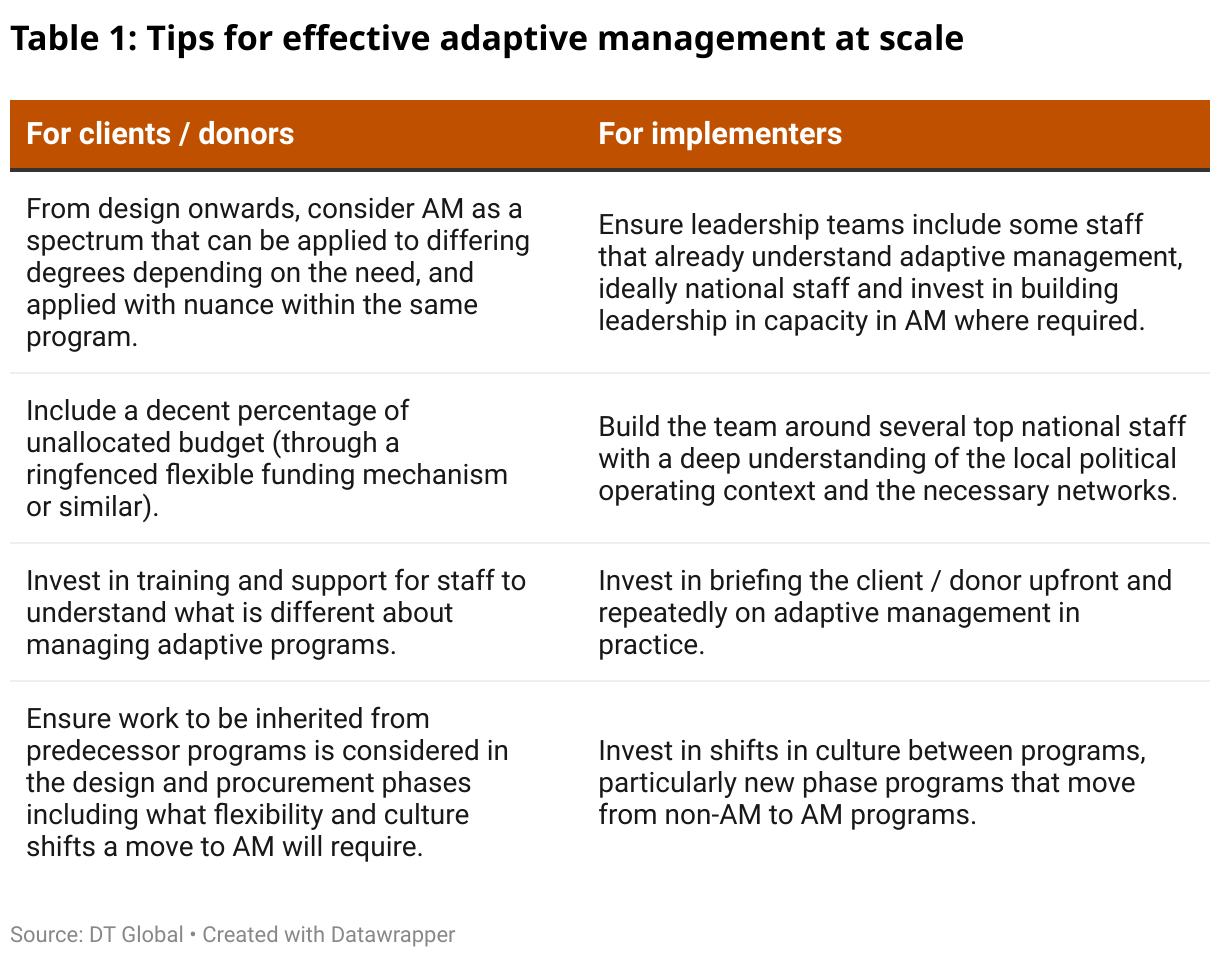
So what should we do differently going into large-scale adaptive programs?
Are you up for an exchange on this? We’d be really interested to hear others’ experiences of working adaptively at scale.