From Berlin to Delhi, powerful nations still decide Pacific futures without Pacific voices in the room.
The Quad’s latest Fiji port announcement is being sold as development assistance. But to many in the Pacific it looks uncomfortably familiar: distant powers gathering behind closed doors, shaping regional futures and expecting island nations to accept decisions already made elsewhere.
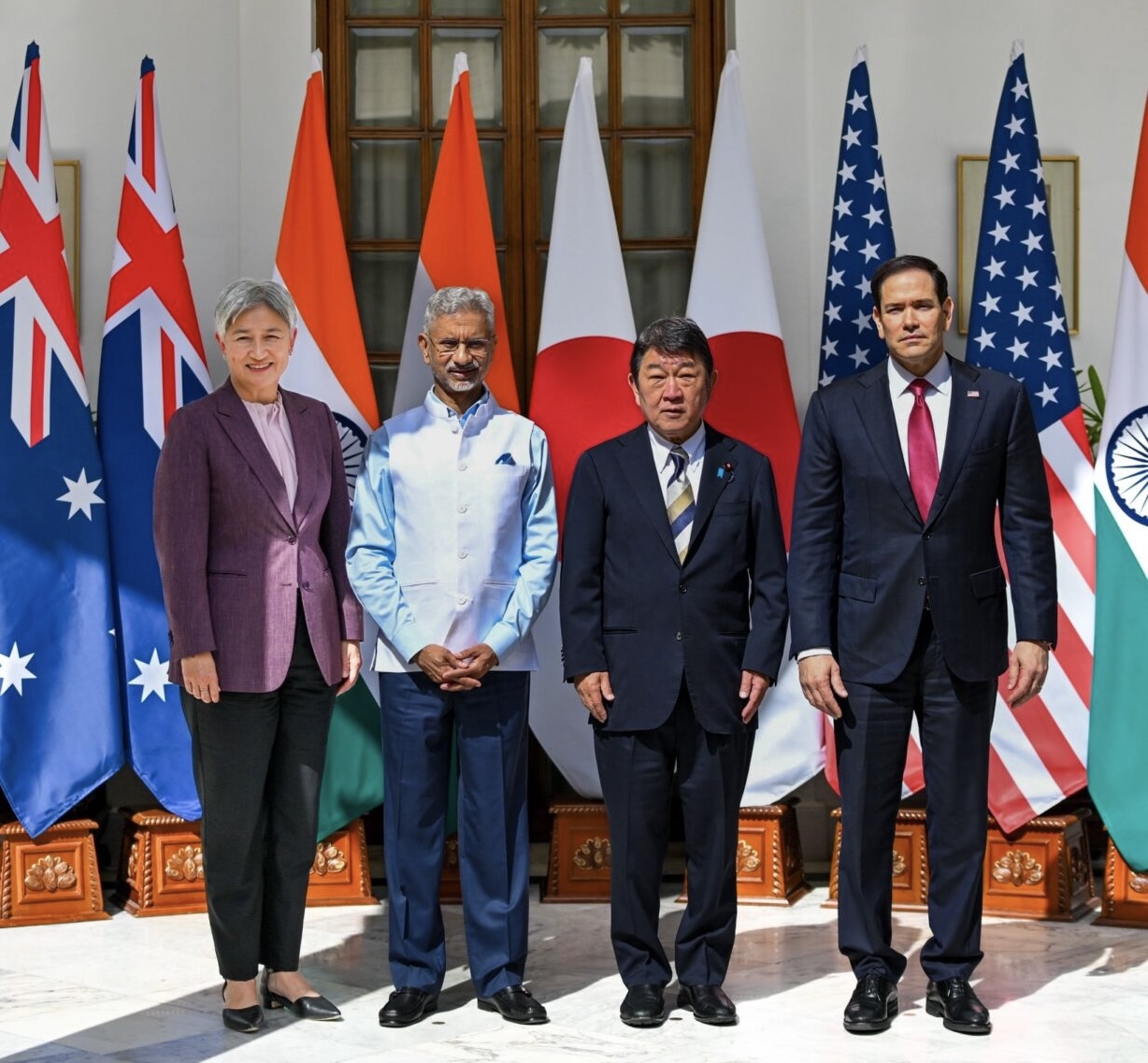
Like a diplomatic masonic lodge, “the Quad” — Australia, India, Japan and the United States — gathered its foreign ministers in New Delhi this week and calmly made decisions concerning another nation, Fiji, which was neither represented at the meeting nor, days later, entirely clear on what had been decided in its name.
The 26 May Delhi meeting carries an uncomfortable echo of the 1889 Berlin Conference, where Germany, Britain and the United States deliberated over the fate of Samoa without a single Samoan in the room. Fiji, likewise, was absent from the Quad’s table.
The age of empire may officially be over, but for South Pacific states the pattern remains stubbornly familiar: distant powers still confer, strategise and decide their futures with little consultation, and even less representation. Increasingly it looks as if Australia has acquired a sense of ownership over the region.
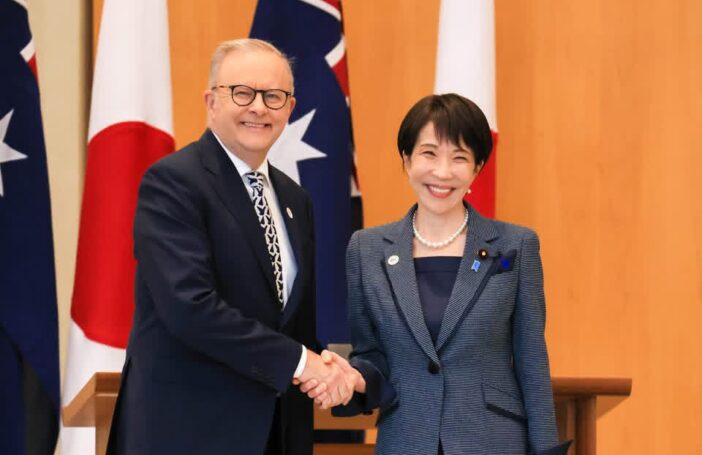
Making decisions for the Pacific were Australian Foreign Minister Penny Wong, Indian External Affairs Minister Subrahmanyam Jaishankar, Japan’s Foreign Minister Toshimitsu Motegi and US Secretary of State Marco Rubio.
They announced several concrete decisions directly affecting Fiji and the wider South Pacific — none of which involved Pacific representation. The Quad unveiled its first-ever joint infrastructure project, a new port in Fiji, aimed at addressing insufficient port capacity across Pacific Island nations. The project is framed as a demonstration of “high-quality, resilient infrastructure” delivery in the Pacific.
To be fair, the port plan is not and could never be entirely an external imposition. Fiji has been actively shopping a Suva port redevelopment for years. Prime Minister Sitiveni Rabuka pitched the project — covering port and shipbuilding upgrades — to Chinese President Xi Jinping in 2023, and Fiji Ports Corporation, which is 41% government-owned, has more recently held talks with US officials about a US$181 million upgrade as well as a more ambitious US$1.82 billion plan to relocate Suva Port. Rabuka has also struck a deal with the US Millennium Challenge Corporation for a feasibility study on port development. In that sense, the Quad’s announcement takes something from an existing Fijian wish-list rather than appearing out of nowhere.
Even so, it seems the Quad wants to experiment on Fiji, which has the attraction, for high-paid experts, of luxury resort hotels. Details are sparse, and it is still unclear how the Quad’s “first-ever joint infrastructure project” maps onto the plans Fiji has been developing, or how much say Suva residents have had in what is now being announced on their behalf from New Delhi.
Under the “Ports of the Future” partnership, Fiji becomes the pilot site for a Quad-led port upgrade and capacity-building program. Wong described the plan as the Quad’s “strongest ever commitment” to the Pacific, adding: “I was in Fiji just a couple of weeks ago, and I know how important this will be to that country.” It is a remarkably thin level of engagement for a project that risks turning Fiji into a quasi-Quad maritime base. And what is not clear here at all is what this means to Fiji’s sovereignty, what’s in the fine print and the terms and conditions. What’s the price Fiji pays for a Quad port?
The Quad also launched a new framework to coordinate investment in critical minerals supply chains, including mining, processing and recycling. The framework does not explicitly mention seabed minerals, but nor does it exclude them — and its emphasis on “supply resilience across the Indo-Pacific” aligns with recent US moves to accelerate deep-sea mining in a region that includes Pacific Island states with significant seabed mineral potential. As is being seen with the Cook Islands, Tonga and Nauru, among others, some Pacific states are already keen to sell the sovereignty of the ocean to the United States.
Some of the Delhi meeting was more security directed, including a call to expand work on maritime domain awareness.
Fiji’s response to the announcement has been cautious and, at times, caught off guard. Speaking in parliament on Monday 26 May, Rabuka said it was unclear whether the Quad initiative would slot into Fiji’s existing port plans or whether Fiji would press ahead separately.
“Whether we can fit it into that or we will still move ahead looking for public-private participation, [it will be] based on the plans we already have,” Rabuka said.
Those existing plans centre on Rokobili, at the northern end of Suva harbour, which Fiji Ports Corporation and the Asian Development Bank have shortlisted for the long-mooted relocation of Suva Port. Rabuka had earlier told parliament that the government backed a “mega port” there and had already developed a plan for a container terminal at the site. Also in 2025, he told the Fiji Times the port development was purely for development and not military purposes — a stance he has not walked back since the Delhi meeting.
“They want to help us so that we get up to the various targets that have been set by the international community on how nations tackle the challenges of the Millennium,” Rabuka said at the time.
Defence Minister Pio Tikoduadua has likewise insisted the Quad plan has nothing to do with China.
“It’s a port facility — it’s good for the development of Fiji and the region … (It) allows Fiji to support all of the functions of the state in developing the economy and security.”
Ironically, the Berlin Conference was itself partly triggered by dreadful port facilities in Apia, Samoa. In the 1880s imperial Germany and the United States were competing for control of Samoa, with Britain taking something of an interest. Mostly the competition involved creating civil wars in Samoa. As I describe in “Looking up Samoa on the map”, the high chief Mata’afa Iosefo inflicted a heavy defeat on German forces in the first Battle of Vailele in 1888 (10 years later in the battle’s second edition, he did the same to allied British and American forces). This prompted a build-up of naval forces parked in Apia harbour, an exposed and dangerous port, and on 15 March 1889, a cyclone hit. Six ships were wrecked and 146 crew killed. The great powers, having created chaos, then sought “order” — and convened the Berlin Conference.
Fiji writer Charlie Charters, commenting on the Quad, reached back to Berlin and its times:
“The Berlin meeting produced the 1889 Tripartite Declaration — cleaving the Samoan islands into a German colony [now Samoa] and an American one [American Samoa]. A disfiguring that continues to this day. No actual Samoans were recorded as being present at either meeting.”
The 1889 Berlin Treaty established a tripartite protectorate, with Germany, Britain and the United States exercising joint influence over a nominally independent Samoa. The formal partition into German Samoa and American Samoa came a decade later, under the 1899 Tripartite Convention — but the point is right: the architecture for that later carve-up was built in Berlin, by outsiders, without Samoans at the table.
Fiji’s people might find the comparison with 1889 Samoa uncomfortable, but the parallel is clear: powerful states making decisions that affect Pacific nations without those nations present.
Of course, the contexts differ. The Berlin Conference produced a binding condominium-style arrangement that set the terms for Samoa’s eventual partition in 1899. The Quad’s statements are political commitments among its members. Berlin shaped Samoa’s political fate; the Quad meeting determined infrastructure and security initiatives that will shape Pacific regional dynamics.
Pacific Island societies have long histories of colonial partition, strategic competition and outsiders imposing their own geopolitical aims on them.
At best it can be said the Quad is not dividing territory, or imposing governance, yet.
And places like Samoa and Fiji are sovereign and independent, and while Australia and others seek dominance, they do belong to international and regional institutions.
The Quad style of meeting and statements is a critique of great-power behaviour in the Pacific. It highlights a recurring pattern where powerful states make decisions about the Pacific without Pacific participation. It is far from “Pacific-led, Pacific-owned” decision-making.
A version of this article was first published on the South Pacific Tides Substack.