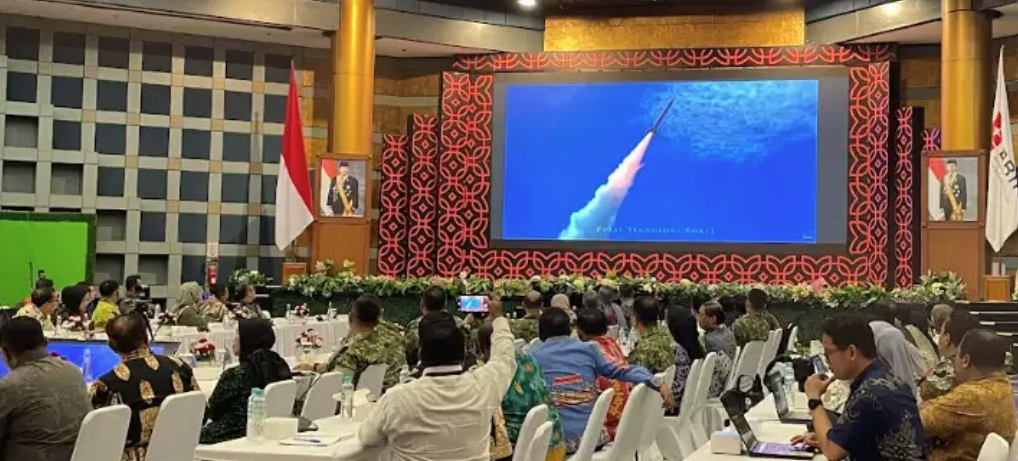
The long-discussed spaceport project on the island of Biak has again attracted public interest after Indonesia’s National Research and Innovation Agency (BRIN), the Papua Provincial Government and the Biak Numfor Regency Government signed a Memorandum of Understanding in June 2026. Biak’s relevance as a potential satellite launch site is rooted in its history as a major World War II battleground, where Japan and the United States fought a series of intense engagements in 1944. The Allied forces built extensive airport infrastructure that to this day remains a vital part of the island’s strategic importance. Geographically, any aeronautical development in Biak has wider regional implications, given its location in a sensitive Indo-Pacific corridor linking Southeast Asia, the Pacific Islands and Australia. Most critically, Biak’s location just one degree south of the equator gives it an optimal launch advantage: rockets can reach orbit with less fuel because of the stronger equatorial rotational velocity.
The proposal to develop Biak as a spaceport has divided local sentiment between those in favour and those opposed.
Supporters emphasise the project’s potential benefits, arguing that the development would bring gains to the island, to Indonesia and to the wider international community. At the local level, the project is expected to generate direct socio-economic impacts by reducing unemployment through new job opportunities for younger generations and by stimulating existing sectors in Biak, including tourism, hospitality, transport and small and medium enterprises. It is also projected significantly to increase local revenue (pendapatan asli daerah) through taxes, levies, land and building charges and fees from commercial satellite launches. This revenue could in turn be channelled into strategic sectors such as health, education and infrastructure, while further strengthening Biak’s potential as a centre for spaceport studies.
Nationally, the spaceport would improve Indonesia’s space sector, making the country more competitive in satellite launch and emerging commercial space markets. It would allow Indonesia to develop and test rockets and related technologies at home, without relying on foreign facilities and partners, while accelerating technological advancement and stimulating industries such as aerospace engineering, telecommunications and national research institutions. The project would also enhance Indonesia’s geopolitical stature by making the country a regional hub for space activity in the Indo-Pacific.
Internationally, Biak’s spaceport would give Indonesia a new position in the global satellite-launch market, which has long been dominated by the United States, Russia, China and Europe. Indonesia would emerge as a provider of satellite-launch services for other countries and could open the door to deeper cooperation with NASA, the European Space Agency and major commercial players such as SpaceX. As Southeast Asia’s largest economy and the world’s fourth most populous nation, Indonesia’s ownership of the spaceport has the potential to reshape Indo-Pacific geopolitics, with countries lacking equatorial launch sites increasingly relying on Indonesia for satellite deployment.
Opponents, however, highlight the severe implications the project could have for the community and the environment. Peaceful demonstrations took place not only in Biak but also in several locations outside the region, signalling protesters’ rejection of the plan and urging authorities to listen to local concerns. One of the posters often displayed during the protests read “biak bukan pulau kosong” which translates as “Biak is not an empty island”. The slogan underscores a central message from local communities: that Biak is home to Indigenous peoples whose presence, rights and authority must be respected in any decision about the project.
Indigenous landowners at the proposed site in Saukobye village (also known as Warbon) located in a northern Biak district do not uniformly support the project. Some back the plan while others oppose it, and they have not yet been asked to provide free, prior and informed consent, a principle protected by international human rights standards. They face the risk of losing customary land and housing passed down through generations if the plans go ahead. They may be relocated to agreed sites, but their relationship with their ancestral land would be reduced to a story. Such relocation also carries the potential to trigger social conflict and further marginalisation.
As an island community, the Byak people and the wider West Papuan population have raised concerns about the environmental impacts of the proposed spaceport, including deforestation, declining biodiversity and the destruction of habitats for endemic species, as well as potential coastal ecosystem pollution linked to rocket activity. They also point to the risks posed by launch failures, demonstrated by incidents such as the 2020 failure at Europe’s Guiana Space Centre, where a rocket crash into the sea caused environmental damage and financial losses, and the 2003 Alcântara Space Agency launch accident in Brazil, which killed 21 engineers and technicians.
The debate over the Biak spaceport highlights a deeper tension between national ambitions and the everyday realities of local communities. For supporters, the project represents a rare opportunity for Indonesia to strengthen its role in the global space sector, bringing new infrastructure, investment and technological progress. Biak is imagined as a strategic frontier where economic growth and scientific advancement meet. Yet this sense of opportunity sits alongside significant uncertainty, especially among Indigenous residents who worry about environmental damage, cultural disruption and the risks of launch failures. Their concerns reflect long-standing anxieties about major projects being introduced into fragile ecosystems and socially complex regions.
The conflicting views illustrate that the Biak spaceport is more than a technological proposition: it is a contested idea of what the island’s future should be. A more inclusive and transparent strategy will be necessary moving forward, one that takes serious account of environmental safeguards, respects Indigenous rights and ensures that promised advantages do not come at the cost of irreversible damage. Rigorous re-evaluation of the proposal is needed before it can gain broad legitimacy among the populations likely to be most affected.