


In a year that has seen climate-related disasters, escalating conflict and increasing global displacement, the system intended to reduce human suffering is itself being undermined. Humanitarian assistance is under unprecedented pressure, not only through massive cuts to overseas aid funding but also through attacks on the norms and values that have long supported principled humanitarian action.
At a recent Médecins Sans Frontières (MSF) webinar, experts from the humanitarian sector laid out the grim picture. As head of programs at MSF Australia, I framed the discussion with a sobering but astonishing statistic: 91% of all humanitarian aid now goes to protracted crises — up from 29% ten years earlier. Conflicts and crises are lasting longer, they are more complex and humanitarian responders are more stretched than ever. But government funding is being slashed, humanitarian access is being blocked and political leaders or donor governments are using aid increasingly as a commodity rather than as an unconditional lifeline based on needs and the preservation of human dignity.
In 2025, the world’s largest donor, the US Government closed its aid agency (USAID) and immediately slashed its programs by over 80%, sending shockwaves through the humanitarian community. But the US is not the only country reducing aid — Germany plans to cut its foreign aid by 50%, in February this year the UK imposed a 40% reduction while France cut its foreign aid by 37% in their recent budget cycle. Meanwhile, Australia has steadily cut and allowed inflation to erode its aid budget to a historic low of less than 0.2 per cent of Gross National Income. These decisions are not just arbitrary — they will have devastating impacts on people’s lives. According to a new study published in The Lancet, funding cuts to US foreign assistance by the Trump administration could lead to more than 14 million additional deaths globally over the next five years. All of this as the climate emergency — forecast to displace over 100 million people by 2035 — accelerates humanitarian needs.
While MSF does not rely on government funding, our projects and patients are deeply affected by the collapse of the aid ecosystem around us. Louise Roland-Gosselin Muamba, MSF’s humanitarian affairs coordinator, based in Nairobi, and Dr Tom Ellman, director of MSF’s Southern Africa Medical Unit, outlined for me how these cuts are translating into real-world consequences.
For instance, one program in southern Africa which supported 10 million adolescent girls to access sexual violence prevention, HIV support and reproductive healthcare has now collapsed after 10 years of operation. In Kinshasa, Democratic Republic of Congo, a community HIV clinic that serviced over 2,000 LGBTQI+ people lost funding, with vulnerable populations having no other options for medication and care. In the north of Mozambique, conflict intersects with HIV in Cabo Delgado, where supply-chain breakdowns for TB and HIV medications are pushing patients back to an era before prevention and treatment. As a result of these programs’ closing, MSF clinics have been flooded with patients desperate for care and without other options.
This will cost thousands of lives over the coming years, unless the cuts can be reversed. Where MSF previously worked alongside UN bodies, local NGOs and government agencies, now we’re increasingly shouldering a greater burden, and we are deeply concerned about the increasing unmet needs of populations.
This is not only a crisis of financing; this is also a crisis of state integrity. In the emerging new world order, donor governments are making aid increasingly conditional — linked to trade or migration deals, security understandings or their domestic politics. The multilateral system is being defunded and the impartiality principle — providing aid based on need alone — is being abandoned.
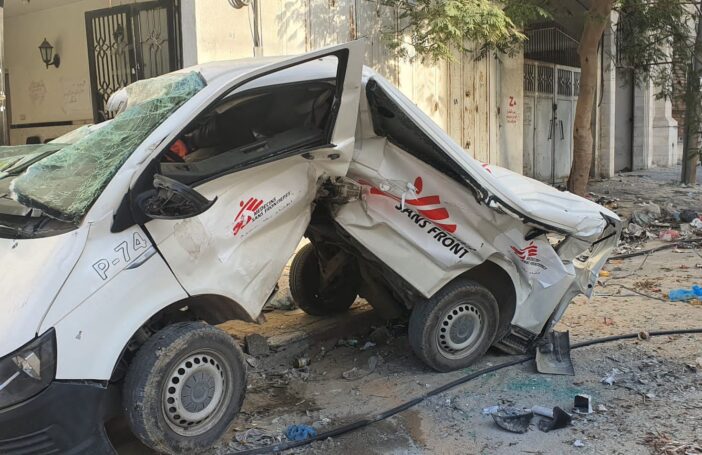
We are also witnessing the disintegration of the legal and ethical norms that protect humanitarian aid workers and the people they are attempting to assist. In Gaza, 12 MSF colleagues have been killed while performing their medical humanitarian work since October 2023. In Sudan and Myanmar, medical facilities have been repeatedly attacked. The laws of war — which provide for the protection of medical personnel and patients — are no longer fully respected by states and other armed groups. Worse still, International Humanitarian Law is being consistently violated in many conflicts, as decisions of the international courts and the UN Security Council are not enforced and states act with apparent legal and moral impunity.
A particularly alarming dimension of this erosion is the growing hostility toward science and research. One of the earliest decisions under the current Trump administration was the withdrawal of funding from the World Health Organization (WHO), as well as from international medical research. The impact of these decisions, and others like them, is now being felt acutely.
Ellman highlighted how decades of progress in HIV and TB research — particularly driven by institutions in Southern Africa — are now at risk. Research that had led to breakthrough treatments like long-acting HIV prevention, models for community-based care and simplified diagnostic tools is being abandoned. MSF often participates in these studies to ensure that innovations serve people in low-resource settings, not just the wealthy.
Without investment in global health research, we not only lose the treatments of today but also forfeit the possibility of better ones tomorrow. This is not just shortsightedness; it is self-defeating. Global health crises like the COVID-19 pandemic showed the vital role of WHO in coordinating the international response and sharing science. Undermining WHO now sends a dangerous message: that scientific evidence and expertise are not central to health policy decision-making.
MSF is responding in various ways. We have developed an international dashboard to monitor changes in the aid environment so that we can respond rapidly and lead evidence-based advocacy. We are expanding our health services to meet growing needs where we can and we are strengthening community partnerships to maintain access and legitimacy in increasingly hostile environments. Our independence from government funding means we can speak out when others fear to do so. And we are speaking out now against the weaponisation of aid.
In Australia, that means engaging directly with parliamentarians, their advisers, and with government departments, updating them on the situation in Gaza and elsewhere, and encouraging the government to use all its diplomatic tools to pressure for humanitarian access and respect for international law. As a middle power, well-respected in aid recipient countries, Australia can lead by example in resisting the commodification of aid and the erosion of humanitarian norms.
MSF is calling on the Australian government to reject, strenuously and publicly, the politicisation and militarisation of humanitarian aid in Gaza, Sudan, Myanmar and elsewhere. An MSF Australia petition, signed by more than 70,000 Australians as of 17 July, calls on the government to act to protect lives, lift the siege of Gaza and prevent the weaponisation of aid.
For MSF, this is not politics; it’s a matter of principle. It’s about defending the notion that people in distress — whoever they are, wherever they happen to be, whatever their political landscape — are entitled to care and respect.
We stand at a moment of reckoning. Our humanitarian system is not just failing. It is being systematically eroded by the very states that fought hard to establish the system in the first place, through the UN and the multilateral development system. If we keep moving in our present direction, we will not only lose the ability to respond to crises — we will lose the moral foundation of humanitarianism itself.
At this moment, Australia’s role as a principled actor — and Australians’ continued support for independent organisations like MSF — has never been more important.
Humanitarian aid is not optional. It is not a negotiating chip. It’s a lifeline grounded in universal respect for human rights. And it is disappearing.
The author would like to acknowledge the input of Tom Ellman and Louise Roland-Gosselin Muamba to this post, which is published as part of a partnership between the Development Policy Centre and Médecins Sans Frontières / Doctors Without Borders (MSF) Australia. MSF provides medical assistance to people affected by conflict, epidemics, disasters or exclusion from healthcare. Their actions are guided by medical ethics and the principles of impartiality, independence and neutrality. MSF Australia does not receive public institutional funding.
Read the MSF Australia blog series.



Hi Simon. It’s a terribly bleak picture you paint but one which is brutally clear to us all. The challenge for all of us, I think, is to find new ways to have new conversations with power-holders both old and new, and to really think differently about what humanitarian action and development cooperation can look like in what is a a dramatically changing new world order. We have a lot of work ahead of us.