Australian aid
Now that Australia has been granted the presidency of the negotiations for the COP31 global climate summit to be hosted by Türkiye in 2026, the Albanese government has said it will focus on the climate finance needs of small island developing states and encourage additional donor funding commitments to the newly-established Pacific Resilience Facility. Australia has not committed funding to a new global financing facility designed to protect the world’s tropical rainforests which was launched at COP30 in Brazil in November and backed by 34 countries, including PNG and Indonesia.
At their annual AUSMIN meetings, Australia and the US have agreed to work together with Japan to develop infrastructure projects to boost growth along the “Luzon Economic Corridor” in the Philippines. Also the two nations will continue to work with PNG on telecommunications reform, port infrastructure and disaster management.
PNG’s Acting Minister for Communications Peter Tsiamalili Jr has announced that under the provisions of the new Pukpuk Treaty, Australia will provide US$120 million in financing for three new digital submarine cable systems and that PNG will not have to contribute to the costs from its national budget.
The Australian government has committed $50 million for disability equity and rights programs in Southeast Asia and the Pacific and $48 million to support HIV response efforts in the Pacific. It has not specified the period over which either funding commitment will be delivered. A five-year, $25 million initiative to help address gender-based violence across nine Pacific countries has also been announced.
Australia has allocated $14 million in humanitarian and disaster response assistance for communities in Southeast and South Asia affected by multiple cyclones and flooding events.
Figure 1: Storms and cyclones across South and Southeast Asia from 17 November to 3 December

Source: UNDP
Australia’s “world-first” autonomous sanctions on the Taliban regime in Afghanistan contain provisions for the issuing of humanitarian permits for which DFAT has defined conditions for accredited organisations.
The government has allocated another $10 million in humanitarian assistance to Sudan and condemned the indiscriminate violence against unarmed civilians in El Fasher and other regions. Despite credible reports that weapons exported to the United Arab Emirates (UAE) from the UK and Canada have been implicated in this violence, Defence officials have refused to elaborate on Australia’s defence export permits for exports to Sudan or the UAE in Senate Estimates hearings.
Speaking at Senate Estimates, DFAT officials said that they are working on a trilateral partnership involving Australia, Indonesia and the Palestinian Authority to strengthen education and law enforcement in the Occupied Palestinian Territories ahead of the possible creation of a Palestinian state.
The Joint Standing Committee on Foreign Affairs, Defence and Trade (JSCFADT) has established a new inquiry into “the role of Australia’s international development program in preventing conflict”. The aid program’s first standalone policy on peace, conflict and development was published under the Howard government in 2002. DFAT’s conflict and fragility section was abolished in 2020. An evaluation of “DFAT engagement in conflict prevention and peacebuilding through diplomacy, aid, trade and security” was “paused” in the same year and never resumed. However, a summary of the evaluation was published.
The JSCFADT has also announced an inquiry into “gender equality as a national security and economic security imperative”. The government is yet to respond to the recommendations of a JSCFADT inquiry completed in the last parliament (November 2023) into “the rights of women and children”.
Australia has moved up two spots overall in the Center for Global Development’s latest Commitment to Development Index, ranking 15th of 38 assessed countries. Australia ranks well on trade (2), technology (3), health (5) and investment (9). It ranks poorly on environment (35), migration (25), security (24) and finance (23). Australia’s overall ranking falls to 22nd of 38 once the index is adjusted for income.
Regional/global aid
The government of Vanuatu has disputed media reports that it has “expelled” foreign advisors from the country, saying that it has “introduced measures to ensure that foreign advisers working on national security are stationed at neutral venues or their respective embassies” and that “we will continue to work with all countries to achieve our development goals, but we will do so on our own terms”. Australia and Vanuatu are yet to finalise a new bilateral treaty through which Australia would provide $500 million over ten years in funding for Vanuatu’s climate, security and development priorities. The proposed treaty would, in return, oblige Port Vila to consult with Canberra on funding from third countries such as China in areas like critical infrastructure.
Nauru’s “graduation” to high-income status has been postponed by one year after Australia and New Zealand successfully lobbied other members of the OECD to maintain the country’s designation as a developing country. The decision means that Nauru can continue to access Official Development Assistance until January 2027.
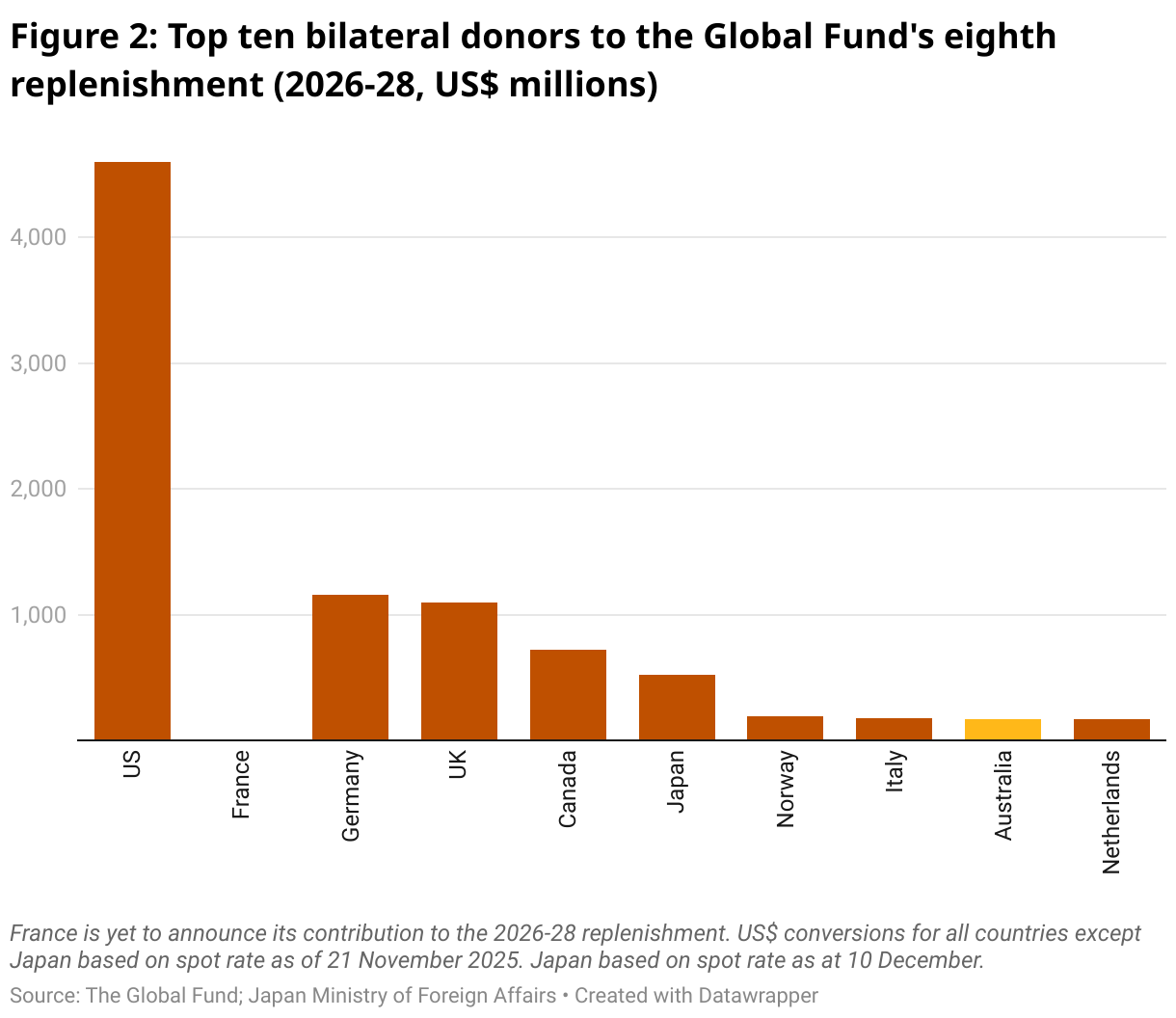
At the G20 leaders’ meeting in Johannesburg, the Global Fund to Fight AIDS, Tuberculosis and Malaria finalised its eighth replenishment, raising US$11.3 billion for the 2026-2028 period. This was well short of its target of US$18 billion. To the surprise of some, the Trump administration has maintained the US’s position as the Global Fund’s largest donor, pledging US$4.6 billion. It is not clear, however, whether the Trump administration will honour the Biden administration’s 2022 US$6 billion pledge, of which US$2 billion remains outstanding despite having been appropriated by Congress. France and the European Union are yet to announce their pledges. Even if France makes a large cut to its 2022 pledge (US$1.8 billion), Australia’s pledge of US$172 million will likely make it the ninth-largest bilateral contributor to the Global Fund replenishment, up from 11th in 2022 (see Figure 2).
The US has voted against a UN General Assembly resolution on the safety and security of humanitarian and UN personnel, citing references to “radical gender ideology”, the 2030 Agenda and climate change among its objections. 153 countries, including Australia, voted for the resolution and six countries abstained — North Korea, Russia, Israel, PNG, Fiji and Burundi.
The UN estimates that even under the most optimistic scenario, it will take at least seven years to clear the rubble created by the Israel-Hamas war in Gaza.
Canada will cut C$2.7 billion ($2.9 billion), or around 15%, from its development assistance budget over the next four years, with funding for global health programs and international financial institutions nominated for reductions.
Sweden will end bilateral aid to five countries — Zimbabwe, Tanzania, Mozambique, Liberia and Bolivia — in order to help fund its commitments to Ukraine.
A parliamentary inquiry into value for money (VfM) in the UK aid program has found that there is no weight given to poverty reduction outcomes in the government’s current VfM assessments, that there is lack of focus on VfM on the part of those who deliver UK aid, and that “whilst private contractors deliver a substantial share of UK aid, opaque procurement procedures and limited transparency threatens their efficiency and accountability”.
Books, reports, articles, podcasts etc.
Presentations and videos from the 2025 Australasian Aid Conference, hosted by the Development Policy Centre and The Asia Foundation, have now been published online.
Missed the annual Mitchell Oration which was presented at the conference by Eric Olander, Editor-in-Chief of the China Global South Project? You can catch up on the livestream, blog or podcast now.
The US-based AidData research centre has published a new publication series on China’s development finance to select countries from 2000-2022, including factsheets on Chinese development finance to Vietnam, Laos, Cambodia and Bangladesh.
The Stanford Innovation Review discusses how a social enterprise used AI tools to preserve 60 years worth of USAID evaluations after the abolition of the agency and its online archives by the Trump administration in early 2025.