In Indonesia, every president carries a nickname reflecting how they wish to be remembered or how their supporters choose to frame them. Sukarno, the nation’s first president, is still celebrated as the Father of Proclamation for his role in declaring independence. Suharto, who followed him, became known as the Father of Development as well as the Smiling General. B.J. Habibie, the engineer-president, was remembered as the Father of Technology. Abdurrahman Wahid, or Gus Dur, earned the title the Father of Pluralism. Megawati Sukarnoputri was often seen as the Guardian of the Constitution, while Susilo Bambang Yudhoyono was dubbed the Father of Peace.
More recently, Joko Widodo, or Jokowi, who was president for 10 years until October 2024, became known as the Father of Infrastructure, overseeing an era of toll roads, airports and highways that reshaped Indonesia’s landscape. Now Prabowo Subianto, Indonesia’s current president, seems determined to carve out his place in this lineage. His chosen title? The Father of Human Development. His administration has leaned heavily on policies tied to education, nutrition and human capacity building. Briefly, it looked like the statistics would back him up.
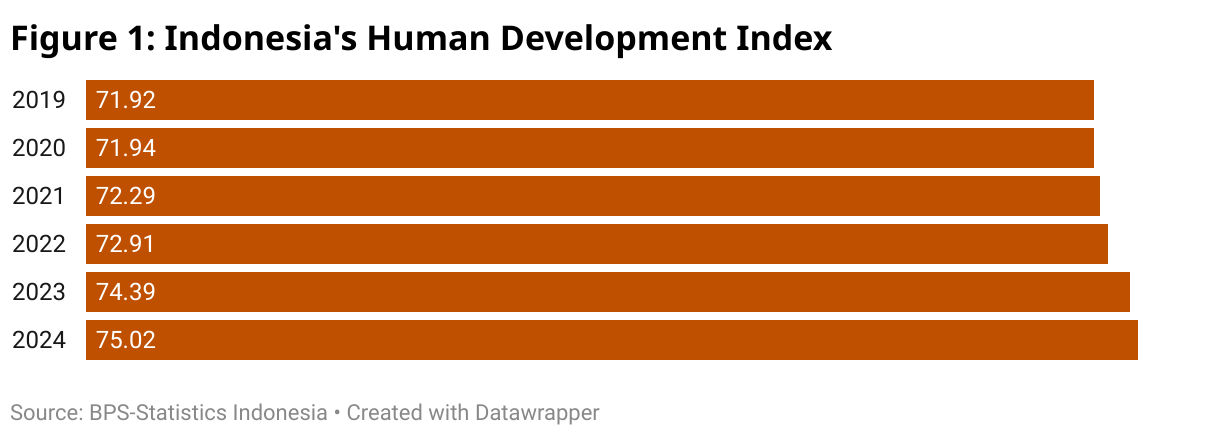
In 2024, Indonesia’s Human Development Index (HDI) climbed to 75.02, up from 74.39 the year before (Figure 1). Over the previous five years, the HDI had grown by an average of 0.75 percentage points annually, according to the Indonesia’s Central Statistics Bureau (BPS). Riding high on that momentum, Prabowo announced on 15 August 2025 that the Lembaga Pengelola Dana Pendidikan scholarship scheme would be expanded to 4,000 recipients by 2026.
Even more ambitious was his flagship initiative launched earlier that year: the Free Nutritious Meals program or Makan Bergizi Gratis (MBG). MBG was an ambitious reform. In 2025, it received an allocation of Rp99 trillion (around A$9 billion), with a projected 2026 budget of about Rp335 trillion (A$30.45 billion). Aimed at reaching 82 million beneficiaries, the program set out to reduce child stunting, enhance nutrition and boost Indonesia’s human capital. The idea was simple yet powerful: feed children better today to build a stronger nation tomorrow.
But, less than a year into its rollout, MBG has become a cautionary tale. Instead of being celebrated, it is mocked across the country. The public has rechristened it Makan Beracun Gratis, Free Poisonous Meals.
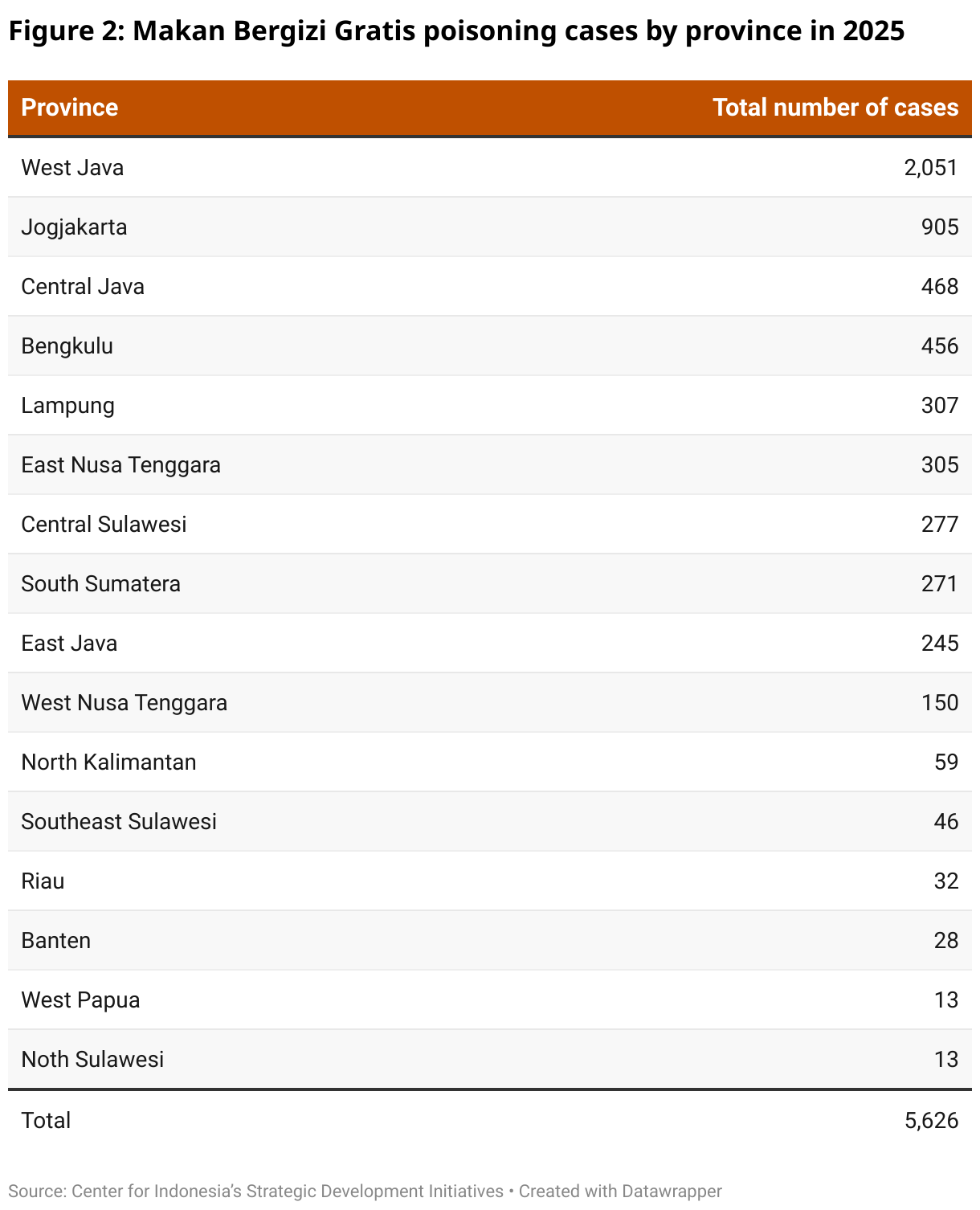
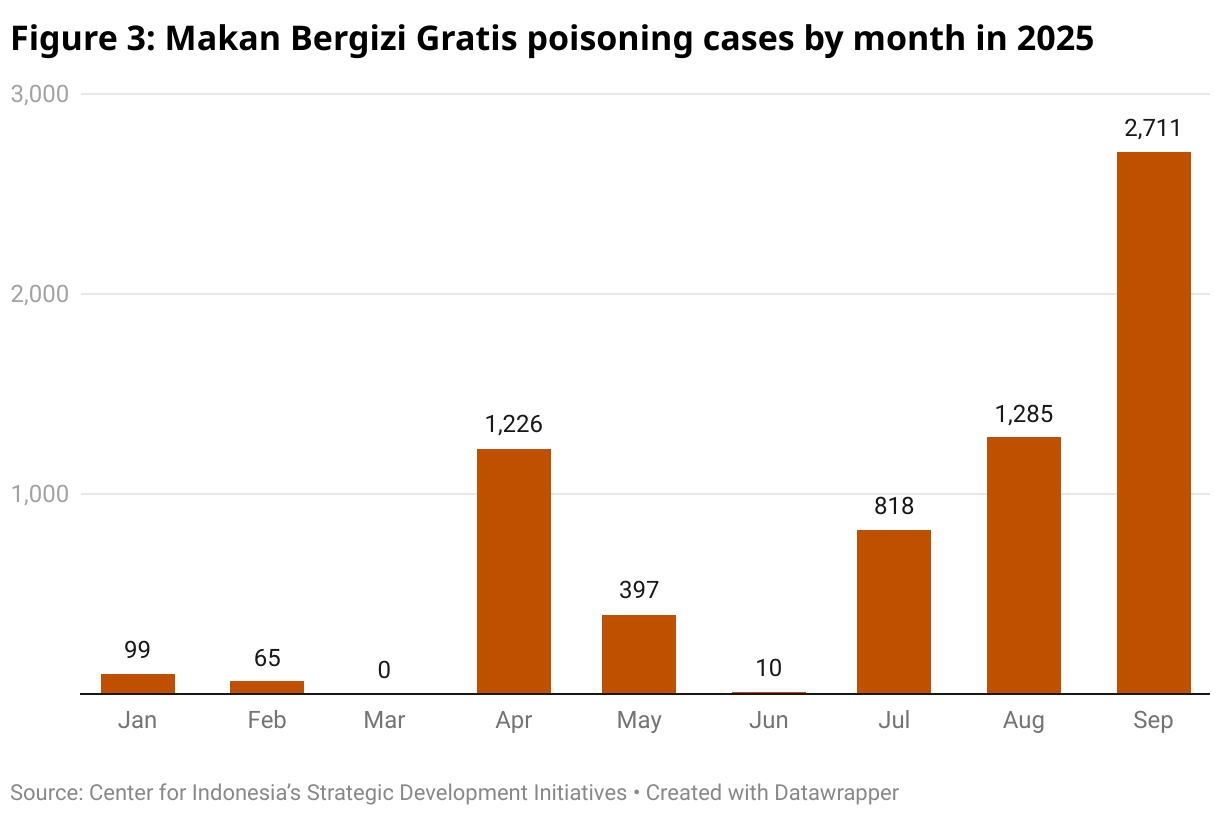
The bitter nickname isn’t just a joke. The Center for Indonesia’s Strategic Development Initiatives has reported that by late September at least 5,626 cases of food poisoning had been linked to MBG meals (Figure 2 and 3). From West Java to Kalimantan, Nusa Tenggara to Sumatra, children have landed in hospitals after eating food that was supposed to nourish them. What should have been a proud symbol of progress has instead sparked fear.
Parents point to hygiene as the most glaring issue. In many schools, meals are served in old ompreng, metal lunch tins reused daily without proper cleaning. What once carried nostalgia has become a breeding ground for bacteria. Instead of protecting children, the meals are making them sick.
Yet health risks are only part of the story. Civil society groups argue that the program’s even greater danger lies in corruption. In June 2025, Transparency International (TI) Indonesia released a report bluntly titled Risiko Korupsi di Balik Hidangan Makan Bergizi Gratis, translated as Risks of Corruption Behind the Free Nutritious Meals. The findings were critical: the MBG program isn’t just poorly managed, it’s wide open to systemic abuse.
The problems start with governance. Unlike most major programs, MBG has no Presidential Regulation to anchor it. Instead, it runs on internal guidelines that leave coordination vague and accountability weak. The lack of a clear legal foundation has created fertile ground for manipulation.
Partner selection has been equally troubling. The Satuan Pelayanan Pemenuhan Gizi, the units tasked with managing the program, have been linked in some cases to politicians, military officers and even the police. Incredibly, even traffic police — whose regular job is to keep roads safe — have been roped into distributing meals.
Procurement has been another disaster. TI Indonesia found that many procurement processes lacked transparency and documentation. In a country where procurement often means bribes and inflated mark-ups, the MBG program has simply scaled up these bad habits. Weak oversight has made things worse, allowing low-quality ingredients and unsafe food to slip through unchecked.
Scandals quickly followed. Reports surfaced that some members of Indonesia’s House of Representatives, the Dewan Perwakilan Rakyat (DPR), are suspected of owning MBG kitchens themselves. The very people tasked with overseeing the program are profiting from it — a textbook case of conflict of interest. A recent report from the DPR’s IX Commission IX — which oversees affairs relating to health, labor, and demography — even revealed the existence of 5,000 fictitious kitchens, prompting calls for the Audit Board of Indonesia (Badan Pemeriksa Keuangan) to step in.
The ripple effects have gone beyond schools. To fund the MBG program, the central government slashed transfers to local governments, money once earmarked for infrastructure. The consequences are visible everywhere: road repairs, bridges and schools projects have been postponed. Local contractors, who relied on these projects, suddenly found themselves without work. A program meant to feed children has ended up starving local economies.
For families, the contradictions are glaring. Their children get sick from MBG meals. Their communities had projects abandoned. They watch legislators profit while trillions of rupiah vanish. They hear lofty speeches about fighting stunting and building human capital but live through poisoned lunches and collapsing infrastructure.
TI Indonesia has urged the government to pause the MBG program until sweeping reforms are in place. They have recommended creating a proper Presidential Regulation, strengthening institutional capacity in the National Nutrition Agency, shifting to targeted rather than blanket coverage, ensuring open and competitive partner selection, enabling civil society monitoring and publishing regular public audits.
Prabowo may dream of being remembered as the Father of Human Development. But unless he fixes MBG, history might remember him differently. Instead of leaving behind a healthier, more educated generation, his legacy could be defined by poisoned meals, squandered budgets and disillusioned citizens. What began as a promise of better nutrition may ultimately be remembered as a poisoned promise.