


A total of 389 students from the University of Papua New Guinea School of Business and Public Policy participated in this year’s UPNG Student Attitudes Survey. The students were again predominantly male (67%) and mostly aged between 18 and 24. In this opening blog on findings from that survey, we focus on their attitudes to gender.
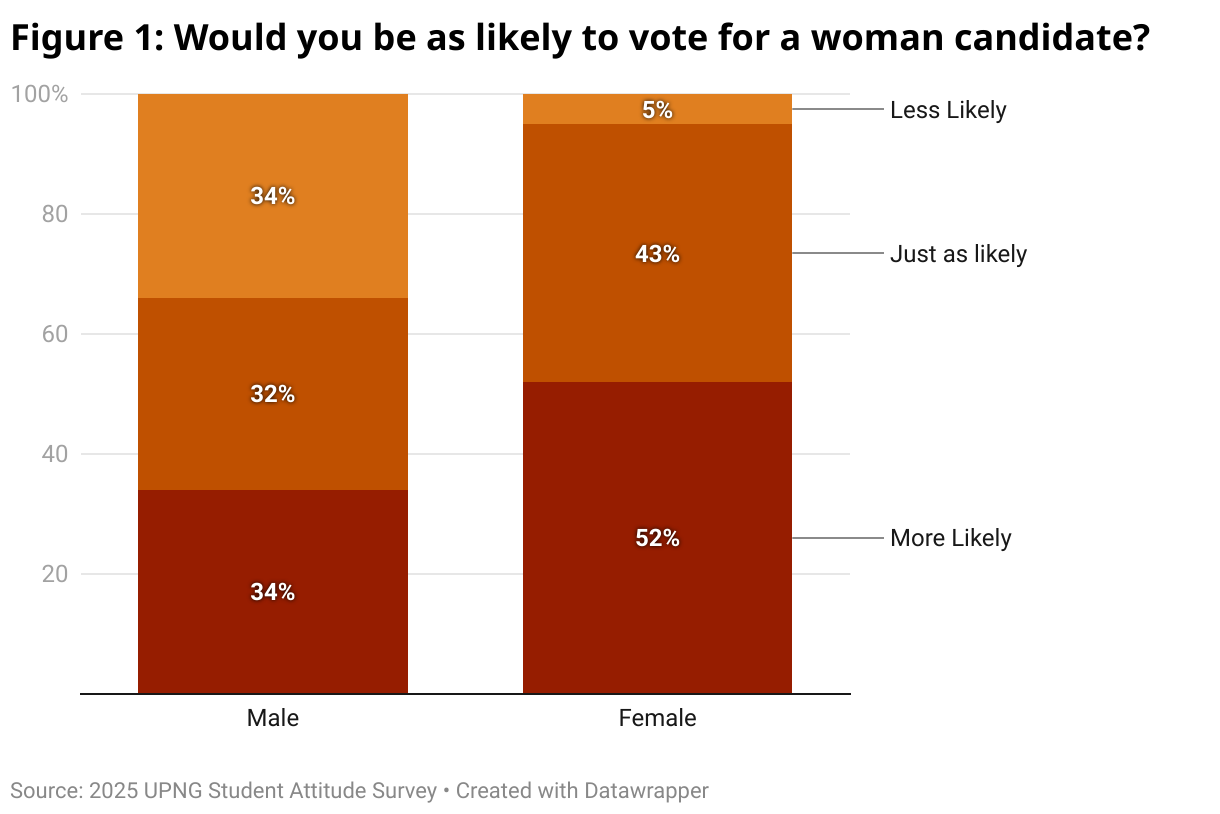
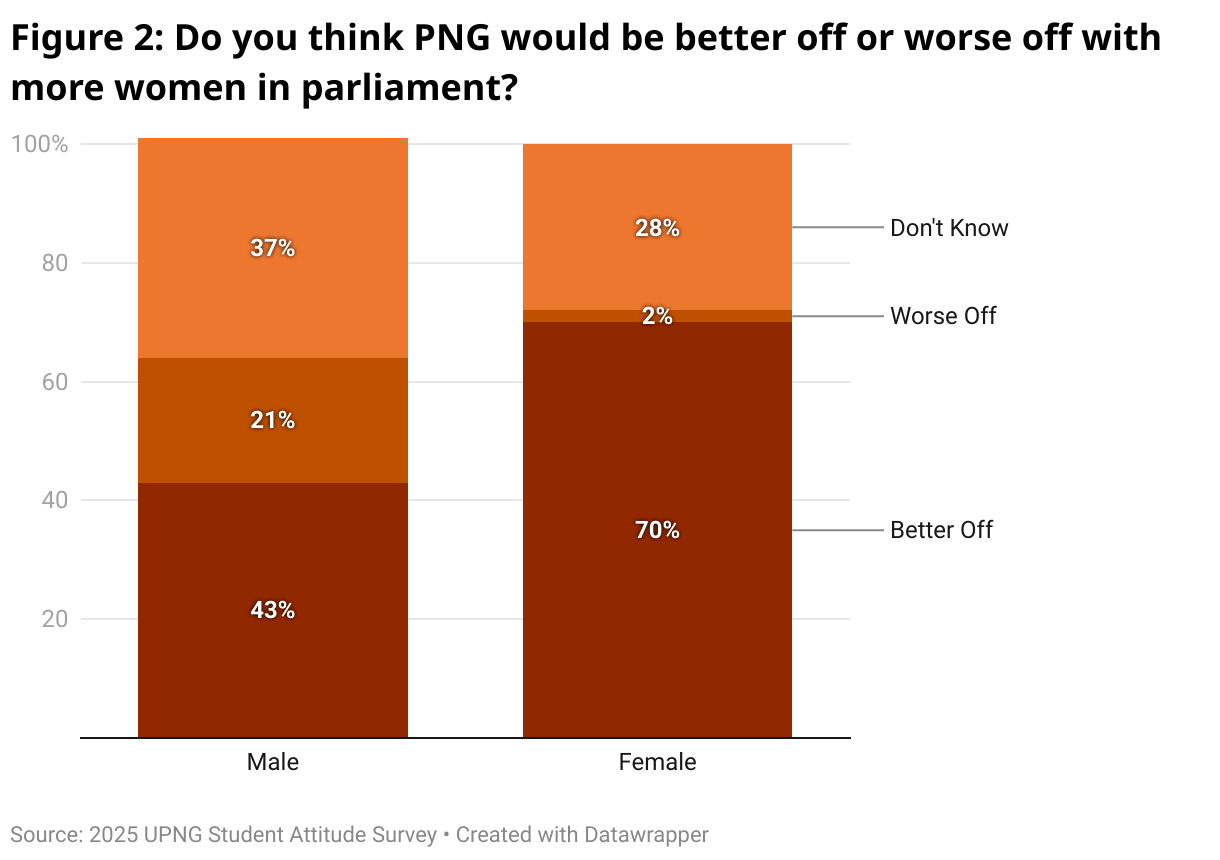
The survey asked students about women in politics. 40% of students said that they would be more likely to vote for a woman while 35% said they would be just as likely to vote for a woman as for a man, and 25% said they would be less likely to vote for a woman. 51% of students said that PNG would be better with more women in parliament, while 34% were unsure and 15% said the country would be worse off.
These responses sound encouraging. More students say they would be more likely to vote for a woman than those that say they would be less likely, and a small majority think PNG would be better off with more female MPs. However, when we disaggregate by gender the results are less reassuring.
As many male students said they would be less likely to vote for a woman as those who said they would be more likely (34% each). And fewer than half of male students (43%) said that PNG would be better off with more female MPs. Given that PNG has one of the lowest rates of female political representation in the world, this is surprising. Female students were much more likely to vote for a woman candidate (52% female respondents vs 34% male respondents) and a much bigger share of women thought PNG would be better off with more women in parliament (70% female respondents vs 43% male respondents).
Gendered differences in responses were also found in other areas. 92% of female students, but only 76% of male students, agreed that women can do the same kind of job that a man can do.
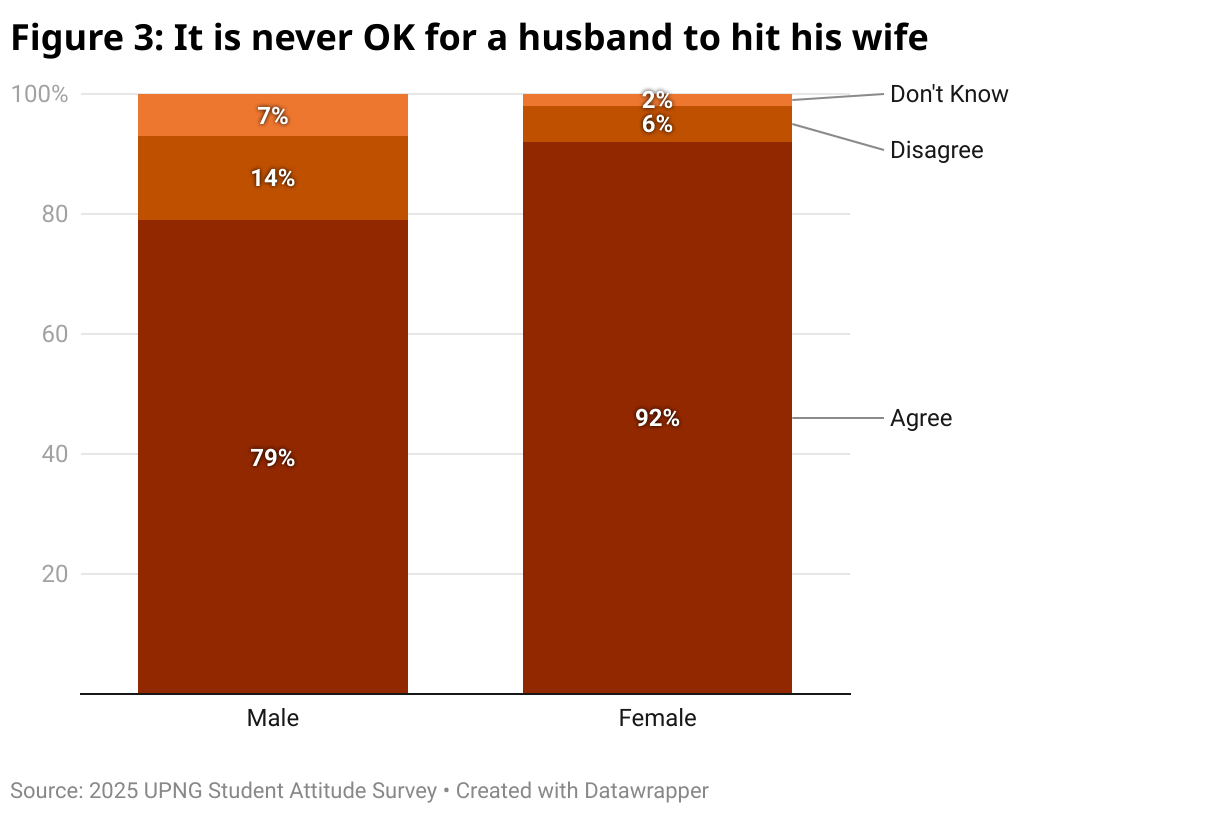
The survey also asked about attitudes to women in a relationship. 83% of students agreed it is never OK for a husband to hit his wife, but 12% disagreed: 14% of men and even 6% of women.
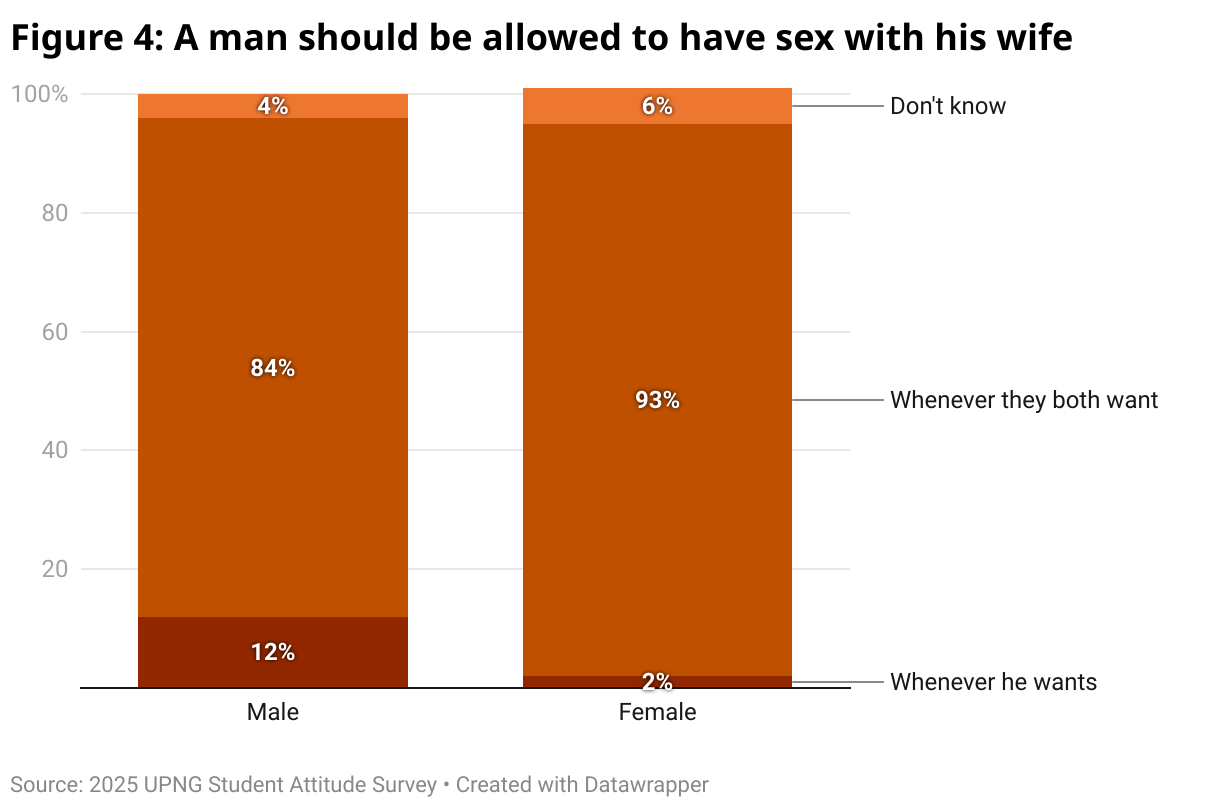
Similarly, 87% thought that a man should be allowed to have sex with his wife whenever they both want sex, but 9% said it should be whenever he wants: 12% of men and 2% of women.
In general, the survey found strong (and statistically different) differences between the two genders about the two genders especially when it comes to politics. Male students are no more likely to vote for female than male candidates and, despite the country’s extremely low level of female representation in parliament, fewer than half of male students think that PNG would be better off with more women in parliament. Moreover, even though it is still a minority, male students are much more likely to condone violence against female intimate partners.
As we’ll see in later blogs in this series, there are other differences in views by gender as well: female students are more worried about their personal security and are (even) less supportive of Australian funding for PNG to have a team in Australia’s National Rugby League.
Given that male students are much more likely to become political leaders, more work needs to be done to reinforce messages to them around gender equality, and the importance of female political representation, consent and non-violence.
Further findings will be published in forthcoming articles and can also be found in this 2025 PNG Update presentation. The results of the first survey, conducted in 2024, were reported here. All the differences across genders are statistically significant at the 5% level using the Chi-square test.


There really needs to be a 1st year compulsory course that addresses issues that consider our culture but also look at ways we can progress as a nation. Such findings point to the deeply ingrained socio cultural systems and beliefs we have which we find our place from. Bringing students fresh from year 12 from all over the country to recognise this and identify for themselves such beliefs and to question whether that aspect of our beliefs is worth keeping or should be adapted and or changed with time should contribute to breaking this gender stereotypes.
While this is a micro-level observation, it carries significant weight given that current students at the School of Business and Public Policy at the University of Papua New Guinea have the potential to serve the nation in various fields in future. “Gendered differences in responses were also found in other areas. 92% of female students, but only 76% of male students, agreed that women can do the same kind of job that a man can do”. Although there persists a substantial gender gap, the acceptance rate of 76% among men showed a positive trend, despite the high rate of gender violence (40% in urban areas and 38% in rural areas) in the country’s context – Geejay P. Milli’s (2020) data reminds us that “not all men are violent – but PNG is not safe for women”. The question now is, of the 76% supportive male students, how many of them would respond positively to self-employment versus traditional wage employment. More importantly, future surveys need to fill this gap and clarify whether these young males are interested in seeing women as equal partners in entrepreneurship or are interested in keeping them confined to established corporate roles.
I think it reflects a school not sensitized with gendered mainstream. Maybe take a poll from students from the school of humanities and social sciences and see the differences. Anyone in PNG can say this and that, just like the 389 students from the school of Business and public policy. And that is the normal way of thinking any ordinary Papua New Guineans think that was reflected. But from someone who studied gender studies, social works, political science etc would say the otherwise.
Verdict: Maybe conduct survey from all different schools and draw the differences.