 For reasons relating to the terms and conditions of the permanent public service, ingrained habits of reticence learned therein, or the uncertainties of consulting, many who work in and around development are hypersensitive about putting their names to their opinions.
I am reminded of this every time I write a review of a book that touches in some way on goings-on in the Canberra aid and foreign policy scene — I get messages from insiders in said scene telling me I’ve either been too tough on the subject or not gone hard enough. Insider tales and perspectives gush out, many of which are amusing, insightful, revealing or chatty, with a few teetering towards defamation. Yet when I ask these individuals to consider penning their own reviews, they go quiet and start to mumble about “not wanting to rock the boat”.
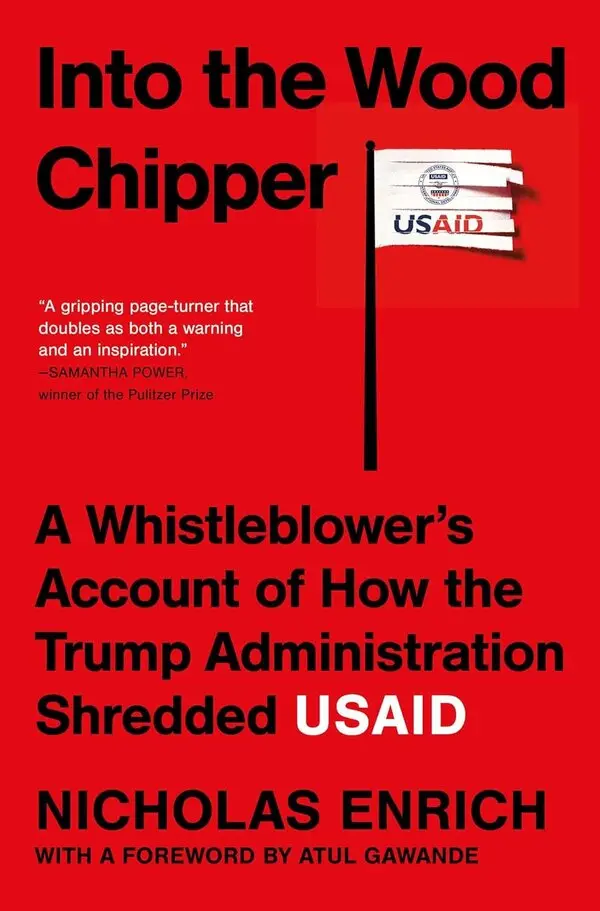
Which brings us to Nicholas Enrich’s book Into the Wood Chipper, a Washington insider’s account of being present at the dismantlement of USAID in the first few months of the second Trump administration.
The agency was among the first to be targeted by Elon Musk’s Department of Government Efficiency (DOGE), and the title of the book stems from a late-night message from Musk that he had “spent the weekend feeding USAID into the wood chipper. Could gone (sic) to some great parties. Did that instead”.
Enrich was USAID’s acting assistant administrator for global health during that period. To use an Americanism that I learned during my own time in Washington DC, Enrich was a man who “keeps the receipts” — he documented every text and email and took contemporaneous notes on every bonkers, Kafkaesque conversation he had with the political appointees and senior bureaucratic enablers hellbent on dismembering USAID. The result is a book that is gossipy, scabrous, pointed, darkly amusing, occasionally profound, insightful on the bureaucratic condition and, in highlighting the cruel effects of these decisions, desperately sad. Enrich is not just a person with the courage to write but a person who can write. He is a pacy, engaging wordsmith with both a pleasingly snarky turn of phrase and an ability to produce vivid scenes that propel his hellscape narrative.
Apart from some scene-setting about what USAID was and potted personal biography, the period that his book covers is short. It spans from November 2024, when Donald Trump was re-elected, to early March 2025, when Enrich realised that he could not conscionably be a part of the process anymore. The organisation that he’d fought for had been reduced to less than a husk by then. He blew the whistle by releasing a trove of memos documenting what was going on behind the scenes.
I lived in Washington DC during the first few months of Enrich’s timeframe and can attest to how accurately he describes the jittery, forlorn, tense, anti-“woke” atmospherics of that time. These atmospherics were fanned by prominent voices in the MAGA-sphere on platforms such as X and podcasts such as The Joe Rogan Experience. (I worked as a senior adviser to the United States Institute of Peace from 2022 to 2025, and DOGE shuttered that organisation shortly after it had finished with USAID. The fate of the institute is a matter still before the courts, although it seems impossible for me to imagine it will return to its former self.)
Yet, as Enrich writes, even the most fatalistic could not have imagined what epic fury would be wrought unto foreign aid so soon after the inauguration. On his first afternoon back in office, President Trump issued an executive order for a “90-day pause in United States foreign development assistance for assessment of programmatic efficiencies and consistency with United States foreign policy”, which was followed soon after by another order decreeing a “stop-work” on all foreign aid projects.
The bland bureaucratese unleashed pandemonium. Staff working on Diversity, Equity and Inclusion (DEI) programs immediately got fired, children receiving drugs in a promising tuberculosis trial stopped getting treatment, medicine and food bound for the needy began to moulder in ports and warehouses across the world.
And then, for Enrich, who was given the dubious honour of being promoted during this period, things get worse. He interfaces with political appointees, many of whom worked with the agency during the first Trump administration and nurse personal grievances against it. One such individual tells Enrich that he believed that USAID staff killed his family’s dog.
The administration announces a waiver for “lifesaving humanitarian assistance” but there is a lack of clarity as to what the waiver encompasses. Ever the bureaucrat, Enrich tries to save what programs he can in the bureaucratic manner he knows how, penning memos and crunching spreadsheets to make his case for reopening some health programs including one that would quell an Ebola outbreak in central Africa.
It is hopeless, as the direction is already set and the infrastructure to support these programs already obliterated. I wrote that Enrich was “like someone taking a banana to a gun fight” in the margins of the book at this point.
The political appointees (and their bureaucratic enablers) are simply not interested in Enrich’s reasons. The waivers are rendered a “farce”, Enrich writes, and no one wants to listen. One of the political appointees advises him to “take a step back” after he points out in one of his memos that terminating the contracts in such a wholesale manner would cost millions of lives.
The atmosphere grew ever stranger and more jittery as more colleagues are terminated and locked out of the building, with some being some reinstated and then fired again. As one example of the paranoia, he cites the case of a colleague who spent “all day eyeing a suspicious-looking croissant that had been mysteriously left on her desk, fearing it might be poisoned” only to learn it was a surprise pick-me-up from a concerned colleague.
Stymied at every turn, exasperated by the torrent of misinformation emanating from the Trump administration about USAID, Enrich realises his work is futile. With colleagues, he compiles documents outlining the impacts of the “pause”, the hollowness of the “waiver” and the impacts of the cuts both on vulnerable people around the world and the global reputation of the United States. Ever the good bureaucrat, he gives the memos the most bland titles imaginable. And then, in the sort of act that would cheer a pissed-off public servant anywhere, he sends the memos out in a mass email to current and former colleagues. Soon thereafter, one surmises, he starts to work on this book.
A little over one year on, the impacts of the abrupt rupturing of USAID are clear. A study published in The Lancet last year estimated that approximately an additional 14 million people could die by 2030 because of the cuts. A new Ebola threat in central Africa is growing, with the World Health Organization (WHO) declaring it a public health emergency of international concern.
Yet even with that stark figure, the ending of USAID feels like yesterday’s news, a topic too impolitic to raise. Governments, ahem, partners who received support from USAID barely mentioned the demise of the organisation at the time and don’t do so now. I was in Papua New Guinea recently and the only physical signs of USAID still visible were placards for abstruse workshops from yesteryear that remain hung up in government offices.
Some US health programs have started up again but on very different terms, now run out of the State Department. These are implemented by the same suite of managing contractors who used to implement USAID programs and who presumably have scrubbed forensically all references to DEI phrases and other now-verboten speak from their websites.
It is in the nature of obituaries that the dead are lauded and their blemishes, imperfections and worse overlooked. A similar halo effect can be observed in how AusAID is referenced nowadays, when it is mentioned at all. If I had my druthers, I wish Enrich had done a tad more reflection about what hadn’t been working well within USAID. My Devpolicy colleague Robin Davies described it once as a “harried, hamstrung and traumatised organisation”. I met some truly amazing people working within it but all labouring in the midst of an unbending contract model and spending way too much time developing metrics that it was doubtful anyone would either use or even understand fully.
Still, Enrich has done USAID a solid tribute with this blow-by-blow account of its demise. He is one gutsy fellow. As prominent writer, physician and senior appointee to USAID during the Biden administration Atul Gawande writes in his warm foreword to the book, Enrich wrote the book when he had “still-young children … a mortgage to pay [and] … no clear job ahead for his future.” That takes courage.
I hope his book gives others situated either in bureaucratic foxholes or nearby vantage points, all of whom have stories to tell, and many of whom are more financially secure than Enrich, the courage to write.