Australian aid
Ahead of the May budget, Foreign Minister Penny Wong said that the government is assessing options to help its Pacific neighbours respond to the energy and economic shocks emanating from the US-Israel-Iran war. Wong has also joined other nations in condemning the deaths of peacekeepers and aid workers in Lebanon and has reiterated the government’s call for “full accountability” from the ongoing Israeli military investigation into its killing of Australian aid worker Zomi Frankcom in Gaza in 2024.
Speaking at the Spring meetings of the World Bank and International Monetary Fund (IMF) in Washington DC, Treasurer Jim Chalmers also highlighted the negative impacts of the global fuel crisis on Pacific nations “and the impact on … protracted crises, including in Myanmar and Cox’s Bazar — where economic and supply pressures will push already-stretched humanitarian services …”. Chalmers also signalled Australia’s opposition to ongoing US pressure on the Bank to abandon its climate strategy, arguing that the Bank must maintain its “focus on its medium- to long-term goal of delivering development impact in line with its vision and mission … includ[ing] addressing the ongoing and compounding impacts of climate change”.
Preliminary data released by the OECD showed an unprecedented annual fall in Official Development Assistance (ODA). Combined ODA from its 33 Development Assistance Committee (DAC) member countries and associates fell by almost a quarter, or over US$40 billion, in 2025. Humanitarian aid fell by over a third (almost US$9 billion) and multilateral aid fell by 13% (over US$6 billion). The OECD projects that total ODA will fall by a further 6% in 2026, bringing the combined cuts since 2023 to over one-third.
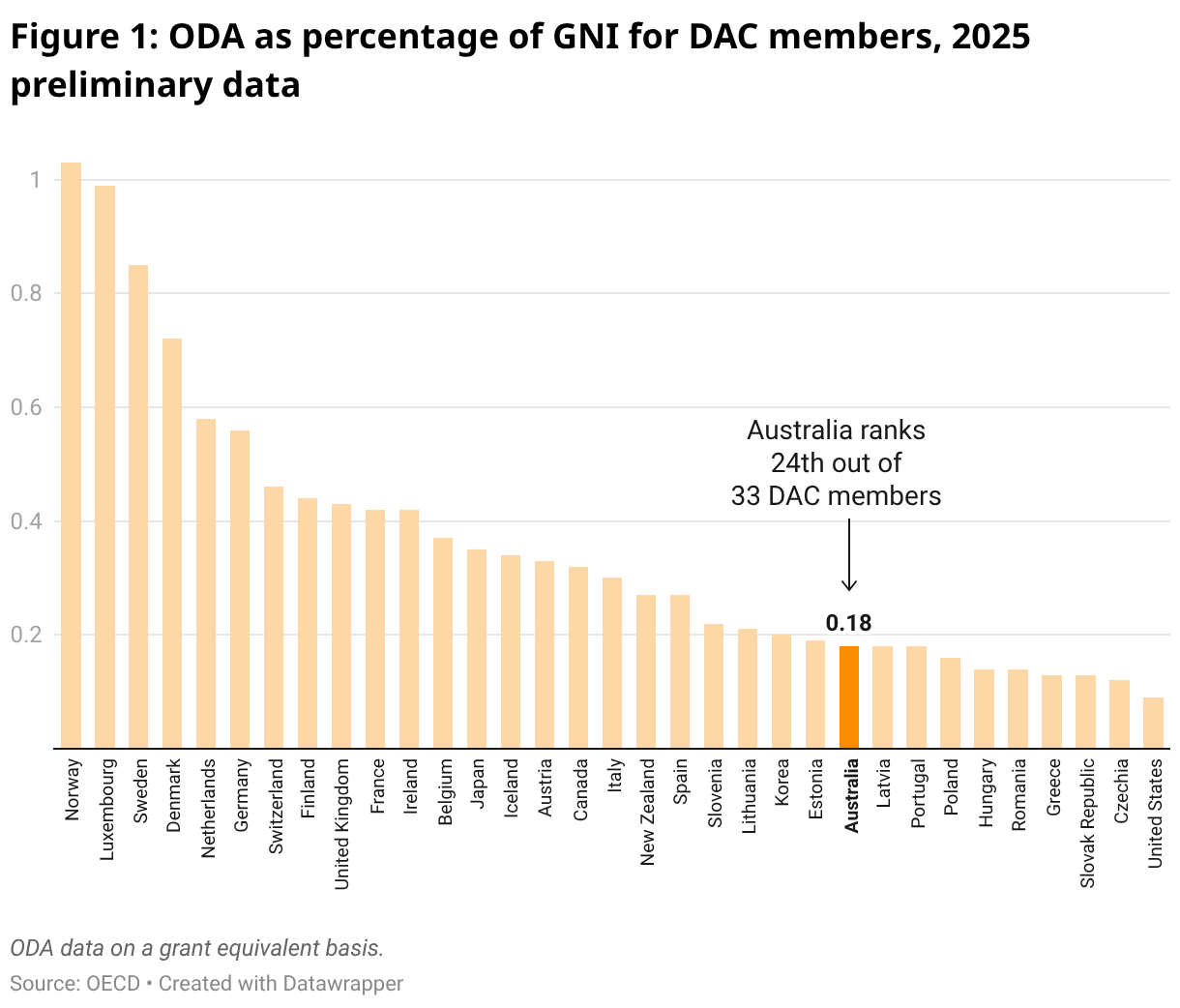
Even with these dramatic cuts by other donors, Australia ranked 24th of 33 DAC member countries on aid generosity, measured by ODA as a share of Gross National Income (Figure 1). At 0.18%, a record low, this share was still well below the DAC average (0.26%) and below all Australia’s like-minded allies and partners, except for the US. The latter recorded a 57% fall in its ODA spending in 2025, “the largest reduction by any provider in any year on record”.
Speaking ahead of the Women Deliver conference in Melbourne, the International Development Minister, Anne Aly, announced the allocation of over $90 million in continued funding for gender equality and sexual and reproductive health and rights (SRHR) programs. This includes more than $62 million over eight years to support local women’s and human rights organisations working in the region, and just under $28 million for multilateral and non-government organisations providing SRHR products and services in the Pacific and Southeast Asia.
While there has been no formal announcement, the government reportedly pledged $7 million in extra humanitarian assistance for Sudan at a recent donor conference in Berlin. The meeting raised a total of US$1.5 billion for what is routinely described as the world’s worst humanitarian crisis.
The government has also allocated $2.5 million in humanitarian funds to support populations in Solomon Islands and PNG affected by Tropical Cyclone Maila.
The Senate Committee on Foreign Affairs, Defence and Trade has released the report of its inquiry into democracy and human rights in Myanmar. Among the committee’s recommendations are that DFAT publish the list of individual initiatives included in its $370 million humanitarian support package, bring forward its mid-cycle review of the Myanmar country strategy and revisit reform of its due diligence framework to support greater flexibility and funding to local humanitarian actors.
DFAT has published the 2024-25 Performance of Australian Development Cooperation report. As well as new data on funding flows to local partners from NGO and humanitarian programs, this third edition includes a summary of the results from DFAT’s inaugural biennial perceptions survey.
Regional and global aid
The US and PNG have signed a new bilateral MOU as part of the former’s new “America First Global Health Strategy”. Under the agreement, the US will provide US$15 million over four years and the PNG government will provide a co-contribution of up to US$3 million toward “disease control programs and strengthen[ing] health systems at the national and provincial levels”. This is the Trump administration’s first such agreement with a Pacific country.
In a sign of the immense pressures on the city’s health system, the recent visit of the Chinese navy hospital ship Silk Road Ark to Port Moresby was greeted by long queues as local residents flocked to access the vessel’s free medical services.
Commenting on a new agreement between his country and New Zealand designed to repair their strained relations, Cook Islands Prime Minister Mark Brown said that while New Zealand would remain Avarua’s “partner of choice” it was also “incumbent on the Cook Islands to be able to look at other development partners who wish to engage with the Cook Islands across a whole range of areas to look at how we can best advance the priorities of our country”.
Japan has pledged US$10 billion to help countries in Asia deal with the ongoing impacts of the global energy crisis. The assistance package will be delivered through Japan’s export credit agency, its bilateral development bank, its aid agency and the Asian Development Bank.
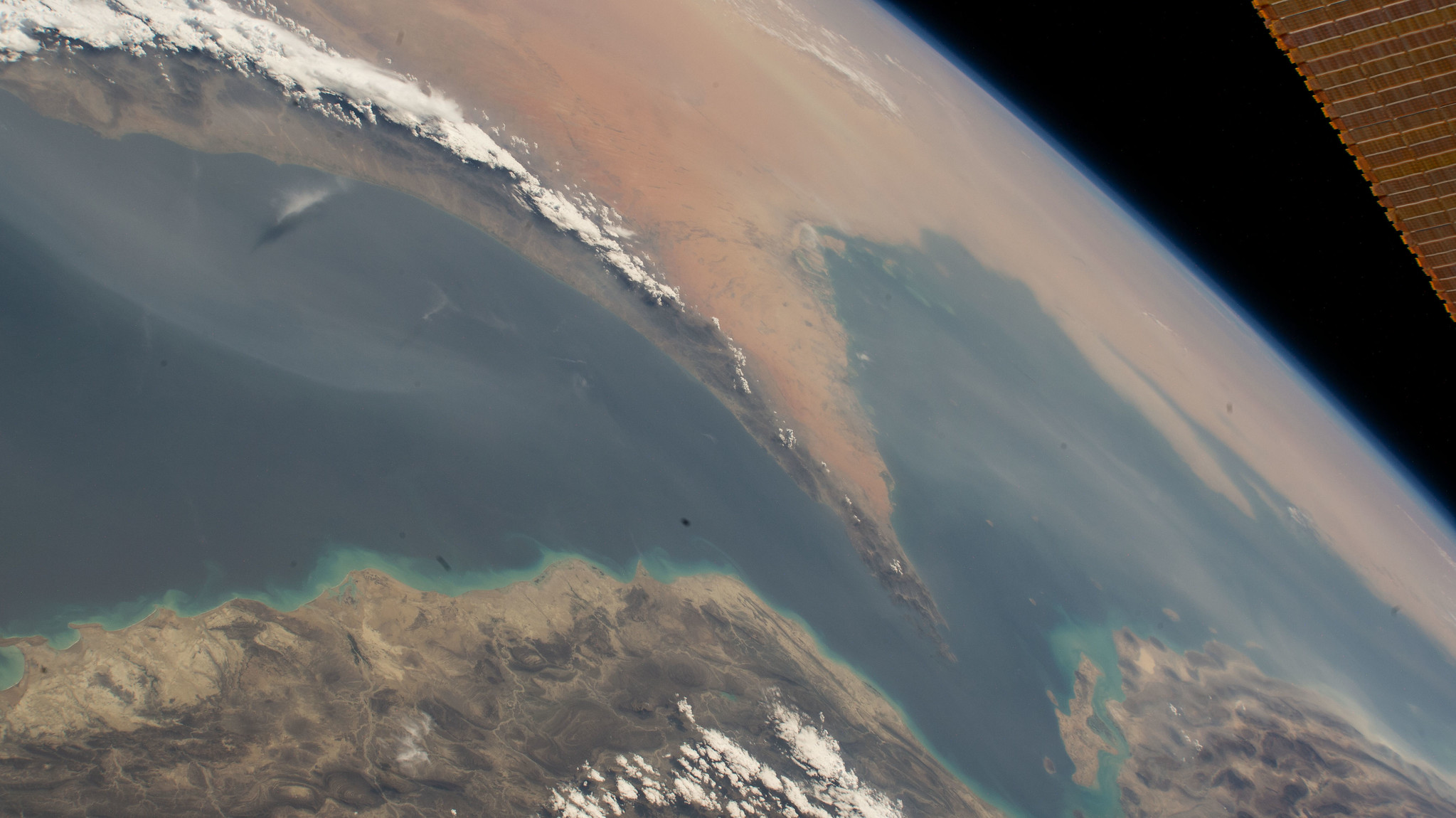
Speaking at the World Bank-IMF Spring meetings, outgoing World Food Programme head Cindy McCain said that if the global fuel, food and fertiliser shock continues until June, an estimated 45 million more people could fall into severe hunger. These deadly effects are being exacerbated by disruptions to humanitarian supply chains and ongoing global aid cuts. In an attempt to mitigate the looming food security crisis, the UN is continuing to negotiate with Iran and the US on a plan to allow ships carrying fertilisers to pass through the Strait of Hormuz.
The UN has said that 2025 was the deadliest year on record for Rohingya refugees at sea. 900 of the 6,500 people who attempted to cross the Andaman Sea and Bay of Bengal last year were reported as dead or missing, which was “the highest mortality rate worldwide of any major route for refugee and migrant sea journeys”.
The Trump administration’s proposed 2027 budget seeks to claw back the increases in foreign aid spending mandated by Congress for 2026. The proposal includes a US$4.3 billion cut to global health assistance relative to the amount enacted by Congress for 2026, a US$2.2 billion cut to humanitarian aid and a structuring of all bilateral economic assistance around Trump’s “America First Opportunity Fund”. The 2027 budget is unlikely to be passed ahead of the congressional mid-terms in November.
At the UN, the Trump administration is seeking support for its new “trade over aid” initiative, while also proposing that new conditions be attached to its core funding for the organisation.
Books, reports, articles and podcasts
Former USAID official Nick Enrich has published his new book, Into the Wood Chipper: A Whistleblower’s Account of How the Trump Administration Shredded USAID.
A new volume edited by ANU’s Annabel Dulhunty and Sharon Bessell examines diverse perspectives on gender and development from Australia and the Pacific.
A new paper from the Center for Global Development (CGD) examines how aid agencies might strengthen their development effectiveness in an era of shrinking budgets, drawing on case studies from New Zealand, South Korea, France and Norway.
And CGD’s Charles Kenny and Eeshani Kandpal look at what’s wrong with the World Bank’s current reform agenda.
2026 aid budget breakfast
Join us online for the Development Policy Centre’s annual aid budget breakfast on Wednesday 13 May at 9am. Register now.