



The Pacific Engagement Visa (PEV) provides up to 3,000 permanent residency visas for citizens of up to 12 Pacific island countries and Timor-Leste. To obtain a PEV visa, you first must enter a ballot, then if you are randomly selected from the ballot you are invited to apply for a visa. To be granted a visa you must then satisfy all the visa requirements, the most difficult of which is normally securing a job offer.
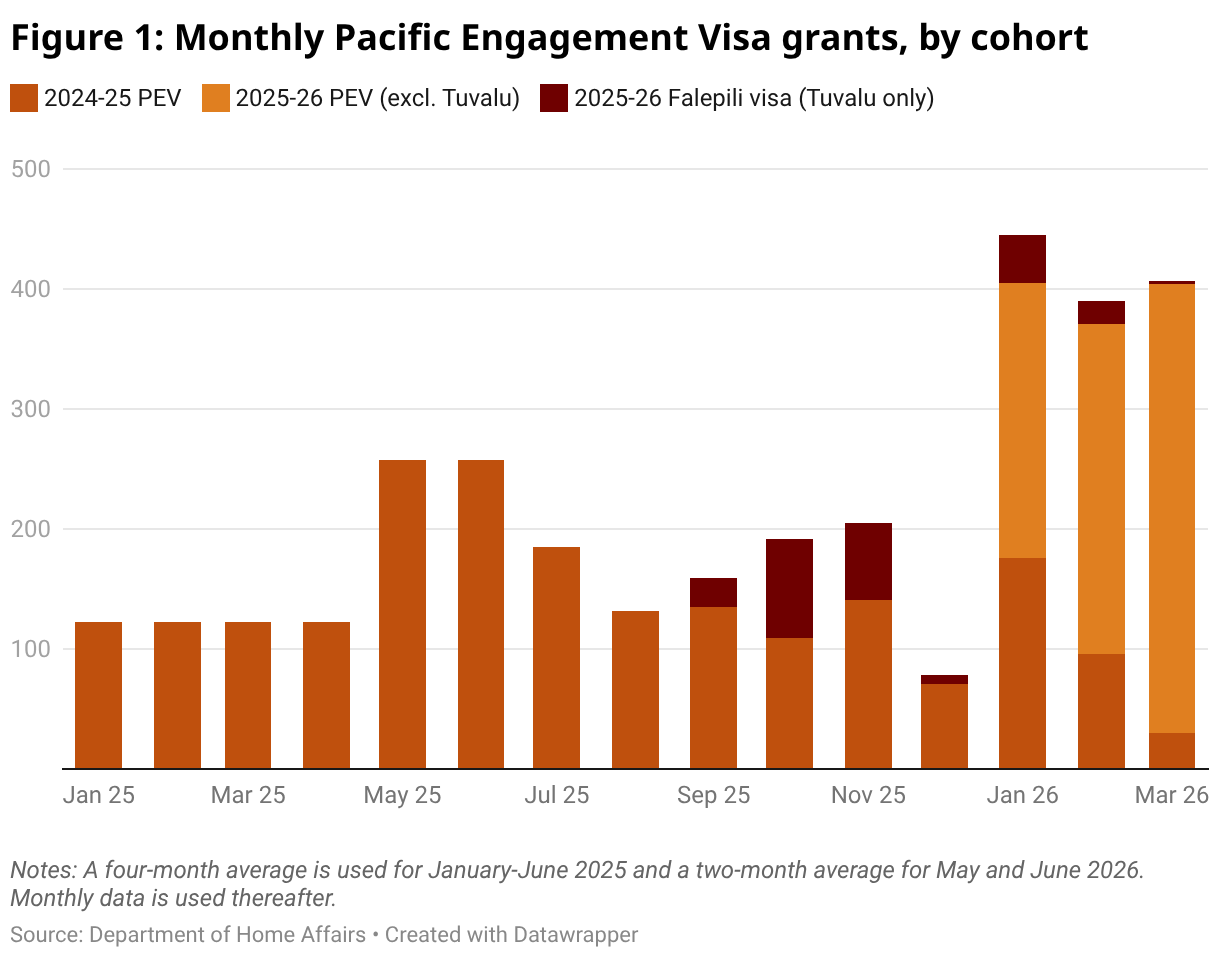
In 2024-25 only 1,006 PEV visas were granted. However, things sped up in 2025-26, and 1,953 PEV visas were granted between July 2025 and March 2026.
In all, 2,081 visas were granted by the end of March to the 2024-25 cohort, a 69% success rate relative to the 3,000 visas on offer. Our earlier prediction that this cohort would achieve a success rate of 70% now looks conservative. Perhaps it will get closer to 80%.
We have said in the past that the first cohort would have the hardest time getting a visa. Over time, as the visa became better known and job pathways better established, PEV visas would be issued more quickly.
This prediction is now borne out by the data. 878 visas were granted for the 2025-26 cohort by March this year. This compares very favourably to the 1,006 visas issued for the 2024-25 cohort by June last year: almost the same number of visas in only half the number of months. We would expect a close-to-100% success rate for the 2025-26 cohort, which is what New Zealand’s equivalent but much-longer-established Pacific Access Category visa achieves.
The pick-up in visa grants for the 2025-26 cohort as well as for the scheme as a whole is evident from the monthly data graphed below.
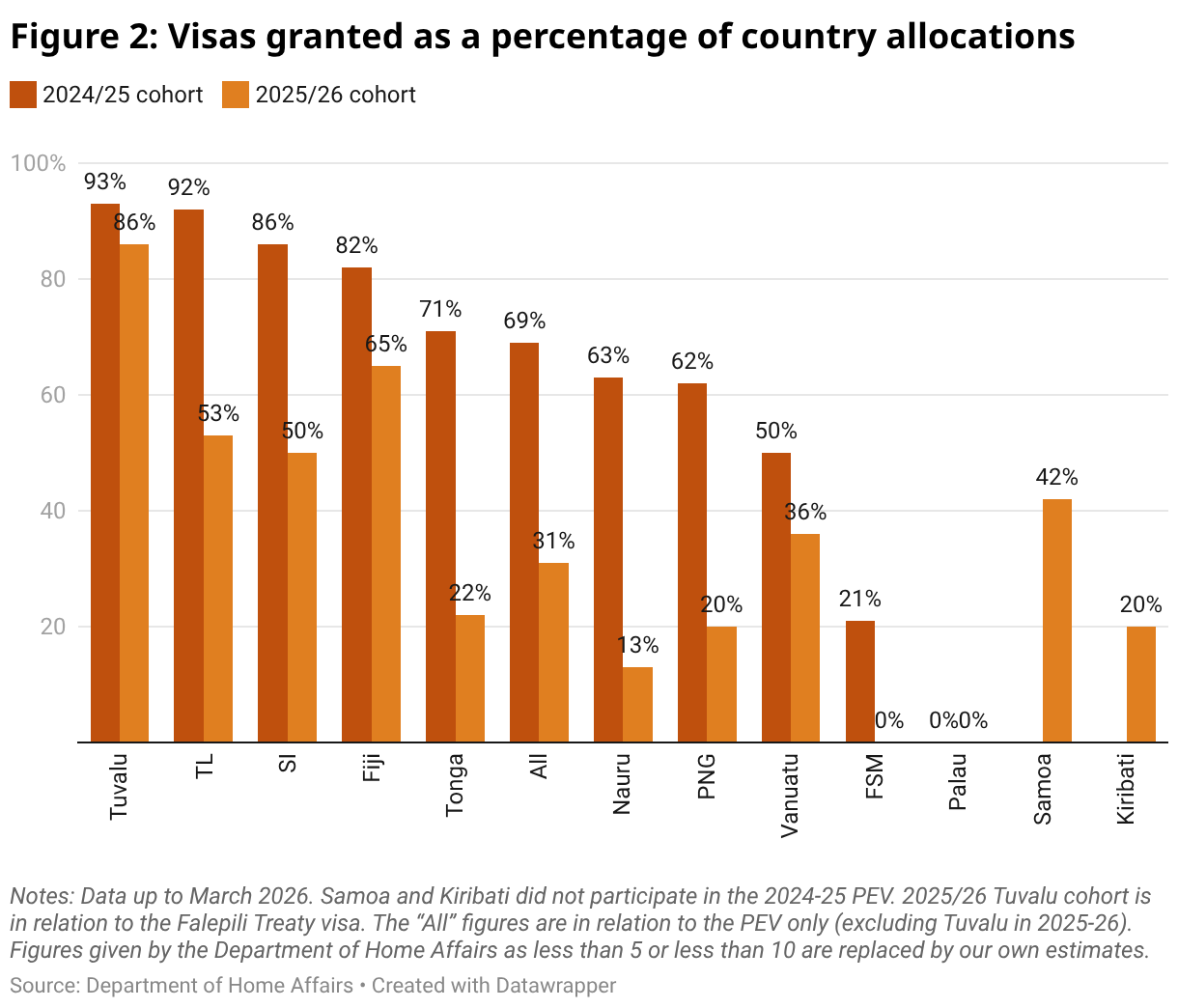
Tuvalu is the most successful PEV country. 93 of its 2024-25 allocation of 100 regular PEV visas have already been issued. In 2025-26, Tuvalu switched to its own Falepili Treaty PEV visa stream, which offers 280 visas and has no job requirement. By the end of March, 86% of these Treaty visas (which are allocated on top of the 3,000 cap) had already been issued.
Timor-Leste, Fiji and Solomon Islands are the next three most successful countries. They have achieved more than an 80% grant-to-allocation ratio for their 2024-25 cohort, and so far more than 50% for the 2025-26 cohort.
Meanwhile, allocations (quotas) have just been announced for the 2026-27 ballot which opens July 1 and closes July 29. These are shown below, with comparisons to the first two years.
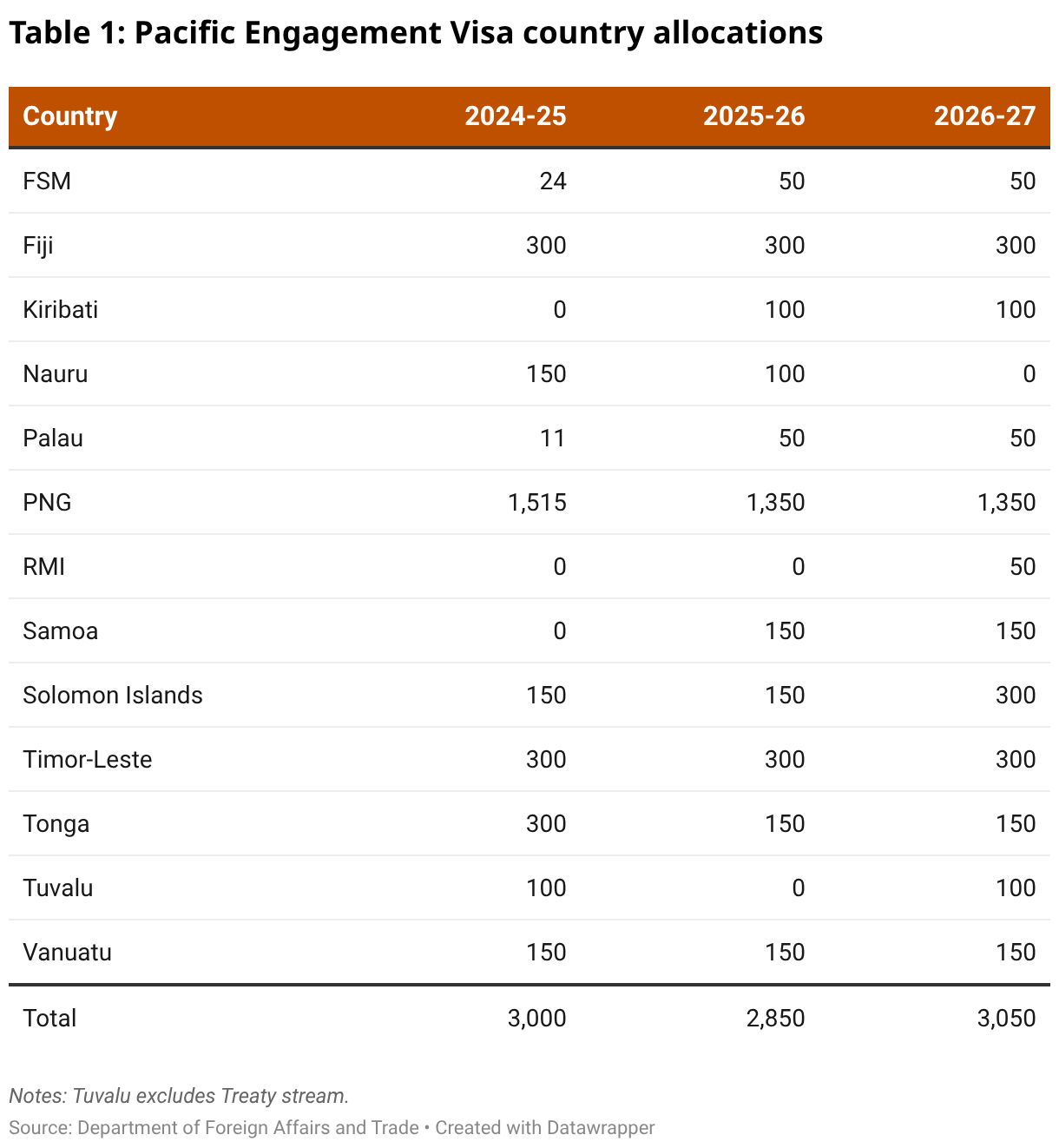
There is one new inclusion in the ballot for 2026-27: the Republic of the Marshall Islands, which has been allocated 50 visas. Given the lack of interest in the PEV from the other two compact states — Palau and FSM — that also have unlimited migration rights to the US, the rationale for this is less than clear. Neither Palau nor FSM has come close to filling its quota in the last two years.
Other decisions make more sense. The Solomon Islands allocation was doubled from 150 to 300. This was at the request of the Solomon Islands government following recent discussions between the country’s new Prime Minister Matthew Wale with Australia’s PM Anthony Albanese as part of a plan to strengthen the relationship between the two countries, leading to a new treaty.
Tuvalu has been included in the regular PEV again, receiving 100 visas on top of its annual 280 Treaty visas. Tuvalu participated in the 2024-25 PEV round, but waited out the 2025-26 round after it got access to its own PEV-like visas as part of the Falepili Union deal with Australia. But now Tuvalu is claiming its right to continue to access the regular PEV on top of its treaty visas. Given its success in the 2024-25 round, this is not surprising. If you include both, Tuvalu is now receiving 380 visas a year — the second-most out of any PEV participating country.
Vanuatu was not included in the initial 2026-27 announcement, but its participation has since been confirmed following the Vanuatu Prime Minister’s visit to Australia this week and the signing of the Nakamal Agreement.
Nauru is not participating in the 2026-27 PEV round. No reason has been given for this, though its low success rate in the first two rounds is evident from Figure 2.
In general though, the growing success of ballot-winners in earlier PEV rounds should encourage participation this time round. We would expect last year’s ballot registration record to be broken by the time this year’s ballot closes at the end of July.
All data on visa grants provided by the Department of Home Affairs in response to data requests.








Through my research on the PALM scheme, I’ve tangentially heard a mixture of success stories and challenges for people arriving on the PEV. The challenges (including employers withdrawing contracts on arrival, access to government services, and acquiring rentals) aren’t necessarily new to migration streams, especially with new systems. However, it sounds as though communities where migrants may be moving to may not have adequate support and resources in place to do so. I’m curious as to whether others have heard similar issues, if these are teething issues that can be overcome, or if there may be more systemic concerns about whether the right supports are in place?
I have been asked why the country allocations for this year’s PEV exceeds 3,000, since the sum as shown in the table for 2026-27 is 3,050. My understanding is as follows. The Australian government commitment is to issue up to 3,000 PEV visas a year/cohort. More than 3,000 people can be invited to apply for a visa in the knowledge that not everyone will be successful.
An excellent success story