


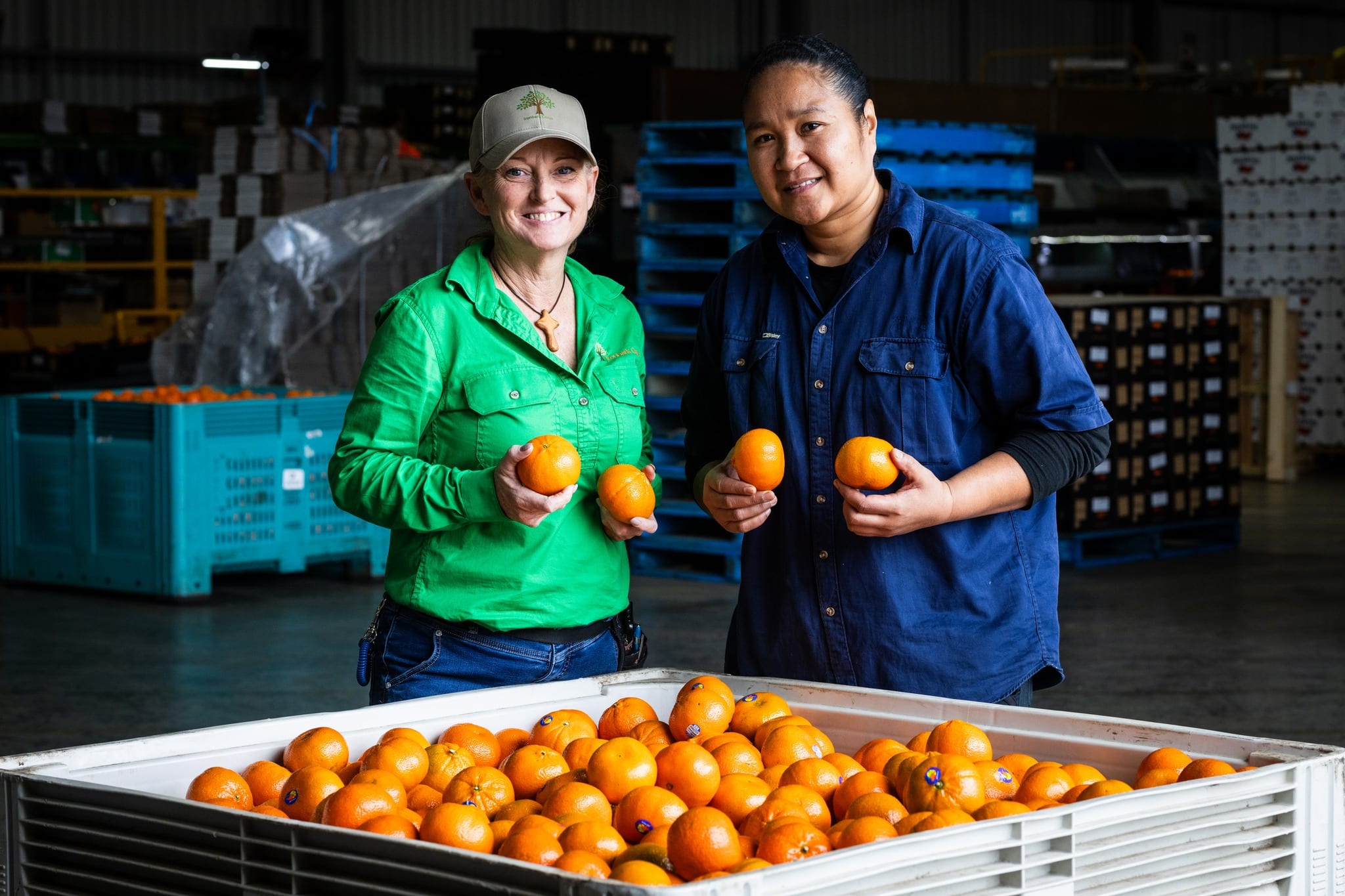
Since the late 2000s, Australia (through the Pacific Australia Labour Mobility scheme — PALM) and New Zealand (through the Recognised Seasonal Employer scheme — RSE) have been offering seasonal employment opportunities for the Pacific countries and Timor-Leste.
These two schemes have contributed to a remittance boom in the Pacific. Unfortunately, PNG is missing out.
The schemes allow temporary migrants to work in agriculture for seven to eleven months under the RSE, and in agriculture for up to nine months or in other sectors such as meat processing for up to four years under PALM.
The labour mobility schemes are mutually beneficial. Recent research shows that the schemes have hugely positive impacts on labour-sending countries. Remittances enhance the inflow of foreign exchange, and the money flows directly to households, which supports family consumption spending and investments in health and education, housing and small businesses. Meanwhile, labour shortages in crucial sectors are being filled in Australia and New Zealand.
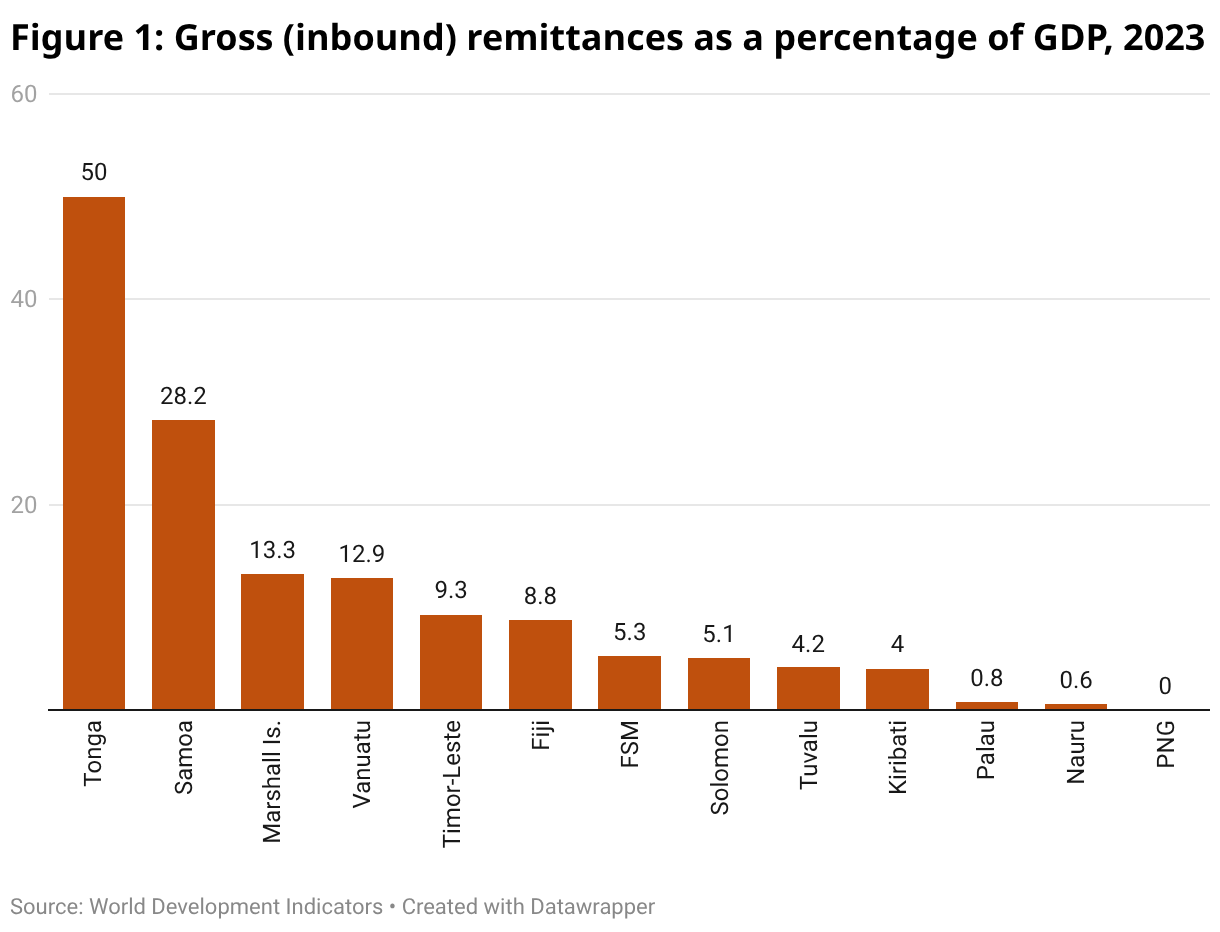
Remittance inflows have traditionally been important for a few Pacific countries, notably Tonga and Samoa. As shown by the figure below, more recently a number of other Pacific countries have grown their remittances, and another six now have remittances in excess of 5% of GDP, including Solomon Islands, Timor-Leste and Vanuatu, which have not traditionally been remittance-intensive.
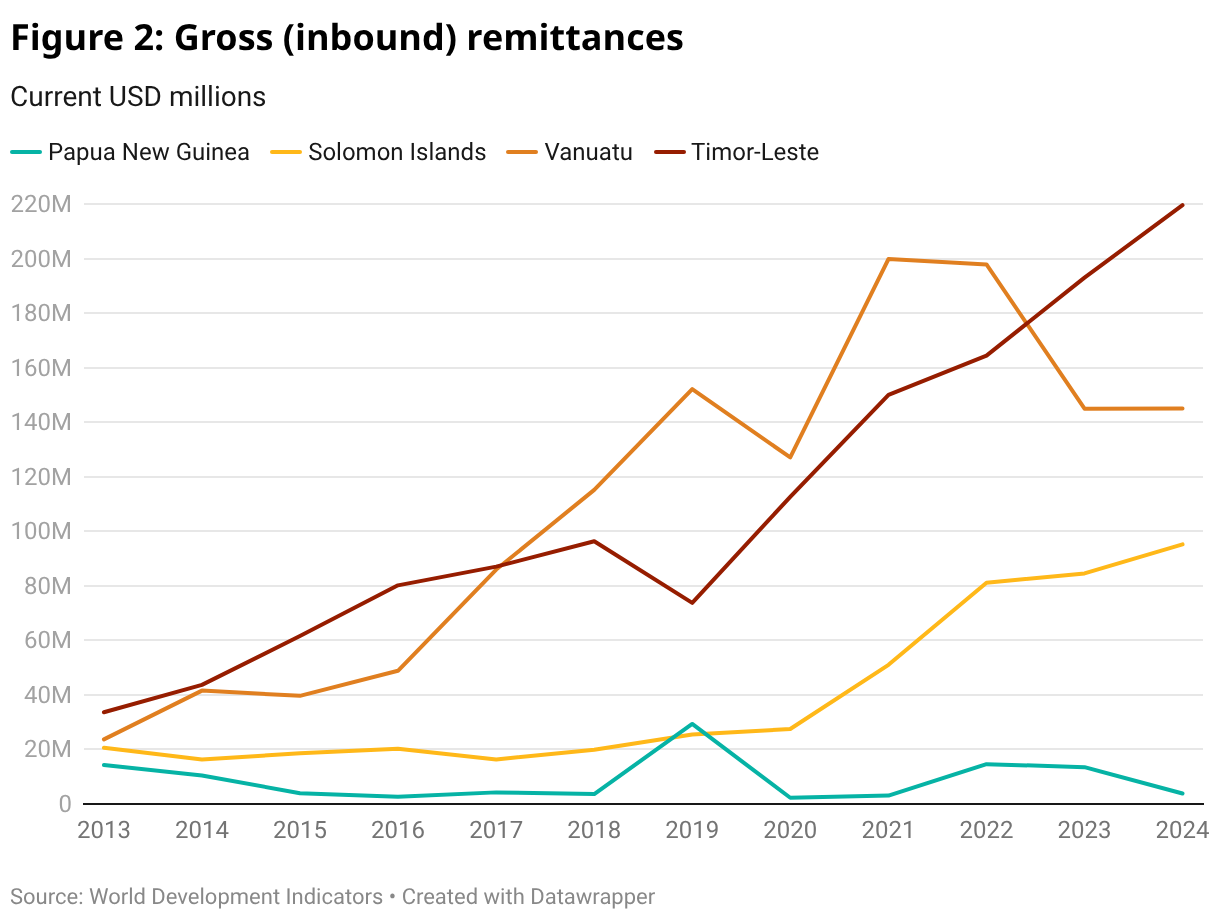
Given its size, it is not surprising that PNG has the lowest level of remittances in the Pacific relative to GDP. A better comparison would be based just on the dollar value of remittances different Pacific countries receive. We focus on those larger Pacific countries which have not traditionally been remittance-intensive. As Figure 2 shows, PNG is missing out. Remittances have taken off in Solomon Islands, Timor-Leste and Vanuatu but not in PNG.
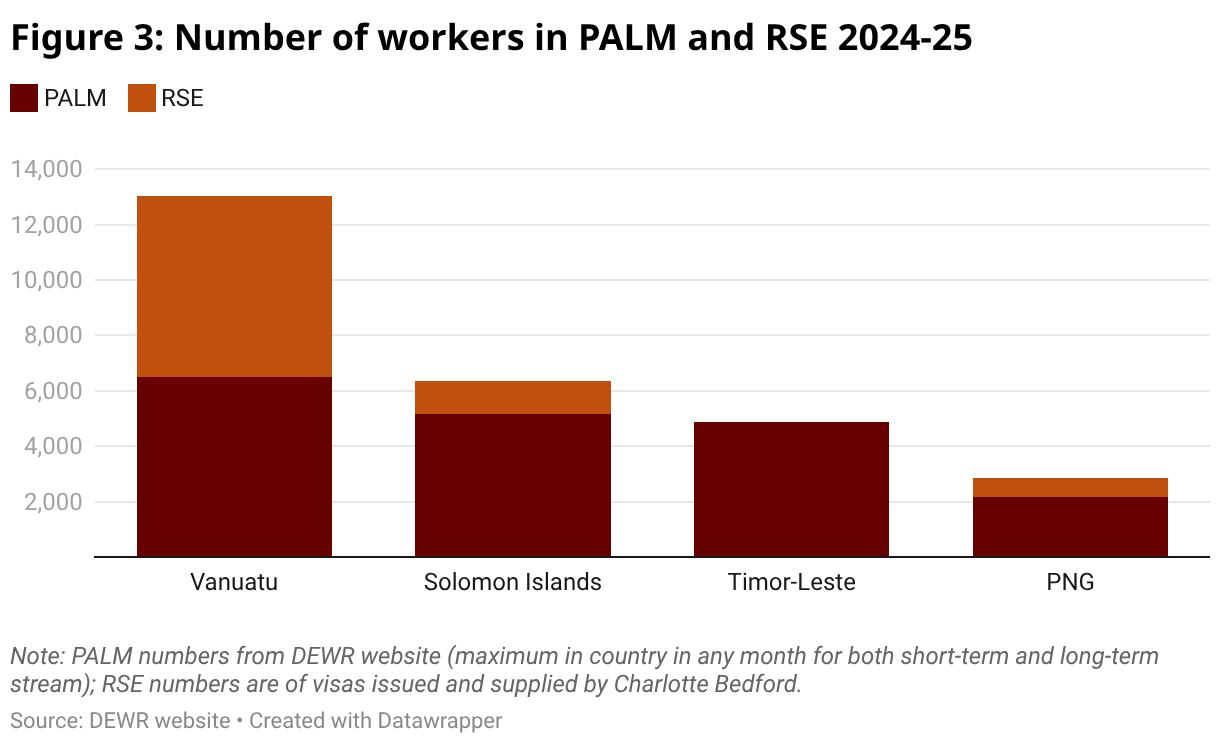
This is directly linked to the number of workers these countries have participating in PALM and RSE. In 2024-25, Vanuatu had 13,000 PALM and RSE workers, Solomon Islands 6,300, Timor-Leste 4,900 and PNG only 2,800.
This difference in PALM/RSE participation, while important, doesn’t explain all the divergence in remittance inflows. We would still expect to see some increase in PNG’s remittance inflows compared to pre-PALM days, if not nearly as much as the other three countries.
According to the World Bank-ANU 2023 survey of PALM and RSE workers, on average PALM/RSE workers earn about $3,500 a month and spend $2,000 a month, leaving $1,500 a month to save. With 2,800 workers overseas, this should give PNG a total of $52 million in potential remittances a year. Why are we not seeing that show up in the data, with inward remittances instead at $15 million or less since the pandemic (Figure 2)?
It might be thought that PNG workers are not saving as much as those from other countries. However, anecdotally PNG labour mobility participation is leading to significant benefits for their families. More likely, workers are not sending funds back to PNG through the banking system but rather bringing their savings back with them as cash when they return. In that case, those savings would not show up as remittances, as they would not enter the banking system as transfers. It could also be that the Bank of Papua New Guinea and the commercial banks are not doing a good job of recording inward remittances; this would be understandable given the low value of inward remittances in the past.
What is clear is that PNG is continuing to miss out in large part on the benefits of the labour mobility opportunities Australia and New Zealand are offering. PNG workers make up less than 10% of PALM workers and less than 5% of RSE workers.
Neither PALM nor RSE utilises country quotas, and employers are free to recruit from whichever Pacific country they want. PNG is a marginal PALM and RSE player in part because it was a latecomer. The O’Neill government ignored the seasonal labour opportunities Australia and New Zealand were opening up to the Pacific. To its credit, the Marape government when it came to power in 2019 rectified this by setting a target of sending 8,000 people overseas by 2025.
Since then, there has been some growth in PNG seasonal worker numbers. Before COVID, PNG sent a maximum of 170 workers to New Zealand and only about 100 to Australia. Since COVID, the number of PNG RSE workers has grown to 650 and PALM workers to some 2,800.
While this is clear progress, the difficulties PNG has had in growing its PALM and RSE numbers have been well documented, and there are certainly some worrying signs. There was hardly any growth in 2025 in the number of PNG RSE workers (a tiny increase from 640 to 658). And the number of short-term or seasonal PNG PALM workers in Australia has actually fallen from above 600 in mid-2023 to under 500 now.
Neither PALM nor RSE is growing in aggregate terms, so it will be difficult for PNG to further grow its participation in these static schemes.
On the positive side, PNG is now the Pacific’s major beneficiary of the Pacific Engagement Visa, a permanent residency pathway introduced by Australia in 2024. The PEV does have country quotas and PNG has been given the biggest quota of all, 1,350 a year. This should certainly help boost PNG’s remittances. Whether it will be enough for PNG to join the Pacific’s remittances boom remains to be seen.


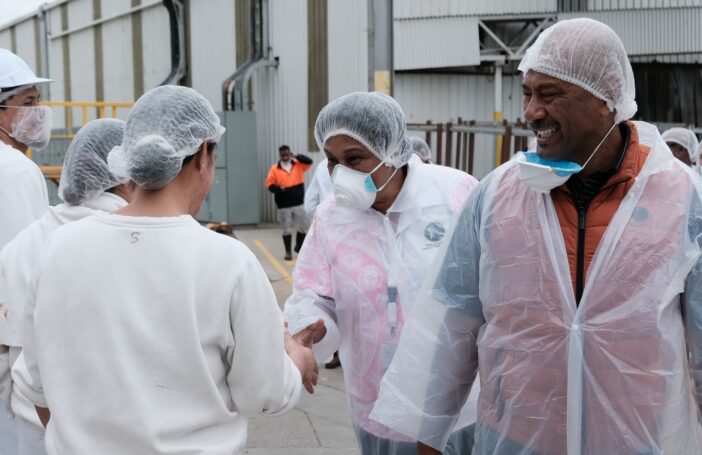




An interesting a probably and unintended consequence is that from anecdotal evidence from Vanuatu is that boys are leaving school earlier than they might otherwise to join these schemes. The longer term development impact would be interesting. Also is there a ‘Dutch Disease’ effect in Tonga?
The other way around could be true as well if studied. PNG should be sending more money to Australia than other Pacific Countries combined.