

The Pacific has a communications problem that extends well beyond social media.
The region covers almost one-third of the Earth’s surface, with small populations scattered across vast distances. Individually, Pacific Island countries have limited global economic and political influence. For these countries, reliable communications are both critical and difficult to control.
At both ends of the system through which information travels, Pacific countries are increasingly dependent on infrastructure and technology controlled elsewhere. Under the ocean, submarine cables carry almost all international digital traffic. At the other end, global technology companies increasingly determine what information people see — through social media algorithms, search engines and artificial intelligence.
These are usually treated as separate issues. They should not be. Together they raise a larger question about Pacific sovereignty: who controls the infrastructure that carries the region’s information, and who controls whether that information reaches its audience?
A recent Australian National University National Security College report, Connected & Protected: Building Australia’s Submarine Cable Resilience, launched on 11 August 2026, highlights the first part of the problem.
Submarine cables are critical infrastructure. Australia relies on them for about 99% of its international data traffic, while Pacific Island countries can be even more vulnerable because they have fewer alternative routes when a cable fails.
Cables can be damaged by earthquakes, underwater landslides, anchors and fishing activity, or deliberately disrupted or sabotaged. In countries with limited redundancy, a failure can affect government services, banking, commerce, media and emergency communications.
Tonga experienced the consequences of cable failure dramatically after the Hunga Tonga–Hunga Ha’apai volcanic eruption and tsunami in January 2022. The eruption severed Tonga’s international submarine cable, leaving the country largely cut off from the outside world. Telephone and internet connections were severely disrupted for weeks. In the immediate aftermath, many families overseas could not establish whether relatives had survived.
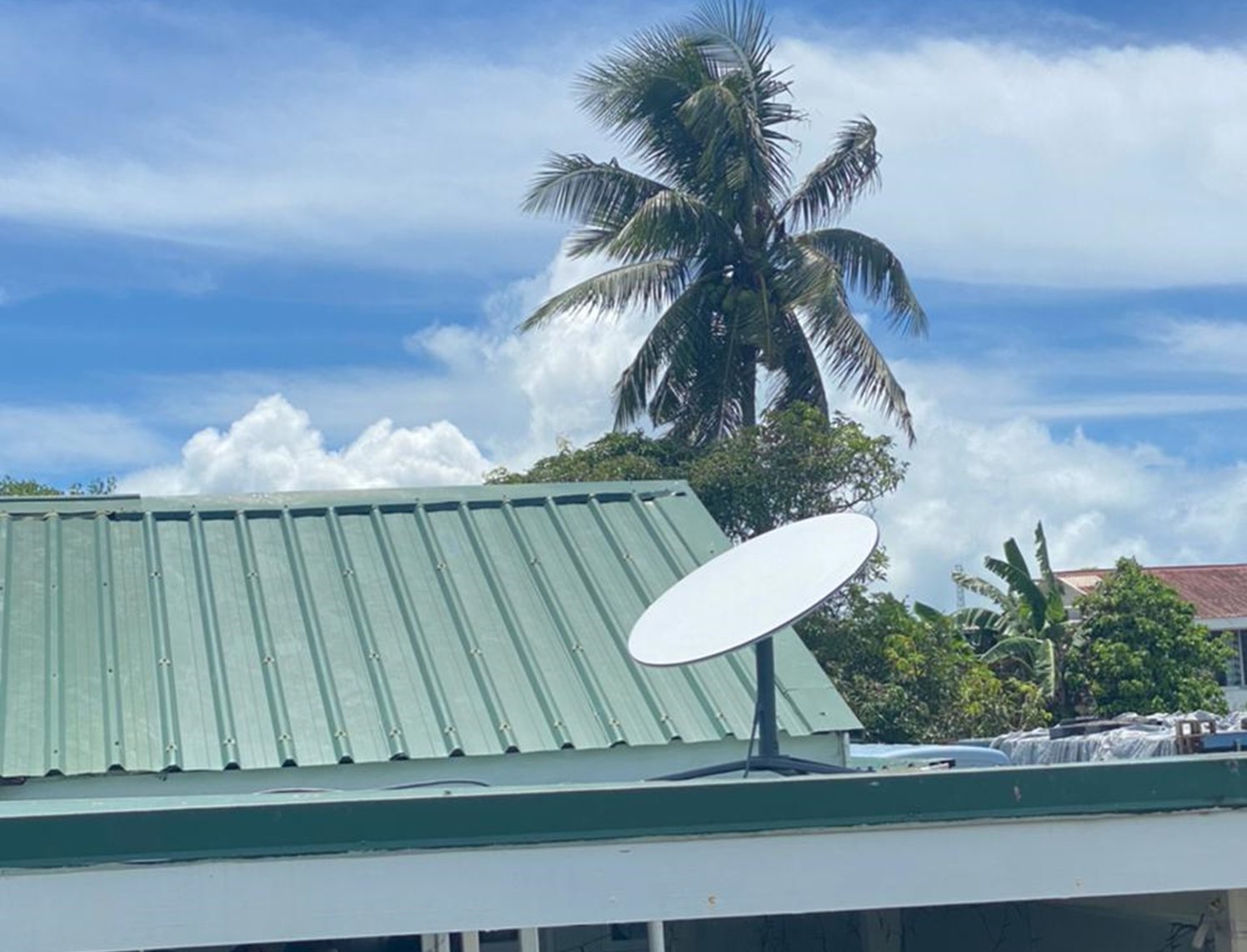
Satellites provide an important back-up. Starlink and OneWeb are spreading across the Pacific and can provide connectivity when cables fail, particularly during disasters. But satellites cannot manage the enormous volume of data carried by submarine cables. They provide redundancy but cannot substitute for cables.
Starlink’s rapid expansion has also raised questions about technological dependence. Researcher Seohee Park has discussed its expansion in the Pacific in the context of “technocolonialism”, where reliance on externally controlled technology can create new forms of dependency.
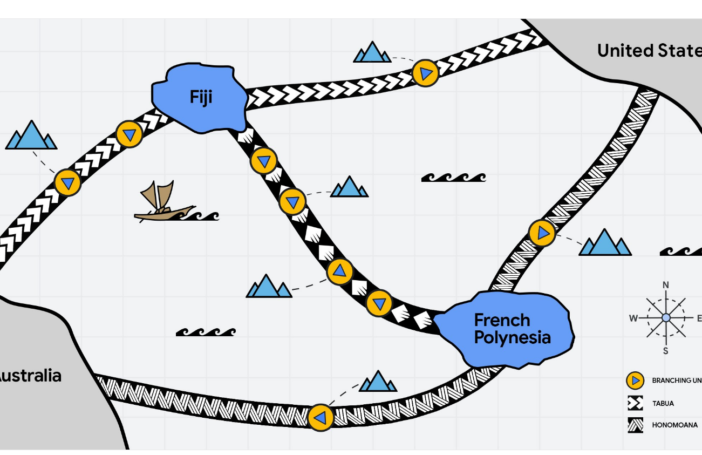
Ownership of Pacific cable infrastructure is complex. Australia has invested heavily in expanding connectivity, but public funding does not necessarily mean Australian ownership — or private ownership.
The Coral Sea Cable System, linking Australia with Papua New Guinea and Solomon Islands, was largely funded by Australia and is jointly owned by the Australian government and state-owned entities in PNG and Solomon Islands. More recent Australian investments are connecting Pacific countries into cable networks being developed by Google and other private operators.
At a forum in Melbourne on 10 August, one of the ANU report’s authors, David Brewster, said, “They are all privately owned, and increasingly, they are being owned by US tech companies such as Meta or Google or Amazon.”
Brewster also highlighted limits on regional capacity to repair cables when they fail. He said Australia has no capability to repair damaged submarine cables quickly, while the vast Pacific region has just one repair ship, based in Fiji.
For the Pacific, the issue is therefore not simply whether there are enough cables, or whether they are protected. It is also about who owns, operates and controls the interconnected infrastructure on which the region depends.
In any case, securing the physical network addresses only half the problem.
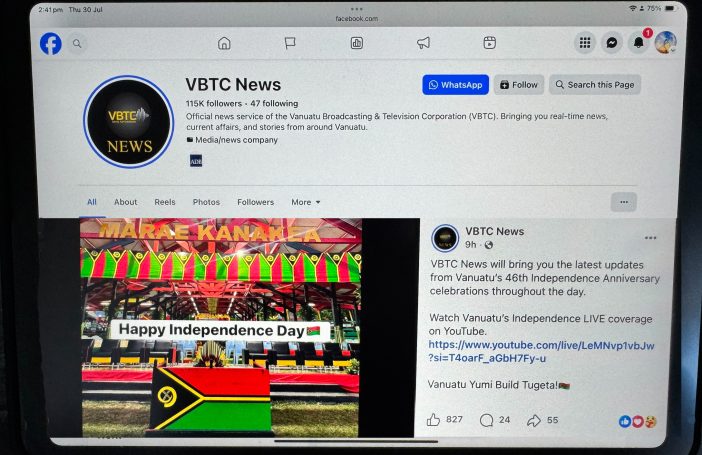
Pacific news organisations have become heavily reliant on Facebook and Google to reach audiences. Changes to Meta’s algorithms have reduced the visibility of news content on Facebook. For small Pacific publishers, that can threaten their ability to reach the communities they serve.
Now search is changing as well. An Axios analysis published on 31 July reported a sharp decline in Google Search traffic to publishers as AI changes how people find information. According to data cited by Axios, Google Search referrals to publishers had fallen 34% in a year.
Small publishers have been hit hardest. Over two years, they lost 60% of Google Search referrals, compared with 47% for medium-sized publishers and 22% for large publishers.
That should set alarm bells ringing across the Pacific. Most Pacific news organisations are small publishers operating on narrow margins in small advertising markets.
AI creates a further problem. Systems can extract and synthesise information without users ever visiting the site of the organisation that produced it. Pacific newsrooms could find themselves producing journalism that helps global technology companies answer questions about the Pacific while receiving neither the audience nor necessarily the revenue generated by their work.
There are now three critical layers to the Pacific information system: the cables that carry information, the platforms that distribute it and the AI systems increasingly mediating it. Pacific countries exercise limited control over all three.
This matters particularly in a region highly exposed to natural disasters. During cyclones, earthquakes, volcanic eruptions and tsunamis, reliable information can be a matter of life and death. Emergency warnings are of little value if communications infrastructure fails. Communities are also vulnerable if trusted local information cannot reach them because distribution depends on opaque commercial algorithms.
Pacific governments are beginning to recognise elements of this challenge. At last week’s Pacific Islands Forum Foreign Ministers Meeting, ministers noted that, for the first time, all Forum members are now connected to undersea telecommunications cables.
They also supported Pacific Digital and Artificial Intelligence Technology Principles and development of an AI Governance Framework, as well as a Pacific regional approach to safer digital spaces involving shared policy principles and engagement with digital platforms.
Individual Pacific states and media organisations have little bargaining power when dealing with companies worth trillions of dollars. Collectively, however, the Pacific has greater weight.
The region has a strong tradition of collective action where individual island states have limited international leverage. Communications sovereignty should become another such issue.
That could include regional work on cable redundancy and emergency communications, clearer responsibility for critical digital infrastructure, stronger arrangements with private cable operators and a coordinated approach to technology and AI companies over the distribution and use of Pacific journalism.
There is a danger this becomes caught up in geopolitical competition. Cable projects and digital infrastructure increasingly attract strategic interest from China, the United States, Australia and other powers. Pacific governments should resist allowing that competition to define the debate.
The central question is not which external power or technology company the Pacific should align with. It is whether Pacific countries retain sufficient control and resilience to communicate with their own populations and ensure Pacific information remains visible.
The Pacific cannot own every cable, search engine, social network or AI system on which it depends. But it can decide that access to reliable Pacific information is critical infrastructure — and act collectively to protect it.
The alternative is a communications system in which others increasingly control both the pipes carrying Pacific information and the algorithms deciding whether anyone sees it.

As someone who has only had a passing interest in this issue – thank you for this contribution – Ive learned a lot!
Thanks for the feedback, Richard.