Facebook is strangling Pacific journalism, with some news organisations losing up to 70% of their audience almost overnight.
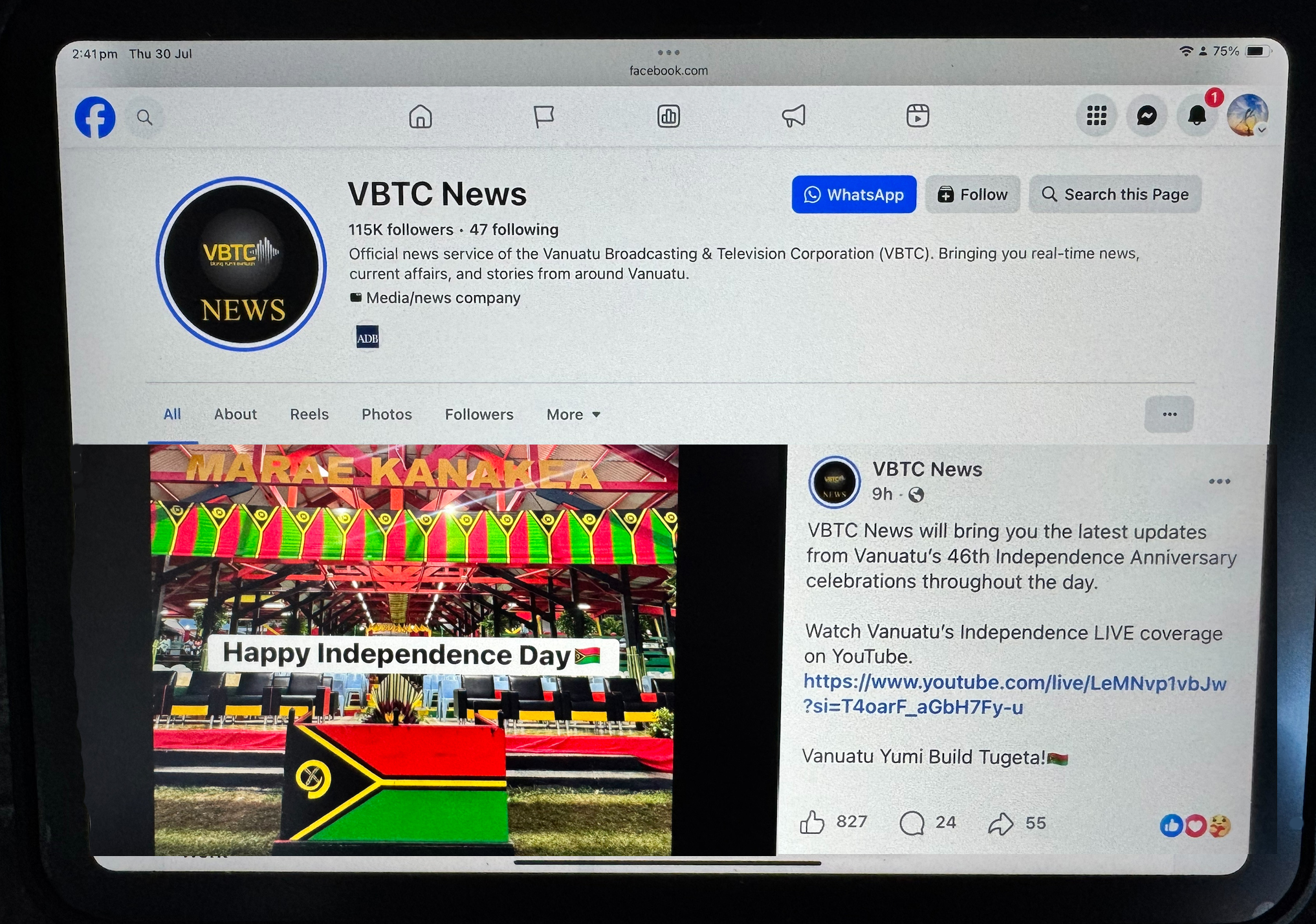
The sudden falls have hit The Pacific Newsroom, the Vanuatu Broadcasting and Television Corporation (VBTC) and the Solomon Islands-based Melanesian News Network, raising fears that changes to Meta’s algorithms are pushing verified news out of Facebook feeds.
The Pacific Newsroom recorded a 70% fall in Facebook views. Melanesian News Network founder and editor Dorothy Wickham says her outlet’s reach dropped by about 45% over four months. In Vanuatu, the VBTC has also reported a significant decline in reach and views across its main Facebook pages.
None of the outlets can prove that a particular algorithm change caused the losses, and Meta has offered no explanation.
The declines raise a larger question: what happens to public-interest journalism in the Pacific when the overseas platform on which many publishers depend changes how their reporting is distributed?
Across much of the Pacific, Facebook has become a principal channel for news, current affairs and official information. Live election coverage, disaster alerts and government statements are routinely distributed directly through Facebook feeds. A Lowy Institute analysis of disinformation in the region describes the extent to which mainstream outlets have been forced to treat Facebook as a primary distribution platform because so much of the population relies on social media for current affairs.
Francis Herman, chief executive officer of the national broadcaster VBTC and an influential figure in Pacific media, says that dependence makes changes to Facebook’s distribution systems a matter of regional media sovereignty.
“When a single overseas platform changes an algorithm without consultation, it can dramatically reduce the visibility of local journalism, public-interest reporting and emergency information across multiple island nations,” he said.
Herman says VBTC has observed a significant fall in views and reach on its Facebook pages in recent weeks, particularly on its news service. He says discussions with other Pacific media colleagues suggest the problem is not confined to Vanuatu.
At The Pacific Newsroom, we noticed the collapse in our figures in June 2026. Facebook views of our posts fell by about 70%, despite our having around 80,000 followers across social media, most of them on Facebook.
We had not changed what we publish or how frequently we post. Our audience had not suddenly disappeared. Meta offered no explanation.
We cannot prove that an algorithm change caused the fall. But there was no obvious editorial or audience change that explained it, and the timing was stark enough to demand scrutiny.
The Pacific Newsroom has operated for more than eight years. At its peak, our stories attracted about half a million views a month. Three of us run it as volunteers, working with journalists, editors and newsmakers throughout the region. They send us stories and tips, help verify reports and alert us when something is wrong.
Much of the news we carry comes from small Pacific newsrooms. By bringing those stories together in one place, we help them reach regional and international audiences they could not easily reach alone. We link readers back to the news organisation that did the original work.
That is why the sudden loss of reach matters. This is not simply an attempt to defend or vindicate one volunteer news service. Our experience is a case study of a wider vulnerability now also being reported by other Pacific publishers.
Meta’s retreat from dedicated news products is well documented. Reuters reported in March 2024 that the company would close Facebook News in Australia and the United States, following earlier closures in the United Kingdom, France and Germany, and would not enter new commercial deals for traditional news content in those countries.
The company has repeatedly argued that news accounts for only a small part of what users see on Facebook. Publishers respond that Meta itself controls what appears in users’ feeds. News is not discovered in a neutral digital marketplace. It is ranked, recommended, suppressed or surfaced by systems that publishers cannot inspect.
There is evidence of a broader decline in news visibility. A 2025 academic study of more than five million Facebook posts found that reactions to news fell by 78% between 2021 and 2024 while reactions to non-news pages increased. The study did not examine the Pacific, but its findings help explain why publishers are asking hard questions about platform distribution.
In a second post, I look at why Pacific newsrooms are especially exposed to these shifts and what a policy response might look like.