

As demonstrated in the previous article in this two-part series, Pacific publishers have seen sharp, unexplained falls in their Facebook reach, at a time when much of the region depends on the platform for news, official information and emergency alerts. The question is why the Pacific is so exposed, and what can be done about it.
Commercial estimates based on Meta’s advertising data put Papua New Guinea’s Facebook audience at about 1.5 million in late 2025, according to DataReportal’s Digital 2026 report. That is not an independently verified count of active users, but it indicates the platform’s scale.
The cost of mobile data, unreliable coverage, power cuts and low incomes all shape how people use the internet. For someone who can open Facebook but cannot afford to visit several news websites, the summary on Facebook may be all they read.
That gives Meta enormous power over the flow of news. It also gives Pacific newsrooms a practical dilemma. If they do not post to Facebook, they may miss a large part of their audience. If they rely on Facebook, they accept a distribution system they do not control.
Meta’s Transparency Center explains that Facebook uses AI systems and numerous signals to decide what appears in each person’s feed. These can include the type of post, previous interactions and whether users click, comment, share, hide or report similar material.
Meta publishes broad explanations of ranking. It does not disclose the weight it gives individual signals, nor does it give publishers a clear notice every time those weights change. That leaves small news organisations trying to guess why one story travels widely while another almost disappears.
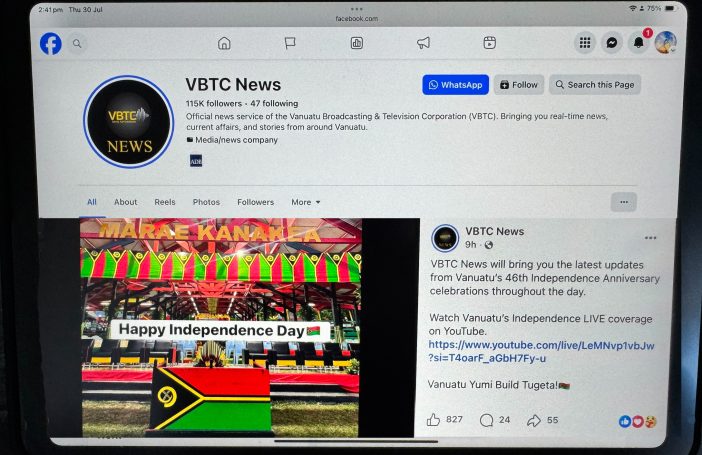
Francis Herman, chief executive of Vanuatu’s national broadcaster VBTC, says his discussions with media colleagues point to several trends that may be affecting publishers: a preference for creator content over traditional publisher pages; reduced distribution of posts containing external links; and heavier reliance on AI-driven recommendations, meaning that following a page no longer guarantees that its posts will appear prominently in a user’s feed.
These are informed observations rather than publicly confirmed Meta rules. But the consequences can be especially severe in the Pacific. Audiences are relatively small, so even a modest ranking adjustment can produce a large percentage fall in reach.
Most Pacific outlets also lack the resources to compensate through paid promotion, search optimisation or diversified distribution platforms.
In many Pacific countries, mobile data is expensive and internet speeds are unreliable. A reader may click a news link only to find that the publisher’s website is slow, costly to load or temporarily unavailable. The reader gives up and returns to Facebook without reading or sharing the story.
This may leave Pacific news links at a disadvantage. The problem begins with poor or expensive internet access, but Facebook’s ranking system may magnify it.
Like many Facebook Page managers, we have been advised to remove links from the body of posts. The suggested tactic is to write a substantial summary, upload an image directly to Facebook and place the link to the original story in the first comment.
There is no published Meta rule saying all external links are penalised. The “link in comments” method is a tactic to test, not a guaranteed solution. It also has an obvious drawback: the original source becomes less visible while the journalist’s work is reproduced inside Facebook. That may help a post travel, but it does little for the Pacific news organisation that employed the journalist and published the story.
We have also been told to publish less often and leave longer gaps between stories. One piece of advice was to wait at least 90 minutes between posts. I can find no public Meta document supporting that rule.
It is also useless during a cyclone, earthquake, tsunami warning or political crisis, when information needs to be published and updated quickly.
The Pacific Newsroom, a volunteer-run regional news service that aggregates and amplifies reporting from small Pacific newsrooms, cannot operate that way. It would be unethical to rewrite other journalists’ work for Facebook or arrange urgent stories around a system Meta refuses to explain. Nor should emergency reporting have to wait 90 minutes to satisfy an algorithm.
Australia introduced the News Media Bargaining Code in 2021 to address the power imbalance between digital platforms and news organisations. It encouraged Meta and Google to make commercial agreements with publishers, backed by the possibility of mandatory negotiation and arbitration if a platform was formally designated.
More than 30 agreements followed. An Australian Treasury review concluded that those agreements were highly unlikely to have been made without the Code.
In 2024, Meta announced it would not renew its Australian news agreements.
Publishers warned that the lost revenue would cost journalism jobs, close publications and leave more communities without reliable local news.
The Australian Government has since proposed a News Bargaining Incentive. Draft legislation released in April 2026 would impose a charge on large digital platforms’ Australian revenue unless they made qualifying commercial agreements with news publishers. The proposal had not become law at the time of writing, and Meta strongly opposes it.
Pacific media organisations have reason to watch closely. Many are struggling to survive in the digital economy. Their reporting circulates on the same platforms, but the newsrooms receive little or nothing in return.
Any Pacific response would need to recognise the size and vulnerability of the region’s newsrooms.
Australia’s original scheme was criticised because larger media companies benefited more easily while smaller and online-only publishers faced barriers. A Pacific model would need to be designed for Pacific conditions, not imported wholesale.
The Pacific Newsroom has repeatedly tried to communicate with Meta. Legitimate stories have been labelled as spam or misinformation and removed. Decisions can be difficult to appeal. It is almost impossible to reach a person who understands journalism or the Pacific context.
We can experiment with different Facebook formats. We can expand on WhatsApp and other platforms. We can encourage people to follow Pacific news organisations directly. But Meta remains too important to abandon while so many Pacific people use Facebook to find news.
That is the trap. Pacific publishers depend on Meta to reach their audiences. Meta can change the way it distributes their work without warning, cut their reach without explanation and leave them with nowhere meaningful to appeal.
Better internet will help connect the Pacific. It will not solve the problem of one foreign company controlling so much of the region’s news distribution.



Thank you very much for your two blog posts. You have identified an alarming recent trend. You have also helped to highlight the vulnerability of Pacific newsrooms. Thank you.