


At the end of April 2026, Cyclones Maila and Vaianu were active across the South Pacific at the same time, hitting Papua New Guinea, Solomon Islands, Vanuatu and Fiji and stretching weather services and emergency teams thin as they tried to manage both events at once. This is what Pacific women are living through. The storms themselves usually pass within hours. For some women, the danger does not.
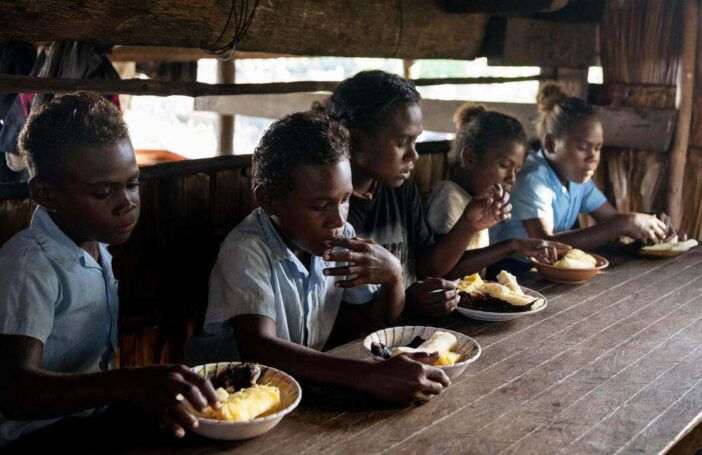
Evacuation centres have become a familiar refuge in the Pacific, and a familiar danger. Families sleep side by side on classroom floors. Privacy disappears and tensions rise. For a woman experiencing violence, the options narrow quickly. The road to the police station is damaged. Clinics are closed or overwhelmed. Phone networks are down. The systems meant to protect her are out of reach.
Community leaders, church groups and women-led organisations work under enormous pressure to keep families safe in these centres. Without proper resources, training and design standards that build in privacy and protection, good intentions are not enough, and the burden continues to fall heavily on frontline actors.
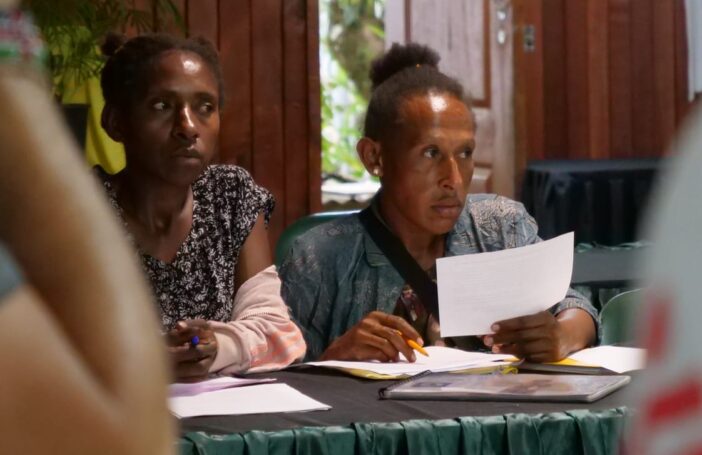
At the same time, ministries responsible for women’s affairs across the Pacific are increasingly recognising violence against women and girls as a cross-cutting issue, including in the context of climate change and action. They are working to strengthen coordinated, multi-sector responses that bring together police, health, justice and social services, and are beginning to integrate prevention into wider resilience and climate adaptation efforts.
While this shift is significant, these ministries cannot do this on their own. They are chronically underfunded, and as climate impacts intensify, the pressure on national systems will only grow. If climate responses are going to deliver resilient and sustainable futures, governments and development partners need to invest in the systems that keep women and girls safe, alongside the roads, seawalls and renewable energy.
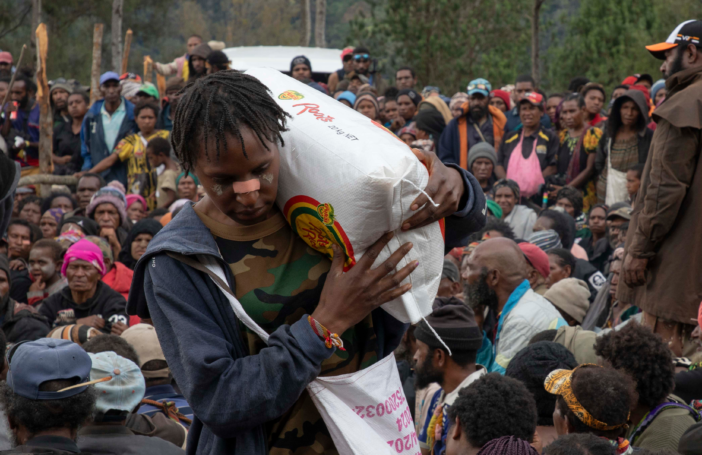
When disaster hits a small island community, the damage extends well beyond flooded roads and broken infrastructure. The social fabric that keeps people safe is disrupted. Overcrowded shelters, economic stress and weakened services all increase risks for women and girls, but those risks are rarely picked up in loss and damage assessments or climate financing decisions. Losses are counted in damaged buildings, destroyed crops and kilometres of coastline eroded. The violence women experience in the aftermath usually goes uncaptured.
The Pacific records some of the highest rates of violence against women in the world. Prevalence studies show high lifetime rates of intimate partner violence, with up to 64% of women experiencing physical or sexual violence by a partner. What makes the Pacific particularly stark is how widely that violence is accepted. In Samoa, 37% of women and 30% of men believe a man is justified in hitting his partner in at least one circumstance. In the Marshall Islands, the figures are 56% of women and 58% of men. In the Solomon Islands, 77% of women and 57% of men agree. Where violence is this normalised, additional pressure from economic stress, displacement or overcrowding does not just add to the risk. It accelerates it.
Climate shocks are exactly that kind of pressure. Research from Kiribati’s Strengthening Peaceful Villages program looked at the 2020 drought and found a clear link between climate-related male income loss and intimate partner violence. 41% of men who had perpetrated intimate partner violence in the past year also reported reduced earnings. When patriarchal norms position men as breadwinners and climate change makes that role harder to fulfil, men’s mental health suffers and the risk of violence against partners rises.
Evidence from Samoa shows climate shocks also make it harder for women to leave violent relationships. Women who had lived through two or three disaster events had more than twice the odds of experiencing intimate partner violence in the past 12 months. For those who had lived through four or more, the odds were over eight times higher. The cumulative weight of these shocks wore down women’s mental health and, with it, their ability to seek help or leave.
Vanuatu tells a similar story. Cyclones, extreme rainfall and flooding are no longer rare. They arrive almost every year, often before households have recovered from the last one. For women already facing violence, the cycle of shock and recovery keeps them stuck in unsafe homes and shelters, with fewer options each time. The recently launched Second National Survey on Women’s Lives and Family Relationships sets out what intimate partner violence looks like during an emergency. One in two women have experienced physical or sexual violence, and 73% have experienced coercive control from an intimate partner in their lifetime.
Vanuatu has responded. We recognise this violence as a critical dimension of non-economic loss and damage, which moves the conversation beyond the purely economic impacts of climate change. Our Loss and Damage Policy and Implementation Plan commits to addressing both economic and non-economic impacts across all climate-related initiatives and financing. This is a world-first commitment, and it should become a regional and global standard.
The 2050 Strategy for the Blue Pacific Continent commits to keeping all Pacific peoples resilient to climate change and disasters. With Pacific Island countries (PICs) among the most vulnerable in the world, the investment required is enormous. The International Monetary Fund estimates PICs need to invest between 6.5% and 9% of gross domestic product each year in adaptation-related infrastructure alone.
Large infrastructure projects move fast, bring in outside workforces and disrupt communities. Without proper safeguards, they can make women less safe. A mostly male workforce arriving in a community, poorly lit or badly designed public spaces, tensions over land acquisition and harassment of female workers can all increase exposure to violence. If those risks are not anticipated and managed, investments meant to build resilience end up undermining safety, participation and long-term sustainability.
When the risks materialise, the project itself is undermined. Community resistance grows, sustainability collapses and the investment fails to deliver. Many international climate funds already require environmental and social safeguards. Building violence prevention into those frameworks would help climate investments protect women and girls and produce better, more durable outcomes.
The same risk runs through climate adaptation, mitigation and disaster risk management more broadly. Planned relocation, for example, can heighten competition over land and deepen community tensions, leaving women and girls more exposed in unfamiliar surroundings with limited support.
Vanuatu’s experience tells us climate resilience and the safety of women and girls are not separate agendas, and it is asking climate finance partners to make this a condition, not an afterthought.
Climate resilience is not only about protecting coastlines. It is about protecting people. The Pacific has long led global conversations on climate justice. Recognising violence against women and girls as a climate-related impact, and funding the response, is the next part of that work.
As Cyclones Maila and Vaianu tracked across the Pacific, women were making their way to evacuation centres. The winds pass. For too many women, the violence does not. The question is what we choose to do before the next shock arrives.




This is a powerful framing of an issue that is often treated separately from climate discussions. Linking violence against women to climate stress highlights how environmental shocks don’t just damage infrastructure—they deepen existing social inequalities and increase vulnerability in very real, human ways. It’s an important reminder that climate policy has to be grounded in protection, equity, and lived experience, not just emissions targets.
This is a powerful and important connection that often gets overlooked. Framing violence against women as part of the climate crisis helps show how environmental stressors don’t just damage ecosystems—they also deepen existing social inequalities and risks. It’s a reminder that climate policy has to be human-centered, addressing safety and protection alongside environmental action.
In view of the growing climate emergency, it’s great that these critical concerns for women have been brought to public attention. Hopefully the resources will be made available for Pacific governments to respond.