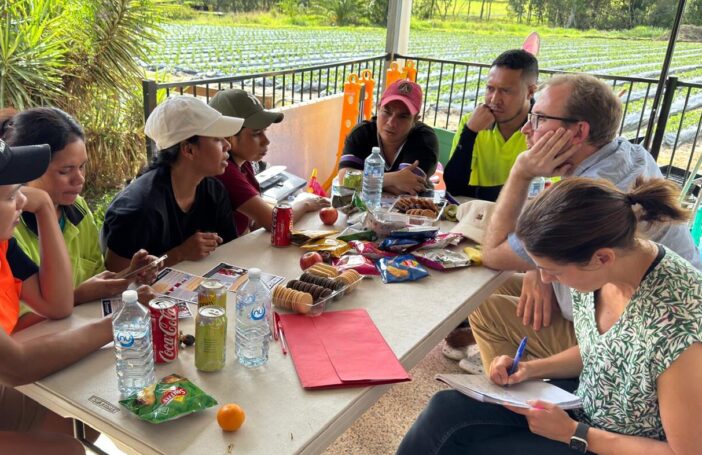
Welfare support is meant to be central to the success of the Pacific Australia Labour Mobility (PALM) scheme, yet little is publicly known about how the system actually works. Our Devpolicy policy brief reports in some detail on the scope and effectiveness of the PALM welfare support system. We conclude that it is extensive on paper but poorly understood and inadequately connected in practice.
PALM welfare support has two broad strands: a set of formal, government-mandated arrangements and various forms of informal, community-driven support. Both are important, but what is missing is a more systematic, collaborative approach to making these elements work together to ensure a better focus on each worker.
At the centre of the formal system is the Approved Employer’s (AE) obligation to provide a Welfare Officer at a ratio of one full-time equivalent per 120 workers. The PALM Guidelines 2.1 (27 March 2026) spell out this role in exhaustive detail: 56 “must” and four “must not” statements across 11 pages, covering everything from financial support to grievance handling. This breadth places a substantial legal burden on AEs, one that is rarely acknowledged by those outside the scheme. At the same time, because the Welfare Officer is employed or engaged by the AE, workers may reasonably fear that raising a concern could jeopardise their job. As no specific skill set is mandated for this role, the skills welfare officers bring to the role can vary significantly between employers.
Workers who don’t want to go through their employer can contact the Department of Employment and Workplace Relations (DEWR) directly by phone or email at any point. There is no requirement to raise issues with their employer first. But these channels require them to share sensitive concerns with a stranger rather than someone they trust. DEWR collects data on worker contact and case outcomes but does not publish it, so how often these channels are used and to what effect is not publicly known.
Country Liaison Officers (CLOs), appointed by the sending countries, offer workers the chance to deal with someone they are more likely to trust, given their shared language and culture. Around 13 CLOs and two Labour Attachés cover the scheme; some are paid by their home governments and some by Australia, with travel costs covered by Australia. But CLOs are liaison, not welfare, officers. While they may be involved in routine welfare matters, they are not expected to resolve them directly.
Two further elements complete the formal system. Regionally based DEWR Relationship Managers focus mainly on monitoring employer compliance rather than providing direct worker support. They do, however, help organise regional community engagement forums which involve PALM workers.
The Community Connections Program is delivered by the Salvation Army with church and diaspora partners, including the NSW Council for Pacific Communities, the Pacific Islands Council Queensland and the Uniting Church. The program, which runs in every state and territory, is now in its second contract stage to June 2027. All but one of its coordinators come from the cultural backgrounds of PALM’s ten sending countries. This DEWR-funded program offers workers opportunities to engage with local community life. It also administers a small Emergency Support Fund for crises. The program has no direct role in resolving welfare grievances but, by tackling the dislocation many workers may feel, it contributes significantly to their overall wellbeing.
Much of the day-to-day support workers actually rely on is informal. The Pacific Labour Mobility Survey, conducted in 2021-23, surveyed 2,085 workers from Kiribati, Tonga and Vanuatu working in Australia and New Zealand. It found that only about one in four workers undertaking short-term work in Australia would seek advice or help from an employer or their representative and only one in three would report a complaint through that channel (it did not ask why). Team leaders, who typically oversee groups of up to 20 workers, are the source of advice to whom workers say they would most often turn, and the most likely channel for complaints. CLOs were among the least likely to be approached, though efforts have been made since the survey was undertaken to strengthen their role. Union representatives, through their presence at Arrival Briefings, focus on workplace rights rather than welfare per se. An Australia Institute discussion paper published in December 2023 (page 7) reports that unions, including the Australian Workers’ Union, help workers to recover unpaid wages, transfer to another employer and pursue disputes with employers over accommodation, pay deductions and hours of work.
Volunteer supporters from churches, sporting clubs and especially diaspora networks also help workers overcome their isolation by enabling them to engage with local community life. However, this support remains largely unfunded, ad hoc and often unrecognised. Faith-based and community organisations play a significant role, often on shoestring budgets. Examples include a Tetum-speaking support officer funded by the Catholic group ACRATH, a Warrnambool foundation funding a support worker for Timorese workers at a local meat-works, an Anglican “Community Priest” in Sunraysia and a Solomon Islands pastor employed by the Uniting Church to support workers in New South Wales and the Australian Capital Territory.
Our policy brief reports on an emerging model from Victoria promoting greater collaboration. In 2023, one of us (Randall), then Community Connections Regional Coordinator for Victoria, began meeting informally with Victorian-based CLOs and DEWR worker support staff to discuss matters of common concern. Those meetings evolved into a structured monthly forum that has now run for over two years. In consultation with CLOs nationally, DEWR has built on it as a recommended practice across all states and territories. PALM scheme Regional Engagement Forums are another form of collaboration: two-day events bringing together workers, employers and officials to address issues such as mental and reproductive health.
The legal employment and duty-of-care relationship between the worker and the AE is the core of the PALM welfare system. That relationship is meant to be one of mutual benefit, but it is between two unequal parties. The wider welfare architecture exists to acknowledge and respond to that inequality. The formal arrangements are thorough in print, but the system’s many parts — government agencies, CLOs, Community Connections staff and community supporters — have operated too separately.
For PALM’s welfare support to deliver what it promises on paper, four aspects need to change. First, closer collaboration is needed among all stakeholders, building on the Victorian model and the Regional Engagement Forums. Second, AEs and their welfare officers need better support, in particular more focused educational resources and training, given the scale of the obligations they carry. Third, the informal support providers who currently sustain much of the system on their own budgets, including faith-based groups, diaspora networks and volunteers, need more resourcing and recognition. Finally, there should be public reporting on how the different forms of welfare support are working, so that workers, employers, the wider Australian public and sending countries can judge the system’s effectiveness. That will be the real test of the scheme’s success, domestically and diplomatically.
The authors are grateful for feedback from relevant government departments, coordinated by DFAT. The assessment of the effectiveness of existing arrangements is, however, the authors’ alone.