Australian aid
Members of Australia’s Emergency Action Alliance (EAA) and their local partners have released an appeal for those affected by the flood disaster on the China-Nepal border, which has killed hundreds of people and left thousands in need of humanitarian assistance. The Australian government has pledged $5 million to multilateral and non-government partners and will deploy humanitarian specialists to assist with relief efforts.
Several EAA members have also released public appeals to raise funds for those affected by the 10 August Colombia earthquake.
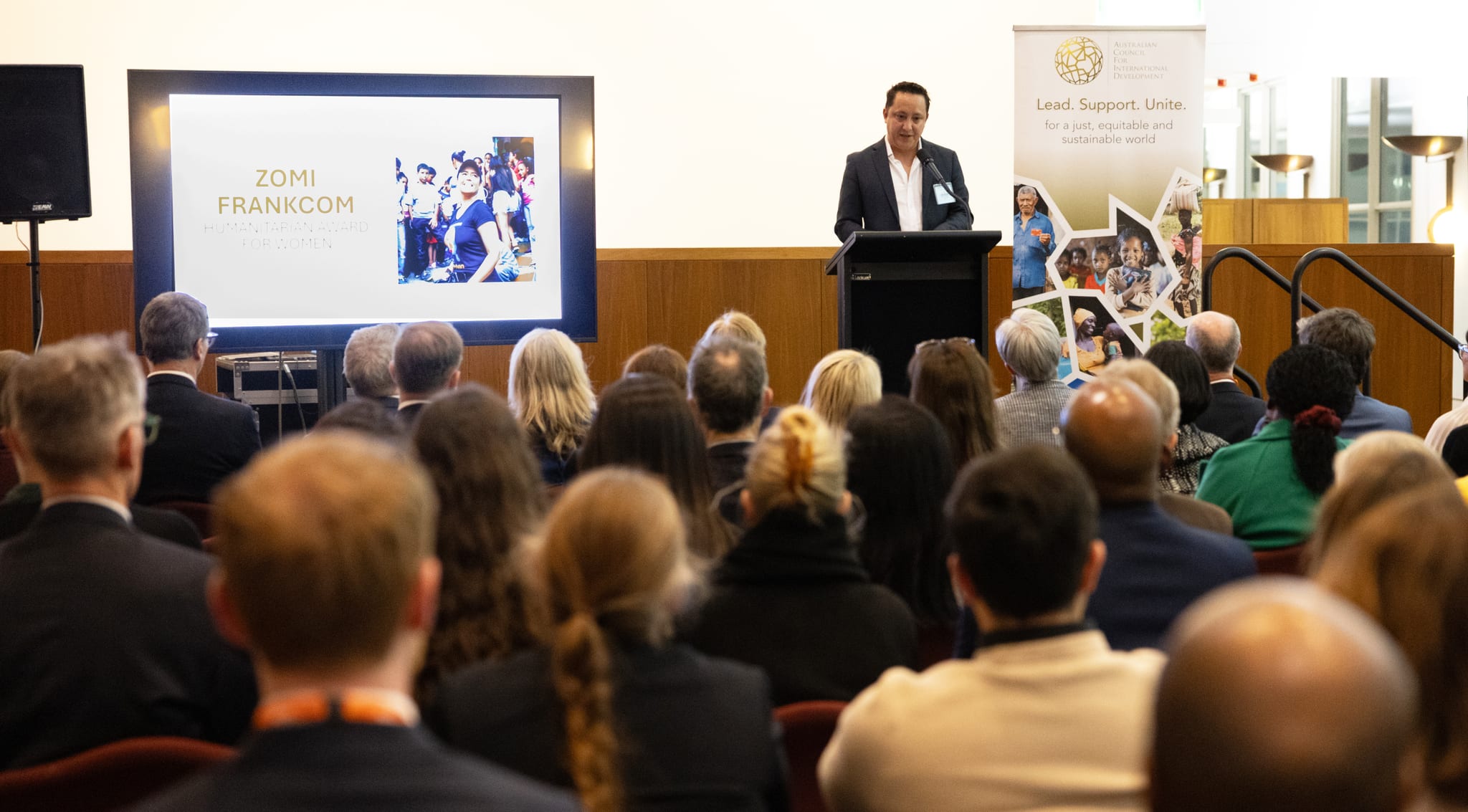
Foreign Minister Penny Wong has said Australia is “outraged” at Israel’s decision not to pursue criminal proceedings against its military personnel involved in the killing of Australian aid worker Zomi Frankcom and her World Central Kitchen colleagues in Gaza in 2024. She described the timing of the announcement, made on World Humanitarian Day moments after the Australian government launched a new humanitarian award in Frankcom’s honour, as “especially insulting”. It is estimated that 187 aid workers were killed in the Occupied Palestinian Territories in 2025 and, to date, 20 have been killed in 2026.
The government has proposed an amendment (see Schedule 8) to counter-terrorism legislation that would expand proscribed offences against UN peacekeepers to include offences against UN personnel involved in peacebuilding programs and humanitarian assistance. The draft bill does not include an exemption from counter-terrorism and sanctions offences for accredited non-government and other organisations engaged in the delivery of humanitarian assistance. The 2025 UN Declaration for the Protection of Humanitarian Personnel, which Australia led, commits signatories to “work with States to ensure that humanitarian activities carried out by humanitarian organisations are not criminalised where those activities are consistent with international law”.
Speaking at the parliament’s inquiry into the role of the aid program in conflict prevention, DFAT officials acknowledged the need to better harness research in its programming, strengthen its work under the women, peace and security agenda and refresh its approach to training. Officials also rejected the findings of a wider OECD peer review of its internal capability in this area, described DFAT’s development-humanitarian approach in Myanmar as “pretty seamless”, and said Australia was “deeply engaged” in preparations for what is likely to be another challenging election in PNG in 2027.
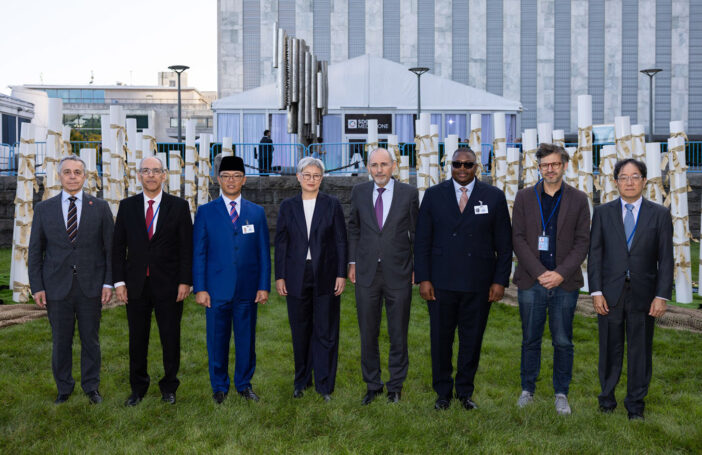
As heads of state and government gather for the Pacific Islands Forum Leaders Meeting in Palau, the chair of the Pacific Resilience Facility (PRF), the Marshall Islands’ finance minister David Paul, has implored more countries to commit funding to the PRF at the upcoming COP31 global climate negotiations. To date, only around a third (US$172 million) of the PRF’s target capitalisation for 2026 (US$500 million) has been pledged. Over two-thirds of pledges have come from just two donors — Australia (~US$67 million) and Saudi Arabia (US$50 million).
The Forum Foreign Ministers Meeting in Suva on 7 August set the agenda for the leaders’ meeting, with ministers agreeing outcomes on regional architecture reform and economic development priorities, as well as preparations for COP31. At the meeting, Wong pledged a further F$23.5 million (A$15 million) to assist Fiji’s response to what has become the world’s fastest-growing HIV epidemic.
Speaking at the launch of the Australian Council for International Development’s State of the Sector Report 2026, Andrew Leigh, the Assistant Minister responsible for charities in the Treasury portfolio, highlighted the significant fall in public donations to Australian development and humanitarian NGOs over the last decade, commended the sector’s increased focus on transparency and learning and urged greater use of evidence, including impact stories, to engage the public.
Regional and global aid
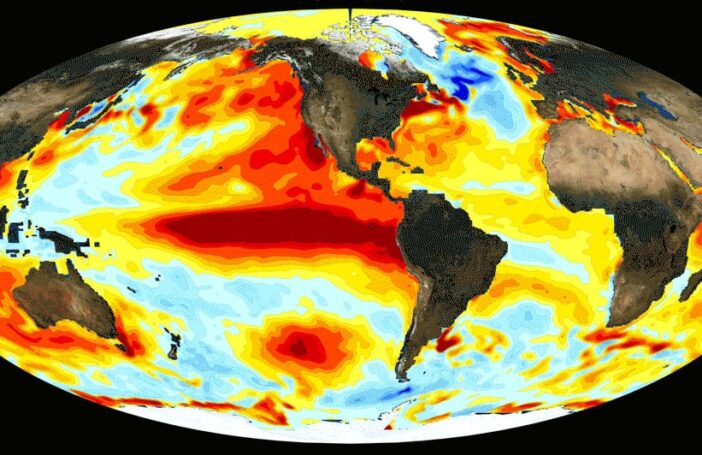
There are renewed warnings that threats to food and water security in the Pacific arising from a stronger than usual El Niño climate pattern will compound the shocks emanating from the ongoing Middle East conflict. In Fiji, the government has warned of “drastic measures” in response to low October–December rainfall forecasts. In PNG, Port Moresby has been drought-declared and several provinces are currently on drought alert, school hours have been shortened in some parts of the country, and the Marape government has sought access to a World Bank crisis budget support facility.
The Trump administration has rejected a claim from the Federated States of Micronesia for a new, US$1.3 billion compensation package as the price for allowing proposed upgrades to US military infrastructure on the islands under the two countries’ compact.
The US and the Philippines have signed a new five-year, US$685 million bilateral agreement as part of the Trump administration’s “America First Global Health Strategy”. Congressional Democrats have continued to criticise the lack of transparency surrounding these agreements.
The State Department has announced an “historic” US$2 billion in global health and humanitarian funding, to be channelled through faith-based and community organisations, including World Vision, Compassion International and Samaritan’s Purse.
The State Department has apologised for a presentation at an international HIV/AIDS conference in Brazil that included an AI-generated map which altered the boundaries and mislabelled the location of several African countries. A study presented at the conference estimated that, globally, 77,163 fewer children living with HIV received treatment in 2025 compared to 2024 owing to ongoing cuts and disruptions to US HIV programs.
In Sudan, the UN Security Council’s August monthly forecast and the World Food Programme’s country brief highlighted persistent famine risk across 14 areas, with conflict-driven displacement and blocked humanitarian access continuing to drive one of the world’s largest hunger crises.
The UN has said that the Ebola outbreak in the Democratic Republic of Congo is spreading exponentially across an area the size of France and has resulted in more than 2,500 deaths to date, with over one quarter of infected health workers dying from the disease. It has also warned that aid funds committed to fighting the outbreak could run out in weeks.
The World Bank will cease its non-concessional lending to China by 2031. China is the Bank’s third largest shareholder (after the US and Japan) and a major contributor to its concessional financing arm, the International Development Association (IDA). China is projected to be formally classified as a high-income country within the next two years.
The Bank has announced that former Indonesian finance minister Sri Mulyani Indrawati will co-chair the next three-year replenishment of IDA, which will be launched in Uzbekistan in early December. One group of experts has argued that in an era of unprecedented aid cuts IDA needs to more strictly adhere to its income per capita thresholds, focus on low income and vulnerable countries and reduce the level of concessional finance offered to middle income, “blend” countries.
In a submission to the current review of the OECD’s Development Assistance Committee (DAC), several former members of the DAC and its secretariat have heavily criticised the group’s self-regulatory model, including when it comes to its overly generous (for donors) treatment of the “grant equivalent” of loans in calculating Official Development Assistance (ODA) flows.
Books, reports, articles and podcasts
Marking five years since the reestablishment of Taliban rule in Afghanistan, Farkhondeh Akbari and Jacqui True examine the interaction between the regime’s system of gender apartheid and the country’s humanitarian, economic and security crises.
A new Pew survey finds that large proportions of people living in middle income countries in Africa and South Asia see US humanitarian aid cuts as mostly having a negative impact, albeit with many respondents unsure. In the case of Ghana, a small but significant share (25%) say that the impact of cuts will be mostly positive.
A new book (open access) by the London School of Economics and Political Science’s Ryan Jablonski investigates how foreign aid, voter behaviour and electoral incentives interact in aid-dependent countries.